Artificial intelligence is changing the way travellers discover destinations, compare hotels and plan holidays, prompting tourism marketers to rethink how they build visibility and influence decisions.
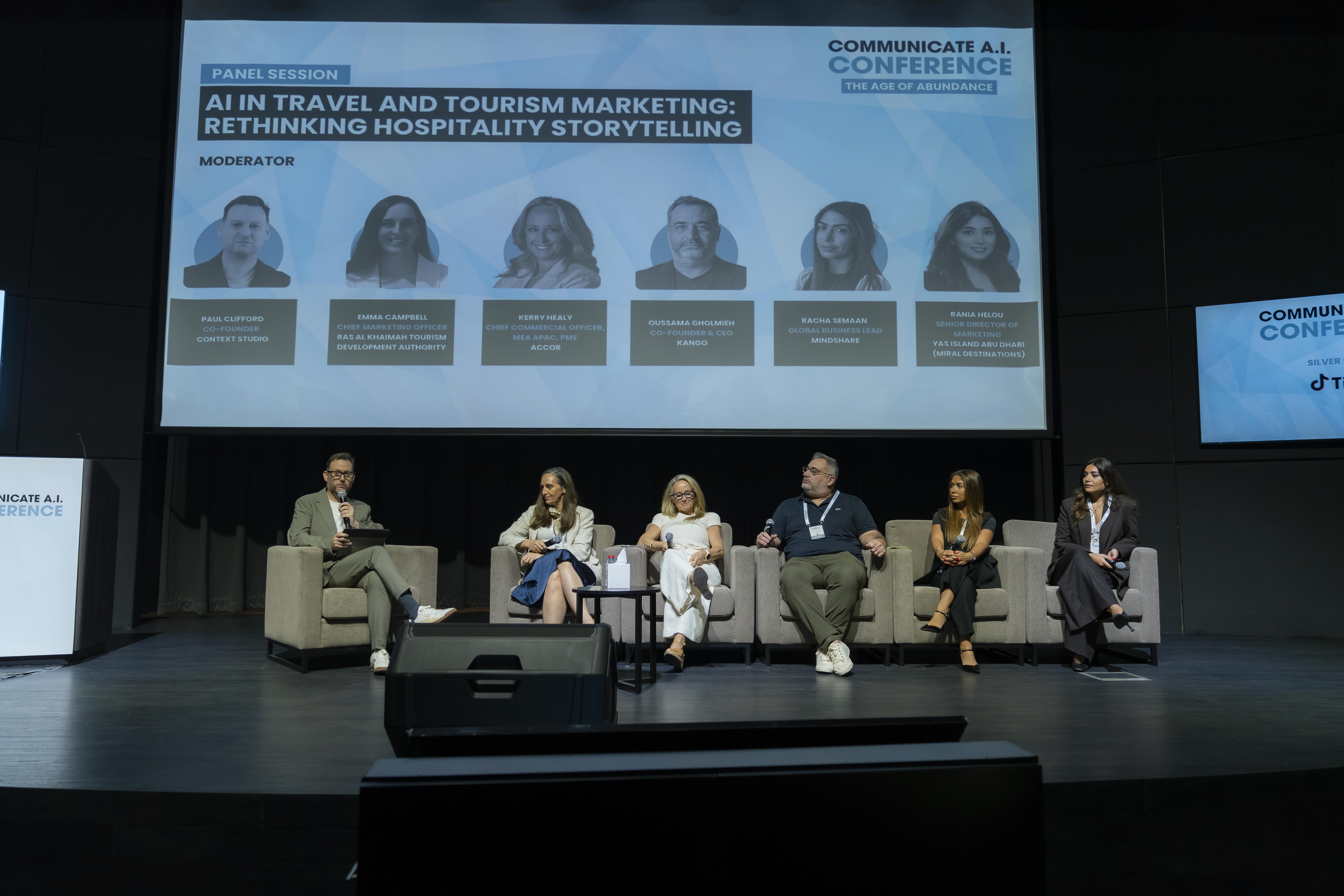
At Communicate’s AI event in Dubai on September 29, a panel titled “AI Impact on Tourism Marketing” explored how brands can remain discoverable as travellers increasingly turn to conversational AI tools for recommendations. The discussion brought together Kerry Healy, chief commercial officer for MEA and APAC at Accor; Oussama Gholmieh, co-founder and CEO of KanGo; Racha Semaan, global business lead at Mindshare; Emma Campbell, chief marketing officer at Ras Al Khaimah Tourism Development Authority; and Rania Helou, senior director of marketing at Yas Island Abu Dhabi, Miral Destinations. Paul Clifford, co-founder of Context Studio, moderated the session.
The shift, the panellists argued, goes beyond using AI to produce marketing content faster. Tourism brands must ensure that AI systems have accurate information about their offerings, recognise their identity and recommend them to travellers at the right moment.
Campbell said marketers needed to pay more attention to how audiences use AI, rather than focusing primarily on how the industry can deploy it.
“I do think that marketers spend too much time thinking about how we use it in a craft and not enough time thinking about how audiences use it,” she said.
She cited figures indicating that more than 65% of travellers in the UAE use AI for trip planning, with adoption in China at around 90%.
“For destinations, we have a real responsibility to make sure that people have the right content at their fingertips,” Campbell said. “We also have to market to machines to make sure that the machines have the right information so that they can serve content that’s accurate, relevant and inspirational about our destination.”
For Ras Al Khaimah, this means aligning the destination’s story across its tourism ecosystem, including hotels, attractions, online travel agency partners, airlines and airports. Campbell said the objective was to ensure that these stakeholders communicated a consistent story while presenting information relevant to their respective offerings.
From share of voice to share of answer
For hotel groups, the change is shifting attention from traditional search rankings towards how often their brands appear in AI-generated recommendations.
“We were obsessed, I think as an industry, when search was search about the listing and where we sat and where we prominent, but now it’s just how many times are we being recommended?” Healy said.
She described this as a shift towards measuring “share of answer” — the frequency with which a brand, destination or individual hotel is cited in AI responses.
Healy said Accor was already seeing changes in booking behaviour. She estimated that around 33% of its bookings were starting within conversational search environments, compared with approximately 26% traditionally associated with SEO. She also said about 40% of bookings were influenced at some point by AI tools or conversational search.
Accor had also launched a conversational search concierge, she said, designed to support travellers from discovery and booking through to the post-booking experience.
The implications extend to media investment. Semaan said advertising budgets were increasingly moving towards three areas: the publishers and creators whose content AI systems draw upon, accurate and structured brand information, and placements that help brands appear in AI-generated recommendations.
“Instead of brands being placed next to the content, we need to be placed inside the content,” she said.
However, she cautioned against abandoning traditional brand-building efforts. Travellers are likely to choose brands they already trust, making awareness and consideration important even as AI changes the discovery process.
“Today it’s both,” Semaan said, when asked whether share of voice or share of answer would matter more in 2027. “They have to work together because share of answer today is very important because in 2027 onwards, travelers will ask before they even see the ad, so brands will need to be in the answers before even getting the ad.”
Third-party credibility becomes critical
The growing influence of AI recommendations also creates a challenge for destination marketers: brands cannot entirely control the information that shapes an answer.
Gholmieh said AI systems may draw on travellers’ accounts of their experiences rather than relying on material produced by brands themselves.
“The reality is this machine is reading between us and the traveler, and it prefers to read content that we did not create,” he said.
He illustrated the point with everyday travel experiences, from a disappointing taxi ride to a meal that failed to meet expectations. Such accounts can become part of the information influencing future travellers.
“It actually should be played up extremely up,” Gholmieh said of PR’s role, arguing that it should have “a performance play as well as just an amplification play.”
For destinations, this makes credible editorial coverage, creators and authentic visitor experiences increasingly important. Campbell similarly stressed the need for more editorial coverage and longer-form influencer content that communicates a destination’s identity beyond short videos and social media stories.
She also said real people experiencing destinations first-hand remained particularly important in restoring confidence in international markets.
Personalisation without losing the brand
AI can help tourism brands adapt their messages to different audiences, but the panellists warned that greater personalisation must not come at the expense of a distinctive identity.
Helou said Yas Island appeals to audiences with different interests, cultures, travel behaviours and age groups. AI can help tailor how the destination is presented to each group by changing the language, format or experience highlighted first.
However, she emphasised that the underlying brand promise must remain consistent.
“For me, personalization is all about changing the entry of the story, but we need to find the balance about how we make us more relevant with AI, but not turning relevance into brand fragmentation,” Helou said.
“You personalize the journey, not the promise.”
Healy said Accor had built AI agents into its e-commerce environment and customer relationship management strategy to handle tasks such as translation and campaign execution. She said these applications were saving teams around 60 hours a week, allowing them to focus on optimisation, governance and cultural considerations.
“Just because something is technically personalized well does not make it culturally relevant,” she said.
Semaan offered a similar warning about relying too heavily on data and automation. In media planning, she said, human insight can reveal cultural nuances that AI-driven optimisation misses, including the importance of relatable family travel imagery for particular audiences.
Gholmieh summed up the challenge as one of attention rather than volume. AI can generate hundreds of content variations, but selecting the one that resonates requires judgment.
“It’s not a quantity problem. It was never a quantity problem. It’s an attention problem. How do I grab your attention?” he said.
For tourism marketers, the emerging task is therefore not simply to produce more content or automate more decisions. It is to make destinations discoverable and credible across an increasingly complex information ecosystem while preserving the human experiences that make travel meaningful.
As Helou put it: “AI is here as an enabler, but human judgment is the differentiator.”