Artificial intelligence may be transforming advertising production, but marketers risk losing sight of what makes a campaign effective if they allow the technology to dictate the idea, according to Yohan Wadia, founder and chief creative officer of Yohan Wadia Studio.
Speaking at Communicate AI in Dubai on September 29, Wadia argued that the value of an advertising campaign lies in its underlying concept, rather than the tools used to bring it to life.
“The medium is not the idea,” he said, using examples from global advertising campaigns to illustrate how AI can strengthen creative work when it serves a clear purpose — and become a distraction when it does not.
“When the medium precedes the concept, it dies before even it gets out into the world,” Wadia said.
He challenged the notion that successful campaigns need to be built around AI simply because the technology is attracting attention. “So great ideas are always at the forefront of great campaigns, and I think that is something that we should all take away with us today,” he said.
Wadia examined several campaigns to show how the relationship between the creative concept, the brand and the technology can influence how audiences respond.
One example was Heinz’s AI-related campaign, developed by Rethink Canada, which he described as a case where the technology was integral to the idea rather than merely a production tool.
The campaign’s premise was that when people were asked to generate images of ketchup using AI, the results pointed towards Heinz, reinforcing the brand’s position in the category.
“As you saw, it wasn’t a campaign that was made to make AI feel like, hey, we just replaced the whole production process with AI, but it was rather the very core of the concept,” Wadia said.
“Could the concept have worked without AI being in there? Absolutely not, because it was a very basis of the concept.”
He said the campaign worked because the brand remained central to the narrative and audiences were able to participate by creating and sharing their own content.
“It was AI was not just the mechanism to execute it,” he said. “It was a very backbone of the campaign.”
In contrast, Wadia discussed a McDonald’s Christmas advertisement that attracted criticism for its portrayal of the festive season. He argued that the problem was not necessarily the use of AI but the campaign’s underlying premise.
“The very problem was that they ruined Christmas as we know it,” he said, arguing that presenting the restaurant as a refuge from the chaos of Christmas clashed with the emotional associations many people have with the season.
“To me, it wasn’t an AI problem, it was the idea problem,” Wadia said.
He added that the controversy illustrated how the conversation around an advertisement can shift away from the brand and its message towards the technology used to produce it.
“The conversation slowly steered from the execution, from the ideation all the way to AI,” he said.
Wadia also presented work by his own studio for Samsung, developed in collaboration with Google. The campaign used AI-generated animal reaction videos to communicate features of Samsung phones, including the ease of transferring data between platforms.
The studio tested AI-generated assets alongside traditional production, with Wadia saying the approach helped address production constraints while keeping the concept at the centre.
“We generated 12 assets less than 15 days. It took 10% of the time as a traditional production asset,” he said.
He cautioned, however, against treating AI as inherently superior to conventional production methods.
“It’s just a medium to pick when you have to pick your battles,” he said.
Discussing a Volvo brand film associated with Saudi National Day, Wadia said the work illustrated the importance of aligning creative execution with brand identity. He noted that the film was withdrawn after Volvo Global said it did not comply with the brand’s guidelines.
Yet he also challenged the assumption that negative reactions necessarily meant an advertisement had failed.
“Backlash is not the same thing as ineffective advertising,” he said, adding that the film had scored five stars in a System 1 audience test, according to the figures he presented.
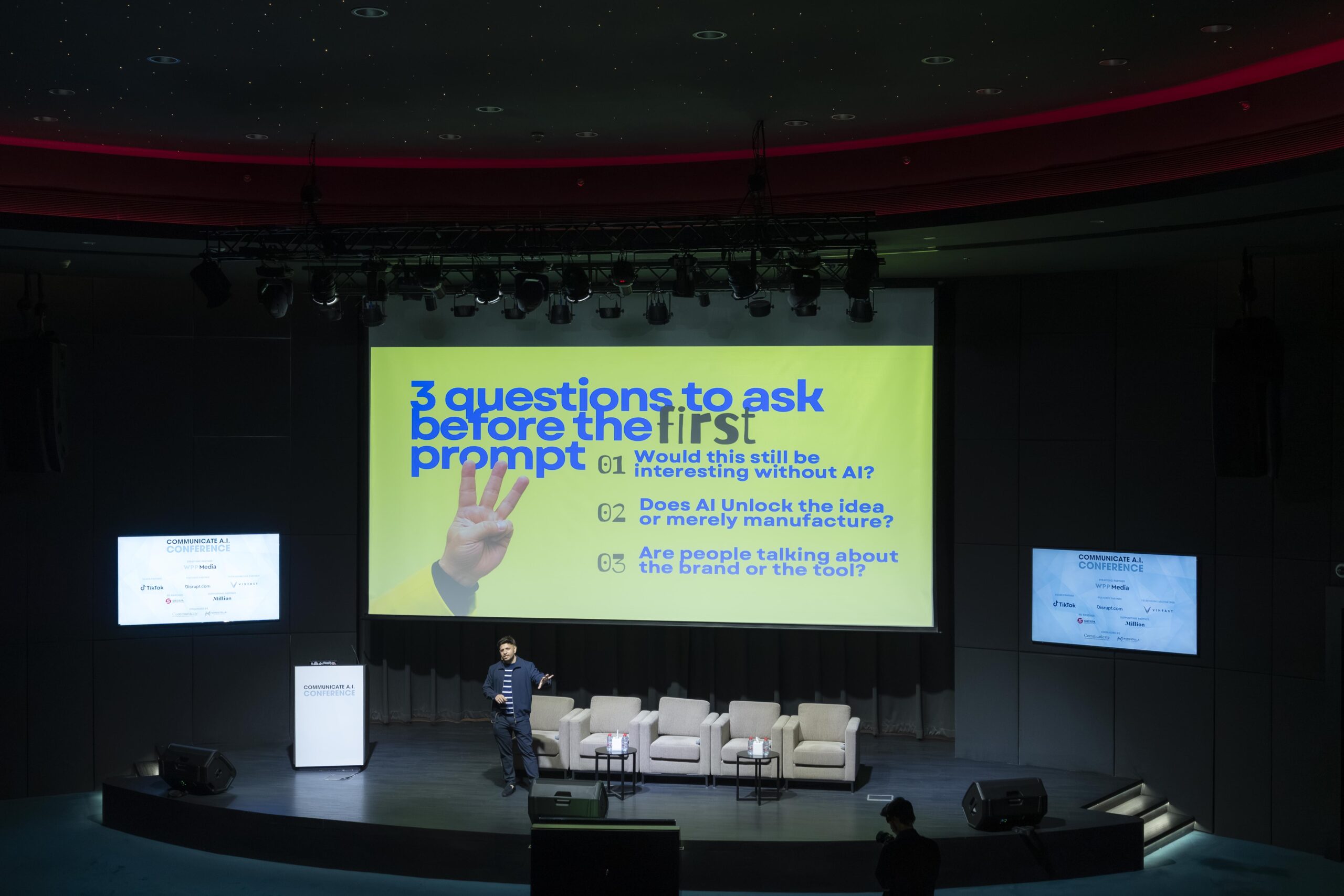
Concluding his presentation, Wadia urged marketers and agencies to ask three questions before using AI: Would the idea still be interesting without AI? Does AI unlock the idea or merely manufacture something? And are people talking about the brand or the tool?
“Are people really talking about what they left with after watching it, or are they still talking about what it was made with?” he asked.
He compared advertising to food, arguing that audiences ultimately care about the finished product rather than its ingredients.
“Nobody talks about the ingredients that go on to the food rather than the food coming together,” he said.
For Wadia, the challenge for advertisers is therefore not simply to adopt AI, but to use it in ways that make ideas more meaningful, distinctive and relevant to audiences.