Advertising agencies can no longer justify higher fees simply by adopting artificial intelligence, as marketers increasingly expect AI to be embedded in everyday workflows and are looking for partners who can deliver measurable business outcomes, industry leaders said at Communicate AI in Dubai.
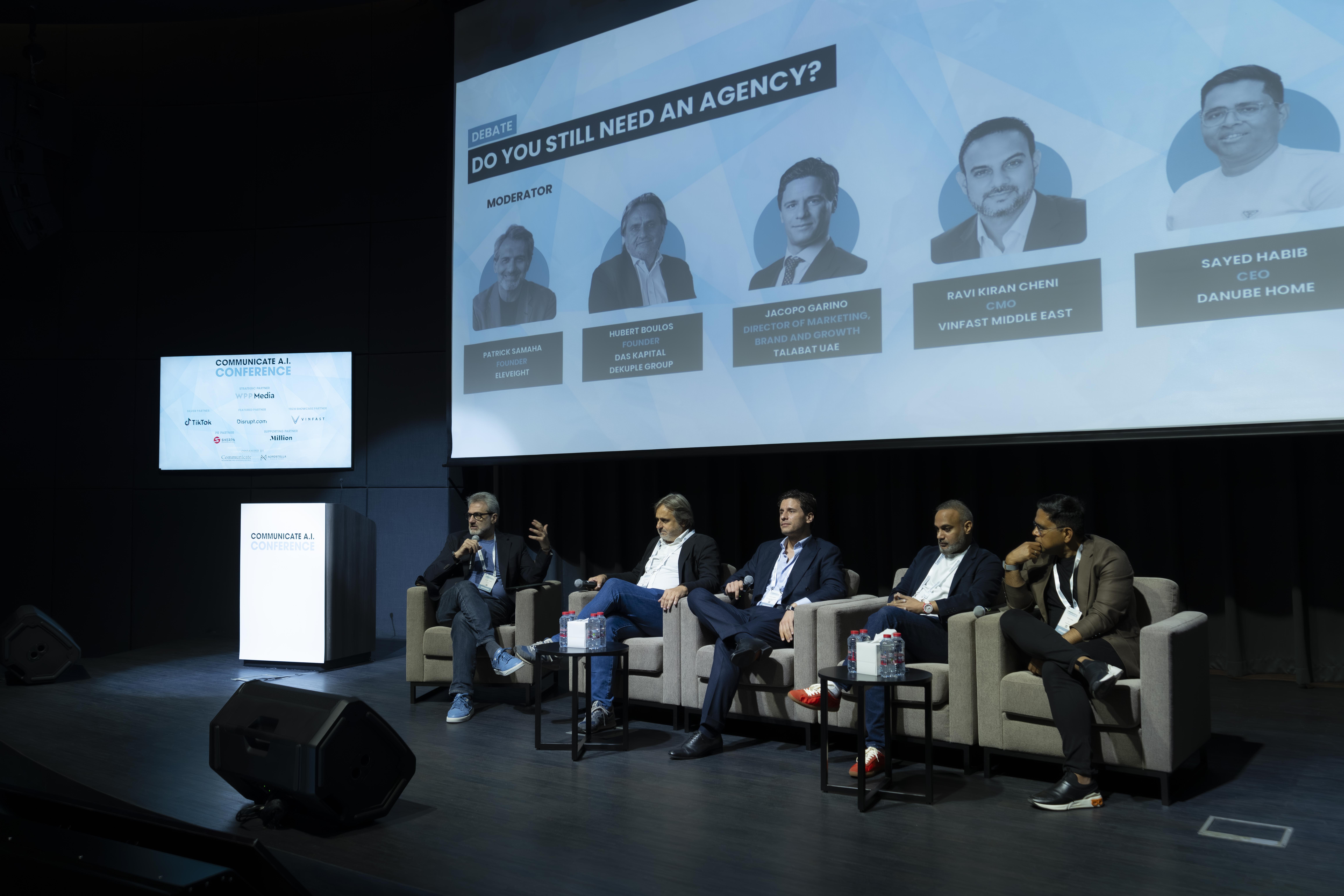
Speaking during a panel titled “Do you need an agency?”, executives from Das Kapital Dekuple Group, Talabat UAE, VinFast Middle East and Danube Home argued that while AI is expanding the volume and speed of content and ideas, agencies must demonstrate deeper business understanding, strategic judgement and the ability to solve consumer problems to remain relevant.
Jacopo Garino, director of marketing, brand and growth at Talabat UAE, said the use of generative AI was already an expectation rather than a differentiator in agency relationships.
“The point is guaranteeing output and business impact,” Garino said, arguing that agencies must keep pace with the demands of a highly competitive market.
He said AI should be integrated into agency workflows to accelerate content production and improve audience segmentation and performance marketing. However, its adoption alone did not justify higher remuneration.
“I think it shouldn’t be warranted by the use of generative AI,” Garino said, adding that agencies needed to demonstrate a compelling value proposition through the results they delivered.
He described the agency’s role as spanning two distinct needs: rapid execution of tactical marketing activity and deeper strategic thinking that supports long-term brand building.
Garino also said agencies would increasingly need to exercise independent judgement as AI made it easier for clients to generate ideas themselves.
“The agency should sort of act as a shepherd of this idea, pressure testing them,” he said, explaining that agencies must be able to evaluate ideas, challenge assumptions and determine which concepts merit further development.
Human judgement remains critical
Hubert Boulos, founder of Das Kapital Dekuple Group, said AI was changing the way agencies worked but did not eliminate the importance of creative talent.
Discussing whether AI was making agency work better, Boulos said the technology offered more options but did not automatically guarantee better work.
“AI is just an average of whatever it picks up,” he said, arguing that the quality of the output depended on how people used the technology.
Boulos was particularly impressed by AI’s capabilities in strategic planning, describing its potential as striking. He said the technology could help professionals think more effectively and improve their work, provided they used it well.
Agencies must solve consumer problems
Ravi Kiran Cheni, chief marketing officer at VinFast Middle East, said agencies needed to move beyond producing creative concepts and understand the problems their clients were trying to solve.
For an electric vehicle brand entering competitive markets, he said, understanding consumers’ rational and emotional needs was essential to developing an effective marketing strategy.
Cheni said he was more interested in a strategic solution that addressed consumers’ mobility needs than a creative proposal in isolation.
He also described how AI was changing the relationship between in-house marketing teams and agencies. Internal teams could use AI to generate a wider range of initial ideas, assess them against the brand’s positioning and take a more refined selection to agency partners.
This could change the pace of agency engagement, shifting the emphasis from generating ideas from scratch to evaluating, developing and implementing the strongest ones.
Cheni said agencies needed to understand the product and its target customers before recommending a creative direction. A campaign that failed to reflect a product’s intended audience or positioning would not deliver the desired results, regardless of how it was produced.
He also pointed to the role of technology beyond advertising and content creation, saying that developments in intelligent vehicles and software were changing the products themselves.
Technology needs business expertise
Sayed Habib, CEO of Danube Home, said businesses could use AI and their internal resources to develop solutions, but agencies could still provide value through specialised expertise and an external perspective.
Using furniture retail as an example, Habib discussed how AI-powered visualisation could help customers understand how furniture might look in their homes. He also pointed to opportunities to develop products that respond more closely to consumers’ needs.
For Habib, the value of an agency lay in combining the client’s knowledge of its business with the agency’s technological expertise.
“I need an agency who could be my partner, who understand the journey of the customer, who understand the real problem statement,” he said.
He argued that agencies should be willing to challenge clients rather than simply execute instructions. An external partner could offer a perspective that an in-house team might miss because of its familiarity with the business.
Habib also said agency relationships should increasingly be built around shared objectives and outcomes rather than a narrow list of services.
The measure of an agency’s relevance, he suggested, was its ability to understand a client’s pain points and help address them.
The panel also challenged the idea that one advertising medium was inherently better at using AI than another. The strength of the idea and its relevance to the client’s brief, rather than the medium itself, remained the determining factors, speakers said.
A changing skill set for marketers
The panelists broadly encouraged young people to consider careers in advertising and marketing, although they differed on how strongly they would recommend the industry.
Garino said marketing would continue to offer opportunities in a world with more content, channels and competition for attention. But he stressed the importance of critical thinking and developing strong independent opinions.
Cheni urged aspiring marketers to develop a broad understanding of business alongside creative skills, while Habib emphasised the importance of understanding how businesses operate and how products and services reach consumers.
Boulos offered a more cautionary view, saying the industry demanded considerable commitment and that people entering it needed a strong desire to challenge conventions and change the business.
The discussion reflected a broader shift in expectations from agencies in the age of AI: as generating content and ideas becomes faster and more accessible, clients are looking for partners who can provide strategic direction, informed judgement and measurable commercial value.