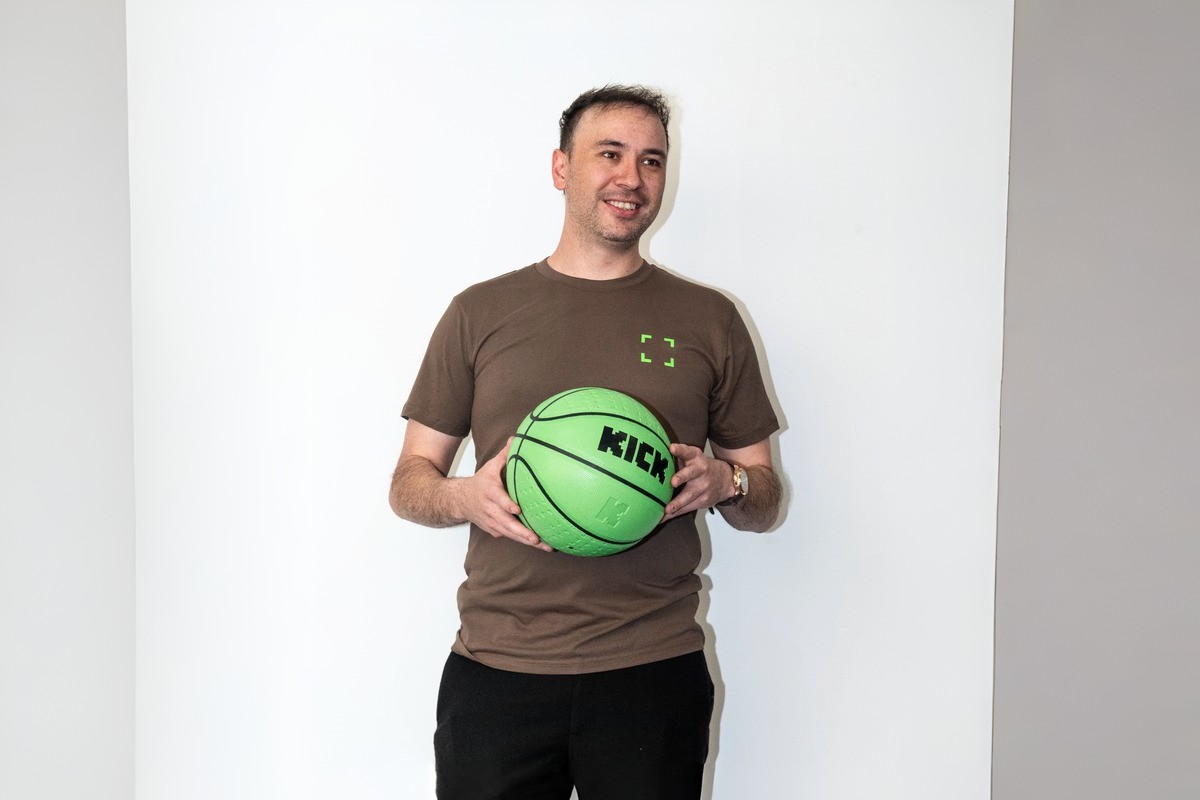
As Director of KICK, one of the world’s fastest-growing livestreaming platforms with more than 100 million users, Ethan Wright sits at the intersection of the creator economy, digital culture, and the future of media. In this interview, he argues that the industry’s obsession with attention is outdated, explains why community has become the most valuable asset in the AI era, and shares why marketers, media owners, and brands need to rethink everything from audience engagement to message control. Wright also discusses the rise of Saudi Arabia’s creator economy and why livestreaming is becoming one of the most influential media formats of the decade.
Everyone is chasing attention. Is that already the wrong metric?
Yes. Attention is important, because you need to bring people in, but connection is the thing that keeps them with you. You can pay a lot of money or use AI to produce an ad that will, at least for a moment, get someone’s attention. What you can’t really do with an ad like that is create a sense of trust—a sense of community. When you look at the biggest streamers—people like iShowSpeed in the US, or Mofareh Al-Asiri (Drb7h) and Ahmed Alqahtani (SXB) in Saudi Arabia—they succeed because their viewers connect with them in a way that they never would if they were just chasing clicks.
You’ve argued that audiences want agency, not just content. In a world of infinite content, does engagement now matter more than attention, and are marketers still measuring the wrong things?

This goes to the previous question. People don’t want to just be talked at or marketed to: they want to feel a connection to the content they’re consuming. If you like someone’s content enough to take time out of your day to join a live stream, there is an implicit trust that you place in that streamer. You spend so much time with them that you feel like you know them. But the value is not only in that relationship. In a live stream, viewers are actively watching, reacting and communicating with the creator and everyone else in the chat. It is a bit like talkback radio, except instead of one caller at a time, everyone can take part. That means when an ad plays, the audience is still present and engaged in the content, rather than distracted or looking elsewhere. Connection is much more valuable than attention.
If AI makes content cheap, what becomes valuable?
The things that AI cannot possibly replicate: real, live, human moments and interaction. There is a reason that live sports and live music make us feel like we’re part of something bigger, and the exact same thing is true with streaming. You and thousands of other people are watching a person, live, and you can interact with them in a way that no AI model is going to be able to replicate. That will matter even more for creators whose content can feel heavily produced or hard to believe. Live gives people a chance to see the person behind it in real time. We are already seeing that shift, with big creators like MrBeast experimenting with live content. I really believe that as fake content becomes easier and easier to produce, people will be willing to pay more for the things that are actually real.
Livestreaming has scale. Why hasn’t advertising caught up?
Part of it is structural. A lot of the frameworks and metrics the advertising industry runs on were built for a different era — TV spots, pre-roll, mid-roll — and those don’t map cleanly onto live, participatory formats. That’s not a criticism of the people running those businesses, it’s just the reality of how industries evolve. The harder truth is that younger audiences are moving faster than the media plans designed to reach them, and the gap is widening. The brands and agencies that close it first will be the ones that treat livestreaming not as a complement to the existing mix, but as a format with its own logic, its own metrics, and its own creative requirements. The opportunity is real — it just requires a different playbook.
Brands have embraced creators, but many still treat livestreaming as a niche channel. What’s holding marketers back?
Corporations, by nature, are cautious and risk averse, but the best streamers—the ones who build connections with their audience—are not testing their content with focus groups, and they don’t care if someone, somewhere, doesn’t like what they say. They’re unscripted. But that’s something that makes traditional PR people uncomfortable, and as a result, they’re much more likely to go with clean, controlled, produced marketing campaigns, even if they’re not actually going to reach the people they want to reach. Recently, we’ve noticed a shift with advertisers realizing that with live streams, what you’re actually buying is the audience’s attention, not endorsing the content.
Is the creator economy becoming the new media industry?
I think we crossed that bridge a while ago. The New York Times, the BBC, CNN — they still matter, and I’d argue they play an essential role in informing public conversation. But when it comes to holding attention, the comparison starts to break down. The biggest creators aren’t just reaching people — they’re holding them for hours, with active participation, not passive consumption. And there’s a trust dimension too. Traditional media still has impressive reach on paper, but audience trust has been eroding for years. Creators, by contrast, have built their influence precisely because their audiences feel they know them. That familiarity is something a headline or broadcast struggles to replicate. Traditional media still has a role. But the depth of connection and influence that the best creators have built with their audiences? That’s a different category entirely.
You are vocal about power shifting from institutions to communities. Are we heading toward a future where creators become the primary media owners and traditional publishers become the supporting act?
Two things can be true at the same time. First: there is, I hope, always going to be a role for traditional media. We need media outlets that can investigate, that can hold people accountable, and that can do the job of reporting the news. I don’t think we want to exist in a world where we don’t have that. But second, as we’ve been talking about, the relationship with the audience is a fundamentally different one than it was even ten years ago. Younger people, in their 20s and 30s, trust the creators and streamers they follow at least, and probably more, than they trust the people who publish traditional news and media. I don’t think that is going to change—it will actually accelerate—so the publishers themselves need to adapt.
Saudi Arabia is building a creator economy at speed. What are global brands still overlooking?
I think your question actually reflects the thing that they’re missing. In reality, the creator economy isn’t being “built” anymore, in the sense that it’s some new development that is under construction. It is a massive, fully functioning media ecosystem. The population here is very young. I think two-thirds are under 35. More than 99 percent of people are online, and about 80 percent of them are watching online videos every single day. People watched Saudi streamers for more than 240 million hours last year—a more than 100 percent increase from the previous year. This is still a creator economy that is growing, yes, but I think if brands should be viewing it as something they need to start tapping into right away.
Beyond the investment headlines, what is happening in Saudi consumer behaviour and digital culture that marketers elsewhere should be paying closer attention to?
As a baseline, we’ve found that viewers here are incredibly loyal to the streamers they follow: really long sessions, very high return rates. But perhaps more interesting for global marketers is the fact that the Saudi market is driving content across the Arabic-speaking world. Arabic is one of our largest language communities, and so much of the content for that community is coming from Saudi creators. When we’re talking about a young, growing, increasingly online population of literally hundreds of millions of people across the Arabic-speaking world, I think marketers would be crazy to overlook the upside of investing in the Saudi creator economy.
What will be the biggest media misconception of the next five years?
As the streamer and creator economy grows, I think there will be a tendency to pile money towards the people at the very top with the biggest audiences—kind of like we did with the biggest TV shows, or the biggest newspapers. But I actually think what will matter more, in that landscape, will be the smaller and mid-sized streamers and creators with a few thousand or a few hundred-thousand really loyal followers who you can then reach much more directly.
What’s one belief that many marketers, media owners and agencies still hold today that will look completely outdated by 2030?
That you can control your message. It’s one of the foundational assumptions of traditional marketing and PR — message discipline, consistent narratives, corporate approval chains. And I understand why: brands have spent decades and billions building how they are perceived. But by 2030, that model is going to look like a relic. If you want to reach audiences authentically, through the creators who have genuinely built communities, you are going to have to hand over some of that control. Creators will not simply deliver your script to their audience. and if they did, their audience would see straight through it anyway. The brands that succeed will be the ones who learn to trust creators to translate their message for their community, even if that means giving up some of the polish and predictability they’re used to. That’s going to be uncomfortable. But the alternative — clinging to message control while your audience moves on — is worse.
What’s the next unfair advantage in media? For the past decade it was data, distribution, and algorithms.
I’ll come back to my first answer: community. The distribution and algorithm-shaping tools that were new in 2016 are now either outdated or used by literally everyone. AI is just going to make those kinds of things more accessible, and we’re seeing that play out in real time. The thing that money won’t be able to buy or create is a sense of community and belonging, and the trust that comes with it.
- What will separate the brands, creators & platforms that win from those that simply generate noise?
I think the cleanest way I can summarize everything we’ve talked about is whether your audience would actually miss you if you disappeared. If you’re a podcaster I listen to on my morning walk, or a streamer I watch after a long day at work, you’ve become part of my life. I would feel it if, one day, you were just no longer there. If you’re just pumping noise into the universe, people will tune you out. But if you’re building something that people would miss—like I see every day on KICK—you’re going to be just fine.