If the agency business were a house, almost every room would currently be under renovation. A very messy one.
Clients are moving some of the furniture in-house. Holding companies are knocking down walls. AI is tearing through production. Procurement is inspecting the bills.
The temptation is to call it a crisis, since the house is being rebuilt while everyone is still inside it. What will be left standing by 2030? How to give everyone better returns within the renovated property?
The good news is that advertising itself is hardly disappearing. Dentsu expects global ad spend to reach $1.06 trillion in 2026, growing 5% and continuing to outpace projected global economic growth. By 2028, it expects 75% of advertising spend to be algorithm-driven.
The existential question facing agencies is how much of that value they will capture and what kind of business must sit behind the word “agency” when 2030 arrives. Let’s find out.
The collapse of average.
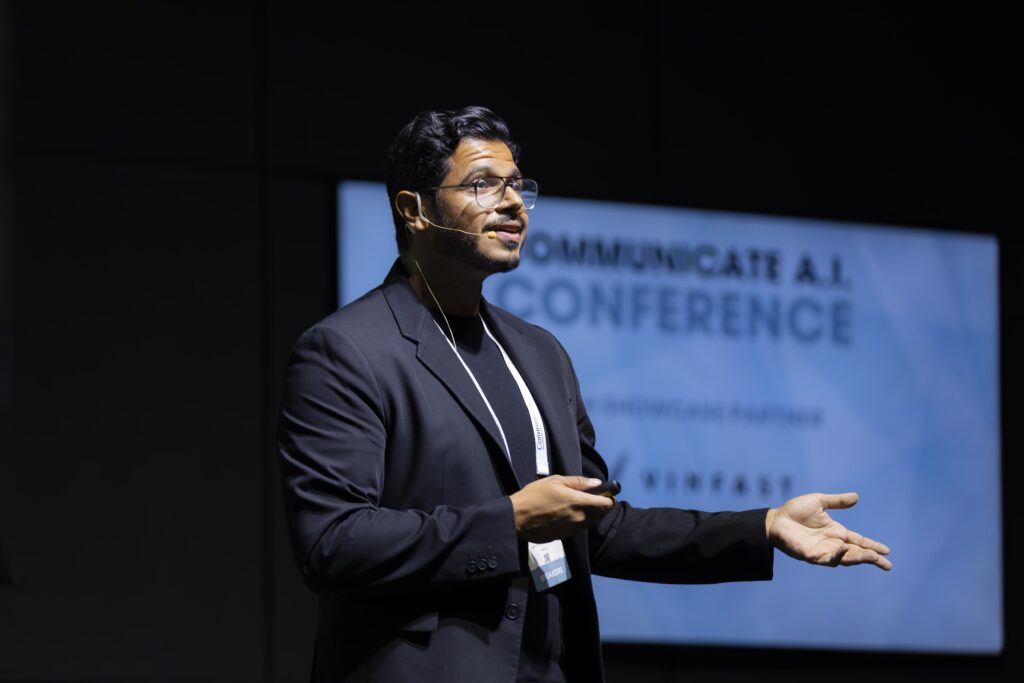
Tahaab Rais, Group Chief Strategy Officer and Film Director at Publicis Groupe MENAT, warns that technology such as AI, designed to accelerate work, can just as easily accelerate mediocrity.
“A foundation is meant to support the building, not become the building,” Rais tells Communicate.
“Too many organizations are adding AI tools to processes that were already slow, siloed or strategically weak. That creates faster outputs without necessarily creating better outcomes.”

So access to AI is rapidly becoming less exceptional. “The differentiator is what organizations can now do that they could not do before, using AI,” Rais says.
The danger for agencies is obvious. If everyone can create more content, analyze more data and produce work faster, output itself becomes the weaker differentiator. If AI takes the busy work, then what?
First things first.
The first changes are visible. Rawan Yaqub, Head of Zenith KSA, highlights manual reporting, campaign optimization and repetitive administrative work among the tasks increasingly being automated.
“But history shows that technology rarely eliminates value; it shifts where value is created,” she says.
“As AI takes over routine tasks, it creates space for higher-value work. Ultimately, I believe the future agency’s value will not come from producing more work. It will come from making better decisions, creating smarter connections, and driving business outcomes faster than competitors can.”
The global labor market is moving in the same direction.
The World Economic Forum estimates that 39% of workers’ existing skills will change or become outdated between 2025 and 2030. Some 77% of employers intend to upskill workers in response to AI, even as 41% expect to reduce workforce numbers where the technology can automate tasks.
PwC’s 2026 AI Jobs Barometer adds another layer. Jobs requiring specific AI skills are growing 69%, versus 9% for the overall jobs market, while those skills command an average wage premium of 62%. AI-exposed junior roles are also seven times more likely to require traditionally senior skills such as judgment and leadership.
The traditional agency talent pyramid therefore needs a revamp. What happens when machines absorb some of the repetitive work through which junior talent once learned?
“For years, we hired for specialization. In the future, we’ll hire for integration,” Yaqub said, as she expects agencies to respond by hiring differently.

Technology, Media and Telecommunications had the highest concentration of AI-related hiring in 2025, with 11.4% of job postings requiring AI skills, followed by Professional Services at 5.6%, according to PwC. By comparison, the figure stood at 0.9% in health.
Yaqub thus describes the future workforce as hybrid talent capable of connecting strategy, creativity, data, technology and AI rather than remaining confined to one discipline.
Cynthia Sarkis, Regional Head of Creative Hub and Operations at FP7 McCann, goes further: “We’re witnessing the end of the agency model as we’ve known it.”
For Sarkis, the old formula was constructed around “departments, handovers, and headcount.” The emerging model is organized around solving problems instead.

That means the size of the team is less impressive than what it can actually solve.
A designer, she argues, is no longer only expected to design. Roles are expanding to include AI, strategic thinking, presentation skills and cross-disciplinary collaboration.
For agencies, then, AI may make some teams leaner without necessarily making talent cheaper.
The more artificial the tools, the more valuable the human?
PwC’s findings complicate the assumption that greater AI adoption automatically means fewer human employees.
Companies most capable of using AI have seen 52% headcount growth from 2018 levels, compared with 36% among the least AI-exposed companies.
What appears to retain value is what humans do after automation removes some of the process beneath them.
“AI can process data, but it cannot replace empathy. It can generate content, but it cannot replace cultural intuition. It can identify patterns, but it cannot replace judgment,” Yaqub explains.
In Saudi Arabia, Neal Brasier, Head of Strategy at Ogilvy KSA and the Levant, reinforces that point:
“AI is compressing how quickly strategists get to an informed view, category dynamics, competitor moves, cultural context, comms history. That’s a real gain in speed. What I’d question is whether speed alone counts as understanding.”
A strategist walking the aisles of Tamimi Markets, sitting in a majlis or observing how Saudi families shop, he argues, should still reach insights that cannot simply be reconstructed remotely from data.
“AI is a genuine accelerant for research and synthesis, but it works best in the hands of someone who already knows, first-hand, what ‘right’ looks like.”
The same applies to talent. The roles moving in-house first are the “doers”, client service and delivery, Brasier explains. When this happens, it is a reasonable question for a client to ask why they need a contact at the agency when they can hire the same skillset directly, according to him.
“What clients are building internally tends to be multidisciplinary: someone who can turn their hand to social and project management, rather than a room of narrow specialists. What stays with agencies, certainly here, is the big idea and the strategic thinking behind it.” What he and other industry leaders value within their teams are “curiosity, restlessness, and a refusal to take a chatbot’s word for what a culture believes.”
From production engine to complexity filter
Clients today can access more capabilities themselves. They have in-house teams, specialist partners, freelancers, platforms and progressively sophisticated technology.
But more choice does not necessarily make their organizations easier to run.
“I don’t think our biggest competitor is another agency anymore. It’s the complexity of the work. Clients today have many ideas or tools. But they’re overwhelmed by them,” Sarkis reveals.
AI, in-house teams, freelancers, specialists, platforms, data… everything is available, yet decisions seem harder than ever.
Her conclusion: “We’re helping clients make sense of the noise, connect the right elements, and move with clarity. Maybe the agency of the future will be mainly a complexity filter.”
Yaqub similarly believes the relationship is moving beyond delivery.
“The agency of the future is a growth partner, one that helps clients navigate change, unlock new opportunities, and create sustainable competitive advantage.”
But she makes an important distinction:
“Ultimately, becoming a strategic growth partner isn’t something an agency can self-claim. A client awards you that title when they trust you to influence business decisions, not just marketing decisions.”
Brasier says Ogilvy KSA is deliberately moving upstream, focusing on “the actual business problem behind the marketing problem” and the conversations concerning CEOs, rather than waiting for the next campaign brief.
As he puts it, “We’re trying to sit in the room where the problem is defined, not just where the solution is executed.”
What are clients paying for?
As access to execution becomes cheaper, Yaqub believes this is what clients will keep paying a premium for: “Clients pay a premium for insight, innovation, and outcomes they cannot achieve on their own.”
For now, that includes data and audience intelligence, AI-powered decision-making, strategic consulting, customer experience, commerce, loyalty and measurement that connects marketing investment to business outcomes.
It is also where Dana Tahir, CEO of Havas Red Middle East, sees another agency function moving further up the value chain.

The communications industry has long relied heavily on outputs such as coverage, impressions and reach. Tahir argues that AI adds a newer layer to that responsibility.
“People now get answers from language models rather than search results. So what credible third parties have published about your brand shapes what machines say about you. We’re now shaping what machines know, not just what people think.”
That considerably expands what an agency may eventually be accountable for, given that visibility has moved from traditional SEO into GEO, or Generative Engine Optimization.
Tahir thus sees that the challenge is now shaping how credibly a brand is represented inside AI-driven answers, summaries, and recommendations generated by large language models. She is equally skeptical of old metrics surviving unchallenged.
“What’s still funded out of habit? Reach for its own sake. Impression targets, AVEs, follower counts. But being seen was never the problem. Mattering online is.”
Rais carries a similar warning into measurement. “The industry must not replace the worship of reach with the worship of whatever is easiest to measure.”
For him, agencies still need to prove movement in memory, perception, behavior, culture or commercial performance without reducing creativity to immediate attribution.
“Attention is the admission ticket. It is not the destination. We should demand measurable impact without reducing creativity to a vending machine where every dollar must immediately produce a trackable click.”
The economics have to follow the work
The elephant in the room is that, since execution takes fewer hours, the agency industry’s traditional economics have become harder to defend.
Amer El Hajj, CEO of WPP Media MENA, sees one model in particular fading.

“Any model built on selling volume. The agency that makes its money from lots of people doing lots of hours is on its way out, because that’s exactly the work machines are taking.”
Agencies have spent decades monetizing the link between people, time and output. AI weakens that relationship.
This does not necessarily mean the solution now is to have the smallest possible team. In fact, it means that the composition and productivity of that team are now a crucial metric.
This adds urgency to the question of scale.
“Any model built on selling volume. The agency that makes its money from lots of people doing lots of hours is on its way out, because that’s exactly the work machines are taking.”
Is bigger still better?
Since AI is allowing smaller teams to produce at levels previously requiring far greater resources, El Hajj believes one of the industry’s oldest assumptions could eventually be challenged.
“Here’s the one my peers won’t like: the agencies of the future that come out ahead won’t be the biggest. The winners will be the most expert, and more adept with tools.”
Size without skills evolution, he warns, could eventually become “the thing that slows you down.”
Holding companies still possess advantages few independents can replicate easily: capital, data, infrastructure, global relationships, multiple disciplines and the ability to deploy specialist capabilities across markets.
Sarkis sees that scale clearly when comparing networks with freelancers and independents.
“Where holding companies still have the advantage is scale. We bring together strategy, creative, media, production, operations, and client partnerships to solve complex business challenges across markets.”
But she does not see the future as a binary contest between the two.
“The future isn’t about freelancers replacing agencies or agencies replacing freelancers. It’s about knowing when each creates the most value.”
The strongest agencies, she predicts, may start treating freelancers not simply as extra hands but “as an extension of their thinking.”
Smaller, more senior, more fluid
So what does the agency of 2030 actually look like? Not everyone expects a completely new species to appear.
“Let’s be realistic first: 2030 is just over three years away. And these big shifts don’t happen on a set date; they materialize over time. So the honest answer is that 2030 is about how the agency models of today will have elevated their capabilities and offerings to serve clients and deliver on their business goals,” El Hajj points out.
For him, the agency of the future will be sharper and more expert. “Simpler to navigate.”
Neal Brasier’s prediction is even more concise: “Smaller, and more senior.”
He expects fewer, more experienced people doing more, directing AI without outsourcing judgment to it.
Rawan Yaqub expects more embedded client teams, multidisciplinary structures and fewer boundaries between functions.
“And the business outcomes these teams create,” she insists.
For Dana Tahir, that fluidity also extends to where and how agencies need to operate.
“What works is going where belonging already exists. Niche communities, creators with genuine credibility, podcasts, newsletters, the spaces people actively choose. Generic messaging dies in these environments; relevance and a real understanding of the community are the price of entry.”
Sarkis expects agency boundaries to blur even further.
Client servicing becomes more strategic. Creative and production become one continuous process. Operations shifts from allocating human resources to orchestrating people, AI, technology and specialist partners.
“The agency of 2030 will be defined by how seamlessly those departments work together.
If you need five meetings, three approvals, and two weeks to make one decision, you are going to have a hard time,” Sarkis says.
“Agility will beat hierarchy every time.”
Don’t turn the agency into an AI factory
For all the structural change, Rais believes the industry’s destination should not be a machine-led content factory.
His formula for the future runs in five parts:
“Human depth × Machine intelligence × Creative courage × System thinking × Commercial proof.”
Each element answers a different pressure on the model.
Machines expand capability, human depth preserves understanding, creative courage fights commoditization, system thinking moves agencies beyond isolated campaigns and commercial proof answers the demand for accountability.
“I do not see the agency of the future as a Gen AI-driven content factory. I see it as a growth partner and an operating system, bringing together business thinking, cultural intelligence, creativity, technology, media and experience.”
Perhaps that is the clearest distinction between disruption and reinvention.
AI will undoubtedly make many of those things faster. But as Rais puts it:
“Our responsibility is to make them matter.”
Buying an AI platform is not reinvention. Automating production is not reinvention. Collapsing departments is not reinvention.
The agency of 2030 will still need to answer the same commercial question every business faces: what can it do better, faster or more intelligently than the alternatives available to its customer?
To survive that reinvention, time will tell who gave their house a real, smartly designed upgrade, and who simply hid dust under the carpet.
This article appeared in the October print issue of Communicate, which you can access in full for more insightful analyses, interviews and more here