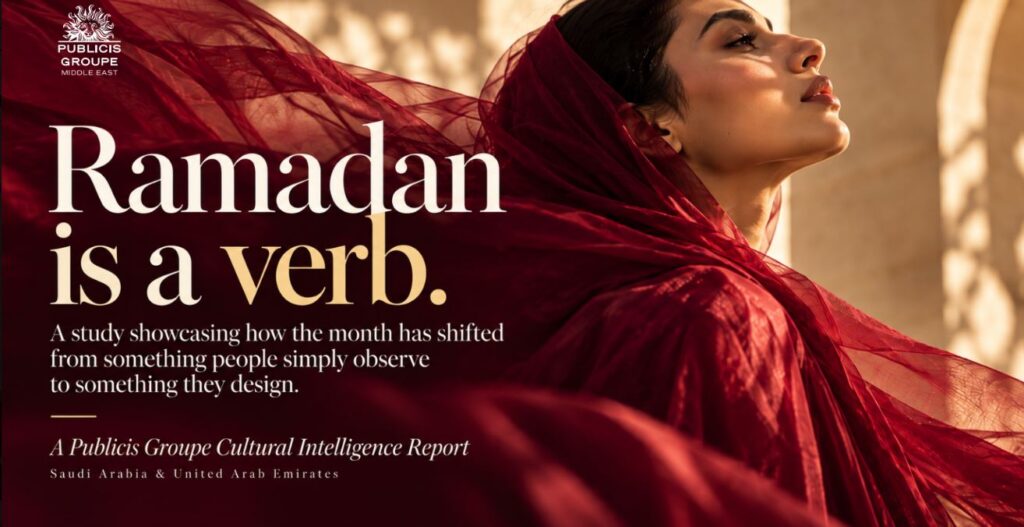
Five key shifts in consumer behaviour during Ramadan in Saudi Arabia and the UAE, which could influence how brands engage with people during the holy month, have been identified in a new study by Publicis Groupe Middle East & Turkey.
Titled Ramadan is a Verb, the report highlights how people are increasingly personalising traditional Ramadan practices, with digital tools, changing family dynamics, more deliberate charitable giving and evolving entertainment habits shaping their experiences.
Based on 1,200 quantitative surveys, 14 digital diaries, in-depth interviews and 60 home visits conducted over 30 days, the research examines how people are adapting established Ramadan traditions to their individual preferences and lifestyles.
The findings suggest that while traditional practices remain central to Ramadan, people are exercising greater choice in how they observe and celebrate the month.
According to the report, 54 percent of respondents believe technology improves how they fast, pray and live during Ramadan, while 56 percent of parents with young children use apps and interactive tools to teach them about prayer.
The research also points to changing roles within households, with 49 percent of men aged 18 to 26 reporting greater involvement in preparing iftar. Personalisation of Ramadan traditions is also evident, with 69 percent of respondents in Saudi Arabia and 37 percent in the UAE saying they decorate their iftar in their own way.
The report identifies five behavioural shifts — Curate, Architect, Orchestrate, Design and Craft — describing how people personalise their spirituality, approach charitable giving, plan their meals, organise their nights and develop individual ways of observing Ramadan.
It argues that brands need to move beyond conventional seasonal advertising and play more meaningful roles in people’s Ramadan experiences.
The opportunities identified include supporting personal spiritual routines, providing greater transparency and control over charitable contributions, addressing changing needs around suhoor and wellness, and developing marketing strategies that reflect different activities and social patterns throughout the Ramadan night.
“The revelation is hiding in plain sight, People haven’t stopped following tradition. They’ve started authoring it. They assemble their spiritual tools, direct their generosity, design what is on the table, programme their nights and put their signature on rituals. If we keep making Ramadan ads for a Ramadan that no longer exists, we will miss the very behaviours that create opportunity. Our five verbs give marketers a more useful brief: Earn utility, build infrastructure, understand the table, design the night and make space for individuality. Stop decorating Ramadan. Start enabling it,” said Tahaab Rais, Chief Strategy Officer, Publicis Groupe Middle East & Turkey.
The report examines opportunities across several sectors, including FMCG, telecommunications, finance, retail, entertainment, wellness and luxury.
Publicis Groupe Middle East & Turkey is headquartered in Dubai and operates across eight markets in the Middle East and North Africa, bringing together 3,600 professionals working across data, technology, media, strategy, creativity and business transformation.