
WARC has identified five trends set to disrupt global marketing practices in 2027, highlighting the growing influence of artificial intelligence (AI), the changing dynamics of social media, the rise of short-form content, climate-driven shifts in consumer behaviour and the need to balance AI adoption with consumer trust.
In its newly released The Marketer’s Toolkit 2027, published on November 10, WARC draws on a worldwide survey of 1,000 marketers, one-to-one interviews with marketing leaders and its proprietary GEISTE methodology to examine the forces likely to shape marketing strategies over the coming year.
The report comes against a backdrop of declining industry confidence. Only 46% of marketers expect business conditions to improve in 2027, marking the third consecutive annual decline in optimism and a drop of nearly 20 percentage points over three years.
However, fewer marketers anticipate budget cuts, while global advertising expenditure is forecast to grow by 8.4% to reach $1.46 trillion in 2027, according to WARC Media.
Aditya Kishore, Insight Director at WARC, said the challenging macroeconomic environment, characterised by mounting sovereign debt, a fading middle market and the cost-of-living crisis, continued to weigh on marketer confidence.
“But beneath these pressures, important shifts are reshaping the industry,” Kishore said. “AI agents are starting to influence how consumers shop, algorithms are superseding social connections on social media, and the rise of the clip economy is changing how brands connect with audiences.”
He added that marketers who understand and act on these emerging trends have an opportunity to turn disruption into growth.
AI agents could reshape consumer purchasing
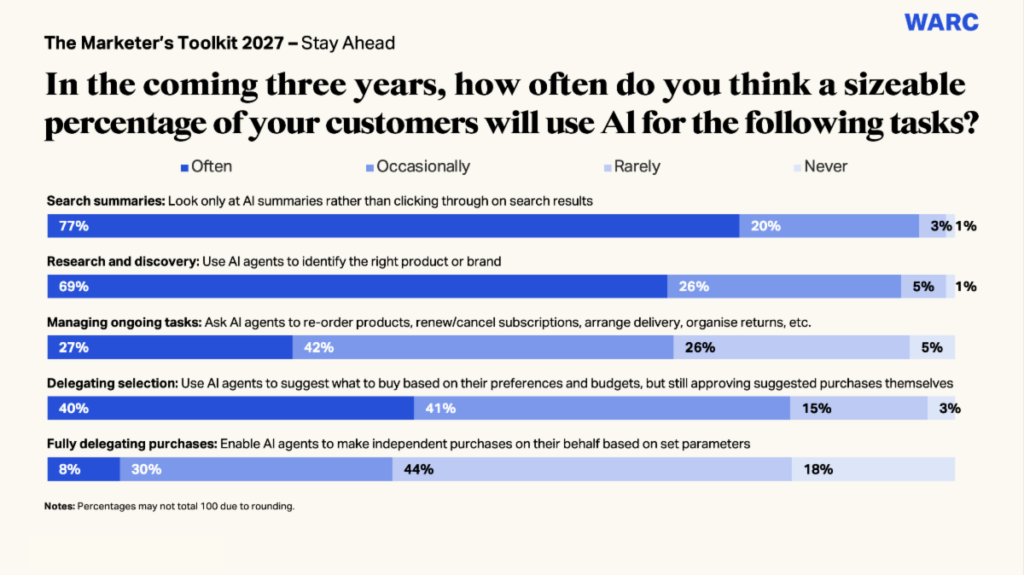
One of the report’s key findings is the growing role of agentic AI in consumer decision-making, with AI assistants increasingly expected to undertake tasks ranging from product research to purchasing.
According to the survey, 69% of marketers expect customers to use AI agents for product research within the next three years. However, only 8% anticipate consumers fully delegating purchases to these systems.
The report, citing projections by PHD and WARC, says agent-facilitated consumer spending could reach $944 billion in 2026 and $3.4 trillion by 2030.
As consumers increasingly delegate everyday decisions to AI assistants, brands will need to rethink how they establish visibility and communicate with these agents. WARC argues that the emerging delegation economy requires a broader approach to brand building rather than an exclusive focus on AI optimisation.
Social media enters a post-social era
The second trend points to a fundamental shift in how social media platforms distribute content and connect audiences.
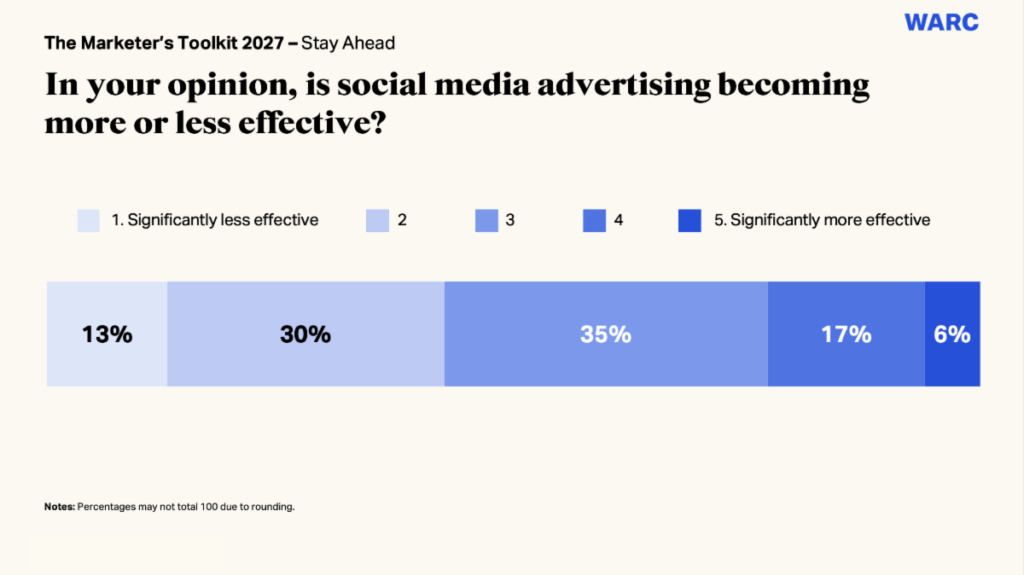
While social advertising investment is forecast to reach $394.6 billion globally this year, up 21.3% from 2025, marketers are increasingly questioning its effectiveness.
Some 43% of advertisers believe social media advertising is becoming less effective, while 58% say their media-buying practices are too firmly established to remove platforms from their plans, even if traffic declines.
WARC describes this as the emergence of a post-social era, in which algorithms, rather than social connections, increasingly determine what audiences see.
Users are being exposed to personalised, interest-based and constantly refreshed content feeds, requiring brands to rethink campaign planning, creative production and measurement.
Marc Pritchard, Chief Brand Officer at Procter & Gamble, emphasised the importance of producing varied and frequent content to remain visible in algorithm-driven environments.
“You need to make sure that you create memory in the algorithm,” Pritchard said. “What we’ve learned is that you need a much higher volume of content, a much higher variety of content, at a much higher velocity.”
WARC advises marketers to prioritise audience motivations and pain points when developing creative content, rather than simply increasing output.
The rise of the clip economy
The third trend concerns the fragmentation of digital content into increasingly smaller units, with short-form video becoming a major driver of attention, discovery and engagement.
While 83% of marketers say short-form video is popular among consumers, 40% remain doubtful that it can deliver the same brand-building impact as television, films and events.
WARC argues that the clip is increasingly becoming the primary point of engagement, often detached from the original content from which it originates. As creators, fans and algorithms take on a greater role in distributing content, brands will need to rethink how campaigns are developed and packaged.
David Sandström, Chief Marketing Officer at Klarna, said clipping had helped advertising regain some of its appeal by aligning it more closely with how audiences want to consume content.
“I think that advertising has slowly regained its mojo due to clipping,” Sandström said. He added that traditional advertising had often been pushed at consumers without sufficiently understanding their content-consumption preferences.
The report recommends incorporating distribution strategies into creative briefs from the outset, treating creators as strategic partners and developing connected content series rather than isolated clips.
Rising temperatures create a summer wildcard
Climate change is emerging as another significant factor influencing consumer behaviour and marketing strategies.
WARC finds that 45% of marketers have not seriously considered how rising summer temperatures could affect their categories, while only 25% have taken action.
Increasingly extreme temperatures are changing when, where and how people spend, disrupting established seasonal patterns and creating new consumer demands.
The report cites Bloomberg estimates that this summer’s heat resulted in a €17 billion hit to European GDP, illustrating the potential economic consequences of rising temperatures.
The changing climate could affect everything from travel and retail spending to product demand, pricing and supply chains, requiring marketers to reconsider traditional seasonal assumptions.
James Thornton, CEO of Intrepid Travel, said the company had observed growing demand for cooler shoulder seasons, particularly in Europe, as well as destinations such as Iceland and Norway during summer.
WARC recommends that marketers assess how extreme weather affects their categories, build flexibility into campaign planning and identify opportunities arising from changing consumer preferences.
Finding the right balance on AI
The fifth trend highlights the tension between the opportunities offered by AI and concerns about consumer trust.
While 42% of marketers expect AI to improve marketing effectiveness, an equal proportion remain uncertain about its impact, while 19% have negative expectations.
AI offers brands the ability to scale advertising production and deliver highly personalised creative content. However, consumer mistrust presents a challenge for marketers seeking to integrate the technology into their operations.
Selina Sykes, Global Vice-President of Digital, Social and AI Transformation at Unilever, said businesses needed to rethink their marketing processes rather than simply introduce AI into existing workflows.
“You can’t just take the way you worked without AI and replace it with AI. You need to reimagine the workflow,” Sykes said.
She said marketers should focus on desired outcomes and work backwards to determine the processes, inputs and wider changes needed across the marketing ecosystem.
WARC recommends greater transparency around AI use, understanding consumer acceptance of AI-generated advertising across different categories and keeping human judgement and creativity central to campaign development.
Together, the five trends point to a marketing landscape in which technological change, evolving content consumption and environmental pressures are challenging established practices. For marketers, WARC suggests, the task in 2027 will be not simply to adapt to disruption but to identify where it creates new opportunities for growth.