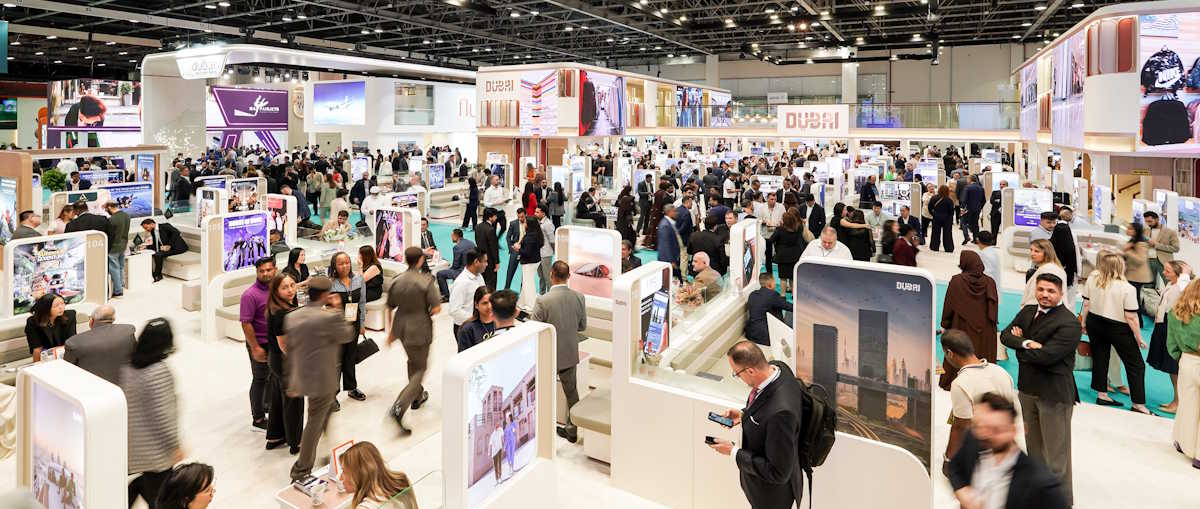
Arabian Travel Market 2026 closed in Dubai with the travel and tourism industry signalling cautious optimism about the final quarter of the year, while operators highlighted shorter booking windows, resilient regional demand and a growing reliance on data and technology to navigate changing traveller behaviour.
The 33rd edition of ATM, held at Dubai World Trade Centre from September 14–17, brought together travel buyers representing more than 115 countries, with more than 55 destination stands participating in the event.
The show also provided a platform for major announcements across tourism, aviation, rail, hospitality and technology, including the launch of Visit UAE, the country’s first unified national tourism brand, and the unveiling of the UAE Grand Tour, an online platform designed to allow visitors to travel through all seven emirates on a single route.
Major deals and launches
Emirates signed 11 memoranda of understanding during the event, while Rotana announced a pipeline of 40 hotels and more than 8,300 keys under development, including 10 projects in Saudi Arabia. Etihad Airways and Etihad Rail also signed an agreement to explore an integrated air-rail travel experience connecting destinations across the UAE.
Technology emerged as another major theme, with Mastercard and Trip.com showcasing AI-powered booking experiences through TripGenie. ATM said floorspace dedicated to technology doubled this year with the debut of the co-located ATM Travel Tech show.
Q4 confidence returns
But conversations with hospitality executives at the event pointed to a recovery that remains uneven and increasingly dependent on rapidly changing traveller behaviour.
Kiran Kumar, Regional Marketing Director at United Hospitality Management, said the outlook for the fourth quarter was improving, although business had not yet returned to previous levels.
“Very. In this market, we all need to be optimistic, and optimism is the backbone of our hope and our strategy for Q4,” Kumar said. “So business is looking positive, much better than before if you compare it to the rest of the year after the situation we are in got initiated by the end of Q1. Q4 looks promising.”
He said UHM was seeing a positive net pickup in bookings, despite cancellations, with business and leisure properties experiencing different demand patterns.
“The business properties have more group inquiries coming in, so which is a good sign,” Kumar said, pointing to demand from Asia, the GCC and local events in Dubai. For leisure properties, he said conventional source markets including Russia, the UK and Europe were also showing positive growth.
Bookings move closer
One of the clearest changes, Kumar said, was the shortening of booking windows.
“People are a bit more cautious and they’re not hurried to make bookings 6 months in advance and 4 months in advance and all that. So the lead time has reduced. So people are booking more last minute or more shorter lead times,” he said.
That shift is forcing hospitality companies to rethink forecasting and revenue management, he said, as consumers increasingly wait before committing to travel.
GCC demand shows resilience
For STORY Hospitality, the recovery is also beginning to emerge, particularly from regional markets.
Rafa Aguado, VP of Marketing & Communications at STORY Hospitality, said the UAE hotel market was showing early signs of recovery, with expectations for a stronger end to the year.
“I think that we’re seeing that somehow the recovery has started already a little bit in the hotels and the property talking exclusively about UAE. And we expect end of the year quite more powerful than this small recovery that we are experiencing at this moment,” Aguado said.
He said GCC markets were among the first to recover, reflecting the relative resilience of regional travel.
“The first clients that we see that we’re recovering is the GCC markets that are also part of the conflict, But they feel like we feel here that there is more or less, more or less normality in our daily life. That’s why this is the first travel that is being recovered,” he said.
Protecting rates
Aguado said the company had responded to changing conditions by shifting marketing budgets between markets and trying to protect room rates rather than relying heavily on discounting.
“The first reaction, and it’s very normal that everybody has, is drop the prices. But that, that is not really beneficial, not for you, not for the industry, because then it’s very difficult to recover the price when you have dropped down to 100,” he said.
Instead, the company has sought to maintain rates while adding services and experiences to create additional value for guests.
Data tracks demand
Accor’s Kerry Healy, Chief Commercial Officer, MEA APAC Premium, Midscale & Economy Brands, said the current environment had reinforced the importance of understanding where demand was moving rather than assuming that it had disappeared.
“Data is everything now,” Healy said. “And it’s funny because recently I was asked a question about, you know, did travel demand, you know, die? And I’m like, no, it never just dies, it shifts.”
For Accor, this has meant following travel corridors and reallocating investment as confidence returns progressively—from local travel to regional and then international travel.
Healy said confidence was rebuilding, but booking patterns remained heavily weighted towards the last minute.
“I think the Q4, I don’t have enough because of what I just said. I don’t have enough data points to tell you whether I think Q4 is going to be good or not,” she said.
She added that Accor was pleased with summer performance and September bookings, but expected demand conditions to remain different from the previous year.
“The challenge for Q4 will not be occupancy necessarily. We might be able to get the occupancy, but it will be that the overarching demand for the destination will be slightly soft,” Healy said.
AI enables personalisation
The shift in traveller behaviour is also accelerating the use of data, technology and AI in hospitality marketing.
Healy said AI was enabling hotels to move beyond broad segmentation towards increasingly individualised communication.
“AI is what allows us to scale it,” she said, describing how data and technology can allow brands to tailor communication to individual customers while maintaining distinct brand identities.
Protecting brand investment
For marketers, however, the current environment does not necessarily mean shifting all investment towards immediate conversion.
Healy said she had argued against cutting brand-building investment even during a difficult year.
“I will never take money from the top of the funnel again,” she said. “Because at some point, if you’re not creating— there is demand. So the top of the funnel is helping me create the demand, help keep the brand awareness high, and create consideration.”
That balance between immediate performance and longer-term brand building is becoming particularly important as AI changes how consumers discover and select travel products.
Recovery remains uneven
Across the three interviews, a common theme emerged: the recovery is underway, but it is being driven by a different pattern of demand than hospitality companies were accustomed to before the latest disruption.
GCC and domestic travel are providing resilience, while international demand is returning selectively. Booking windows are shorter, consumers are more cautious and operators are using data to adjust budgets, pricing and marketing activity more quickly.
ATM 2026 itself reflected that shift towards technology-led tourism. Held under the theme “Travel 2040: Driving New Frontiers Through Innovation and Technology,” the event featured more than 90 sessions across its Global Stage, Future Stage and Experience Hub, alongside 28 live showcases at the Tech & Innovation Hub – Demo Zone.
The event also introduced a refreshed brand identity as ATM positions itself increasingly as a year-round platform connecting the global travel and tourism ecosystem.
With the next edition scheduled for May 3–6, 2027, the industry’s immediate focus is now on converting the cautious recovery visible at ATM into sustained demand through the final quarter and into the new year.