For decades, advertising and marketing operated around a simple constraint: making things took time, money and people.
That constraint is disappearing.
Generative AI can now produce images, video, copy, translations and creative variations in seconds. What once required a team and a week can now be generated, tested and adapted before lunch. But if everyone can make more, faster and cheaper, a harder question follows: what is actually worth paying for? And who in this room is exposed if they don’t have an answer?
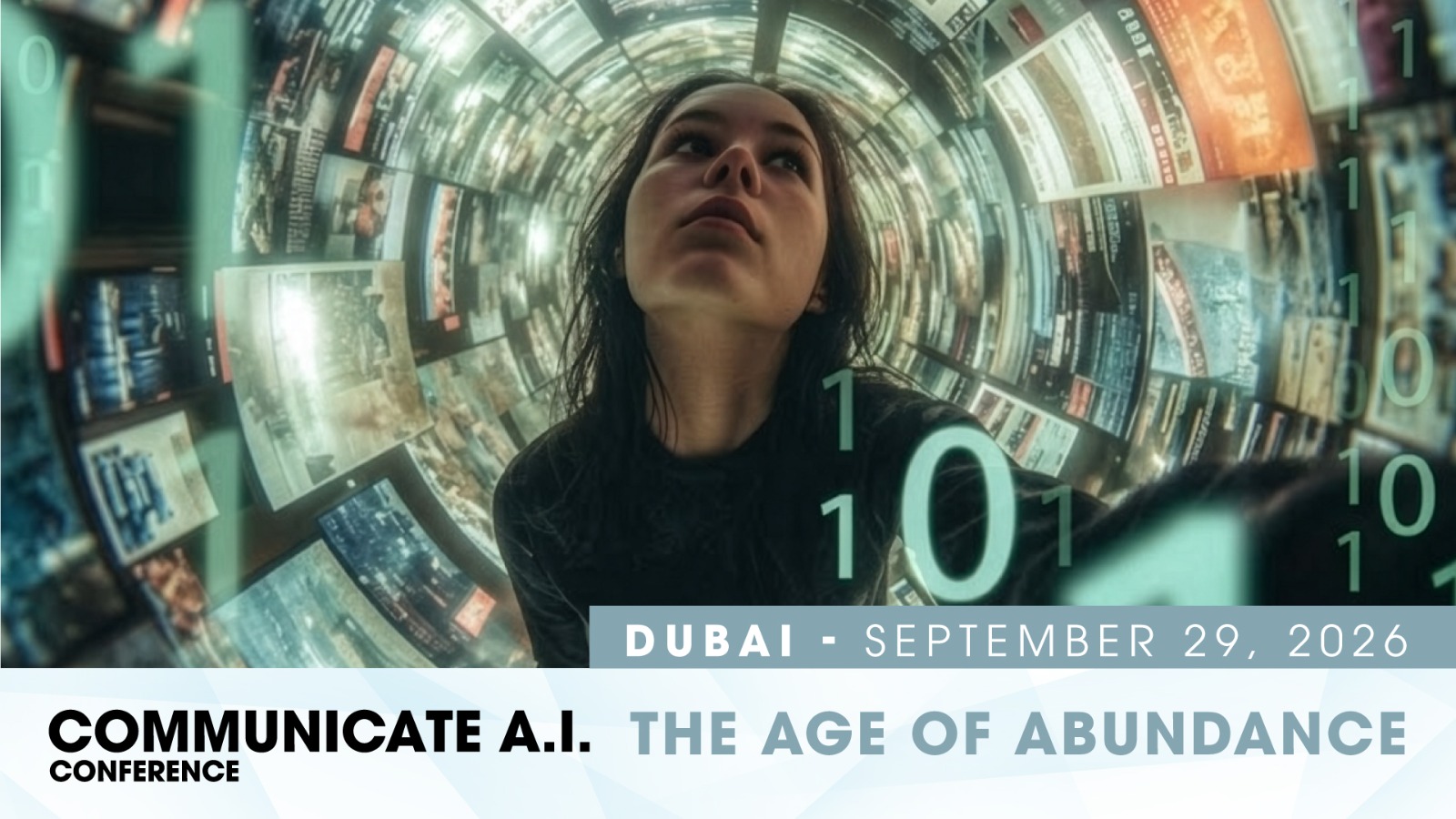
That is the question at the centre of the third edition of Communicate AI, returning to Dubai Knowledge Park on 29 September under the theme “The Age of Abundance.”
The idea is deliberately provocative. As AI makes creative production abundant, the things that cannot simply be generated on demand, taste, trust, cultural understanding, originality, a distinctive point of view, become the industry’s scarcest, and therefore most valuable, assets. Everything else is starting to look like a commodity.
The adoption numbers are real. The impact numbers aren’t.
According to McKinsey’s 2026 AI in Advertising survey, more than 90% of advertisers are already using AI across media planning, budgeting, targeting and creative generation. Nearly three-quarters expect it to increase total media spend, and a third believe it could lift return on ad spend by at least 10%.
Regionally, the picture is just as fast-moving — and just as uneven. McKinsey’s 2025 State of AI survey of 139 senior GCC executives and board directors found adoption climbing from 62% in 2023 to 84%. But only 31% said their organisations had reached the stage of scaling or fully deploying AI, and just 11% qualified as “value realisers”, companies that can point to measurable earnings impact.
Advertising shows the gap most clearly. A 2025 Ipsos study with the Advertising Business Group, surveying more than 100 marketing and advertising professionals across the UAE and Saudi Arabia, found that 96% had used AI tools — but only 26% were using them regularly. Seventy-three percent of companies said they were integrating AI, almost entirely for content production rather than strategic planning, and 70% admitted concern about over-relying on it without human oversight.
Translation for anyone in this industry: everyone has the tools. Almost nobody has proof it’s working. That gap is where the next twelve months of budget conversations, pitch losses and CMO scrutiny are going to happen, and it’s exactly the gap this year’s agenda is built to interrogate.
Abundance creates its own problem: sameness
When every brand, agency and creator has access to the same tools, the same prompts and increasingly the same models, speed stops being a differentiator. A hundred versions of an idea mean nothing if none of them had a reason to exist in the first place — and clients are starting to notice when a pitch could have come from any agency in the market.
This year’s Communicate AI agenda goes straight at that tension: how brands stay distinctive when competitors have the same stack, how creative teams use AI without shipping work that feels interchangeable, and how agencies prove the “AI-powered” pitch is more than a slide.
For this region specifically, there’s a sharper edge to the question. AI can adapt a global campaign for a local market faster and cheaper than ever. But if adaptation becomes effortless, the advantage shifts to what can’t be copied, original ideas, cultural fluency, work built from the region rather than translated into it. That’s the opportunity Communicate AI 2026 is putting in front of the room: can the GCC and wider MENA industry move from adapting global AI output to originating it?
Audience trust is still catching up to the technology, too. Regional consumer research continues to show real hesitation around AI-generated content when it isn’t clearly signposted — a signal that “we used AI” is not yet the flex some brands think it is, and that the trust gap itself may be the biggest commercial opportunity in the room this year.
Human intelligence isn’t going away. It’s getting more expensive.
If everyone has the tools, who has the taste? If everyone can create, who creates something people actually remember? When production is abundant, where does the industry’s real value move to? These aren’t hypothetical questions for a future edition. They’re the questions CMOs are already asking their agencies in pitch rooms, and the questions agencies need answers to before the next RFP lands.
Communicate AI 2026 is where that conversation happens in the open, in front of the people who will be asking it of you next quarter.
More reveals (including speakers, sessions and partners) dropping in the coming weeks. Get on the list before the room fills. Link to register here: