
The moment consumers pause before making a purchase is not a sign of indecision but an intentional act of self-regulation, according to a new global behavioural science study by Mindscope in collaboration with TikTok, which argues that brands risk losing customers by treating hesitation as a problem instead of an opportunity.
The study, The Alchemy of Consideration, surveyed more than 3,000 consumers and analysed over 420 ethnographic videos and mobile diaries collected across five continents. It found that shoppers actively use the period before a purchase to compare options, seek reassurance and guard against buyer’s remorse.
According to the research, brands that respect this “psychological pause” are more likely to earn consumer trust, while those relying on urgency tactics and pressure-based marketing may trigger resistance and lose potential sales.
Lea Karam, CEO & Founder of Mindscope, said: “In a world of choice paralysis, what people pause in is becoming much more meaningful than what they click on. Pausing is a winning currency, and the biggest opportunity sits in the moment when people pause. Consumers rarely move straight from wanting something to buying it – they stop, compare, question and look for reassurance. Yet most marketing is still built to drive the click, not to support the hesitation in between. The brands that win will treat that pause as part of the customer journey, not a leak in the funnel as historically assumed.”
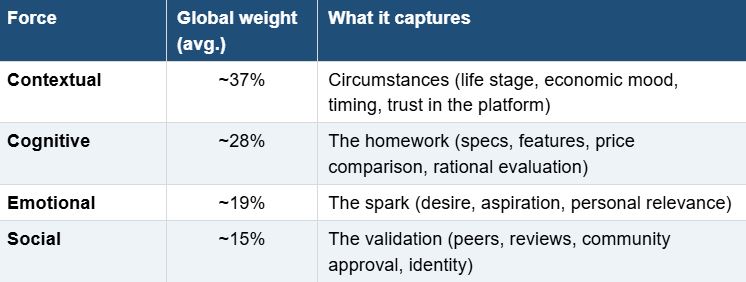
The study identified four behavioural forces that shape purchase decisions: contextual factors such as life stage, economic conditions and trust in the platform (37%); cognitive evaluation including product specifications and price comparisons (28%); emotional drivers like aspiration and personal relevance (19%); and social validation through reviews, creators and peers (15%).
Researchers also identified four distinct types of purchasing pauses: Cooling-Off for Clarity, Desire vs. Need Testing, Emotional Build-Up and Value & Timing Alignment. Rather than being obstacles to conversion, these pauses reflect deliberate decision-making, the report said.
The findings showed that more than half of consumers use “save for later” features when shopping for fashion (61.3%) and technology products (58%), while 42% of European consumers deliberately delay purchases to assess whether they align with longer-term priorities.
The report found that much of this consideration phase now takes place away from brand-owned channels. More than 48% of consumers said they rely on creators over written reviews, while 71% consult creator content before buying technology products.
Elias W. Bassil, Head of Global Business Marketing at TikTok METAP, said: “We have always valued the consideration phase at TikTok. And that’s why we developed TikTok Marketscope which enables brands to truly understand not only where their audience is sitting on the purchase decision journey but more importantly why they are there. We’ve also ensured that brands can act on these insights through smart solutions like Consideration Ads which leverage a complex calculation of different signals.”
TikTok also emerged as the platform most frequently used during the consideration phase, with 68% of its users opening the app daily while researching potential purchases.
Karam said marketers need to rethink where competitive advantage lies in today’s consumer journey.
“The next era of marketing will be won in the consideration phase; not at awareness, and especially not at the conversion phase. Consumers aren’t looking for the cheapest option; options today are abundant. Modern consumers are looking for reassurance that they’re making the right choice. The brands that respect the pause and turn hesitation into confidence will build stronger associations in a world where instant gratification is actually being increasingly replaced by longer consideration loops.”
The study covered five global regions—North America, Europe, Asia-Pacific, the Middle East and North Africa, and Latin America—and examined consumer behaviour across the technology, fashion, travel, FMCG and finance sectors. Researchers said the findings challenge the effectiveness of one-size-fits-all global marketing campaigns, arguing that brands must tailor their strategies to local behavioural patterns and the contextual factors influencing consumer decisions.