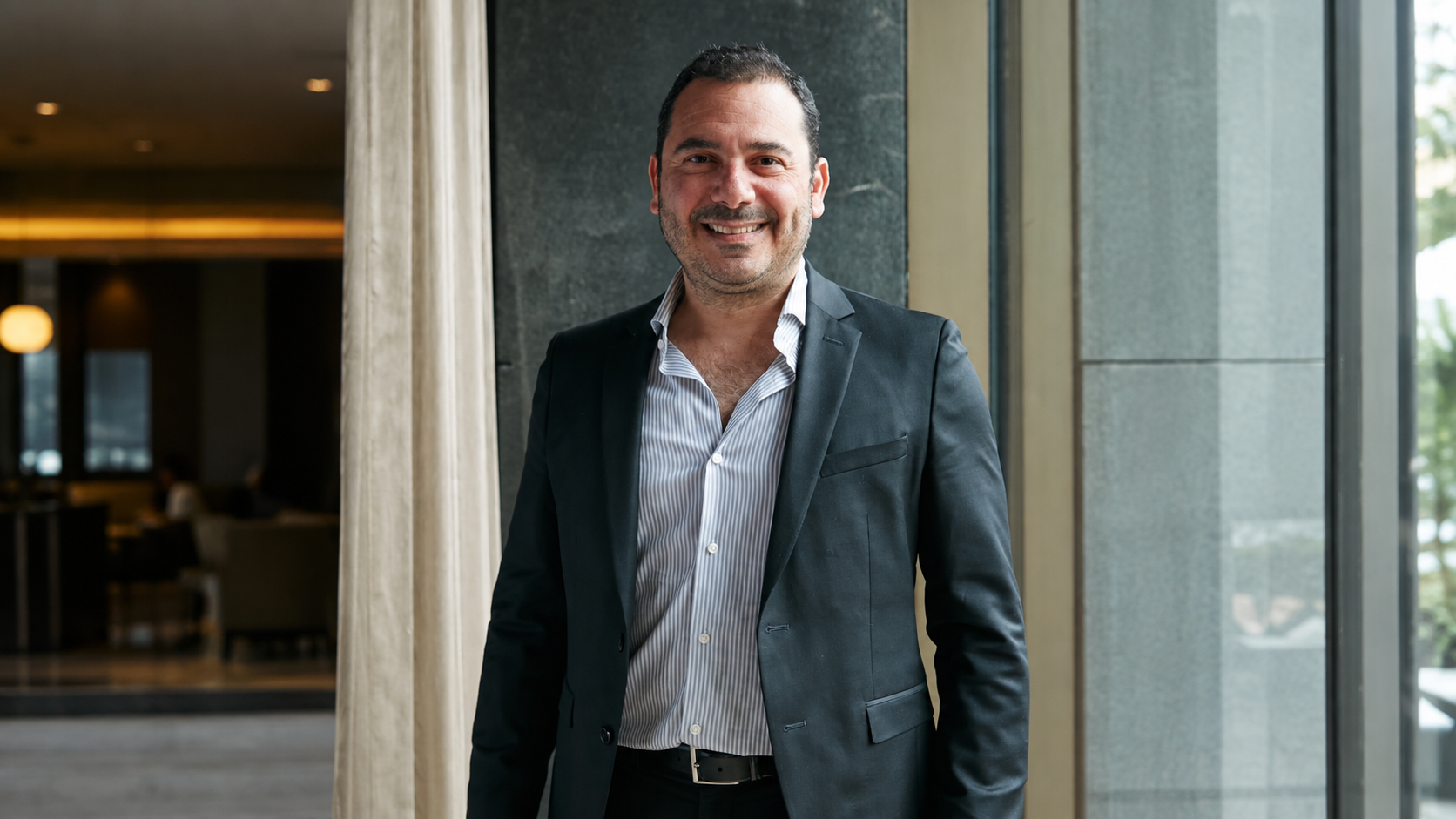
There’s a Cannes Lion holding open the door to Tarek Miknas’s office, another two doubling as bookends on a shelf that’s clearly run out of room. It’s a fitting image for a leader who, weeks after this interview, would announce he was stepping down as CEO of FP7 McCann, the agency he spent two decades building, as it merges with MullenLowe MENA to form McCann MENA. It’s been three months since Cannes, where the agency walked away with 10 Lions this year, and when we sat down, Miknas was already halfway into a story about 2004. That’s the year, he tells me, that a small independent agency in the UAE won the region’s very first Cannes Lion. He wasn’t there yet, he was in New York, weighing an uncle’s question about when he’d finally come home.
“I said, you know what? I don’t think I’m coming back,” he remembers telling him. “This is it. This is my city.” His uncle pushed back, who was supposed to change the region’s creative culture, if not him? “It really, really inspired everything in me,” Miknas says. “It’s my generation that needs to change that.” That conversation became something close to a raison d’etre, less a career decision than the reason he stayed.
It wasn’t a solo mission, he’s quick to clarify. That first Lion in 2004 set off a kind of quiet, industry-wide competitiveness, agencies and independents alike leaning into the same ambition around the same time. “We were all putting an emphasis towards that creative narrative for our part of the world,” he says. The proof shows up in small moments now: a stranger recognizing the FP7 name at Cannes, or an inbox message from someone at a “typical advertising capital in Europe or New York” asking to come work here because they’ve seen what the region’s ambition can produce. What started as a chip on the shoulder for a handful of agency people has become, he says, a shared project between agencies and the clients funding the work.
So he did what he set out to do, or at least he tried, alongside what he calls a lot of like-minded people who spent years pushing clients toward more ambitious work. It wasn’t a fast campaign, it was a patient, years-long commitment, and the payoff shows up in numbers that would make most agency heads blush: his top 20 clients average 15.75 years of tenure with FP7. Compare that, he says, to the average CMO, who’s lucky to last three.
The philosophy behind the wins
The philosophy behind it is almost stubbornly simple. “Our biggest clients should get our best work and our best brains,” he says, and he means it literally: McDonald’s, MasterCard, and Arla aren’t sideshow accounts winning festival hardware for the sake of it. He points to Arla specifically, a brand FP7 nudged from modest regional recognition a decade ago to a Golden Lion and a Glass win this year. “That was a journey that was a decade long that got us there,” he says. “But it was a committed journey and committed partnership that allowed us to do that.”
Part of what makes that kind of work possible, he argues, is the sheer scale of what clients here are willing to hand over. “We launch cities, we launch ideas, we partner with governments on initiatives,” he says. “We’re not just pushing forward the next variant of toothpaste.” He notices it most at global industry gatherings, watching agency leads from other markets light up when he describes his projects. That comes with responsibility, he says, given how much national ambition is riding on the work in a market like Saudi Arabia. “It’s an honor,” he says, and adds that “it’s important for us in our industry to be the best in our industry on a global level.”
Steady through turbulence
The conversation turns, inevitably, to the region’s turbulence, and here Miknas doesn’t flinch or soften. Since the conflict began, nobody in his industry gave up, he says. “We just kept going,” describing agencies filing into government offices the very next morning. The operating environment has genuinely gotten harder, though: supply chains interrupted, government spending redirected toward more urgent priorities, and a major trade barrier, the strait closure, rippling through nearly every industry’s ability to get supplies as readily as before. Even so, the UAE government has pushed forward stimulus funds to keep business moving, specifically in hospitality, the sector hit hardest. Through all of it, FP7 pitched more than ever. “We’ve never pitched so much, we’ve never been so busy,” he says. “Nobody here is ready to throw in the towel.”
Ask him how optimistic he is heading into the next few quarters and he doesn’t hedge. “We didn’t have major layoffs,” he says. “We didn’t lose any of our clients.” There were drops here and there, he clarifies, but nothing across the board, and the agency leaned hard into scenario planning and steady communication rather than retreat. He points to the Saudi Tourism Authority as the clearest example of a brand that refused to disappear when the easy move would have been to pull back. When uncertainty made travel a harder sell, STA didn’t go quiet. It pivoted, showing up in France with a strong presence around the eWorld Cup it had hosted. “They still were able to pivot and host and play the host in a different and new way,” he says. “That’s creativity at its best, isn’t it? This is when people find alternative solutions.”
AI, Gen Z, and the long game
On AI, he’s neither zealot nor skeptic, just pragmatic in the way people are when they’ve watched a hundred trends come and go. He describes watching senior creative teams treat it like “a third person in the room,” a copywriter and art director bouncing an idea off a platform, taking what works, discarding what doesn’t. “It wasn’t the person leading,” he clarifies. “It was another tool.” He’s unbothered, too, by AI-dubbed safety videos on his own flights, and doesn’t think an ordinary passenger cares whether the voice speaking Mandarin was ever really Arab. “I’m not bothered by it as a consumer that lives in the age of AI at all,” he says.
What animates him most, though, is talent, particularly the wave of Gen Z creatives cutting against decades of specialist thinking. FP7 counts 45 nationalities on staff, he says, people who crossed oceans specifically for the caliber of briefs the region now produces. “Good ideas can come from anywhere,” he insists. “I don’t care what’s on your title.” He’s watched juniors hand back work so sharp it makes him question his own younger self. “They come back with something so bloody smart, you go, how did that kid do that? Why wasn’t I smart when I was that age?”
None of it is left to chance. Miknas describes a deliberate pipeline strategy behind those Cannes hauls, one that runs a year or two ahead of the ceremony itself. “We have a process to our madness, how we do this every year,” he says. “We build up these pipelines of work. It’s intentional that each year we succeed. It’s not an accident. We work towards it way in advance.” This year’s Cannes wins were built back in 2025, he notes, and the agency is already laying groundwork for 2027 based on work it’s producing right now.
By the time the hour is up, Miknas is still circling back to the region he chose over Manhattan two decades ago, the one he now insists is home to some of the most ambitious briefs on earth. Weeks later, he would step down, calling it “the right moment to pass the baton” and saying he trusts Harfouche to “build on what’s great by shaping what comes next.” The Lions crowding his shelf aren’t a finish line. For him, they’re just proof the story was always worth telling.