Meta has announced changes to its ad measurement and attribution system aimed at helping advertisers better understand the impact of their campaigns in an increasingly social-first digital advertising environment.
The company said advertisers should focus on a key question when measuring ad performance: what outcomes were caused by an ad that would not have happened otherwise.
Incrementality experiments such as Conversion Lift are considered the most reliable way to answer this question. However, Meta acknowledged that fully adopting incrementality measurement can take time, prompting the company to introduce changes that allow advertisers to use existing tools more effectively.
The updates are designed to simplify measurement and help businesses make more informed advertising spending decisions.
Shift in click-through attribution
According to the World Advertising Research Center (WARC), social media advertising has surpassed search advertising to become the world’s largest channel for ad spending.
Meta said many current measurement systems were designed for a search-focused era, where users typically interacted with ads by clicking on links. On social platforms, however, users engage with ads in multiple ways — including liking, sharing or saving content — in addition to clicking links.
Until now, Meta attributed conversions to various types of clicks such as shares, saves, likes and link clicks. In contrast, many third-party analytics tools primarily attribute conversions only to link clicks.
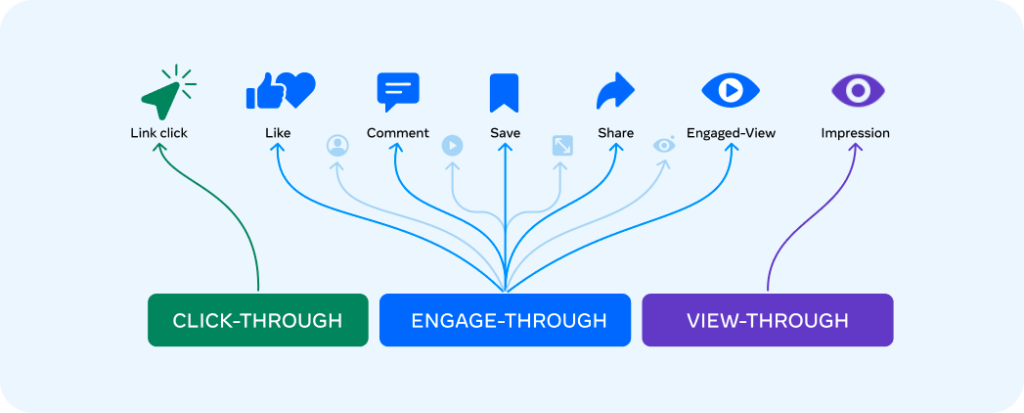
To reduce discrepancies between Meta Ads Manager and external reporting platforms, the company said it will redefine click-through attribution for website and in-store conversions to include only link clicks.
The company hopes the change will improve consistency with tools such as Google Analytics.
After testing the update, Riyad Ebrahim, Co-Founder and CEO at apparel brand JAKI, said: “I’m all for this. This is good for the landscape of ads on Meta because it can help determine which campaigns are more effective at driving results from social interactions compared to link clicks.”
Vinee McCracken, Director of Social at Mpix, also welcomed the update.
“I’m glad that Meta is making this change to help me see customer behaviors more cleanly, as opposed to everything being lumped into one bucket. I understand why click attribution was what it was, but this change makes a ton of sense and gives us a bit more information and granularity to help us understand what we’re seeing, which ultimately gives me a stronger level of confidence in understanding the impact of my Meta ads,” McCracken said.
The changes will begin rolling out later this month for campaigns optimized for website or in-store conversions. Meta said advertisers may see the updates appear in Ads Manager at different times as the rollout progresses. Billing practices will remain unchanged.
Introducing engage-through attribution
Alongside the click-through changes, Meta is also expanding how it measures engagement that does not involve link clicks.
Conversions generated from actions such as shares, saves or other interactions will now be included under a revised metric called engage-through attribution, previously known as engaged-view attribution.
The company said advertisers should use this metric to better understand the value of social interactions that are unique to platforms like Facebook and Instagram.
Meta also noted changes in user behavior around video content, particularly Reels. The company said 46% of online purchase conversions linked to Reels ads occur within the first two seconds of attention.
As a result, Meta has shortened the threshold for counting an engaged video view from 10 seconds to 5 seconds, which it believes will provide a more accurate indicator of meaningful engagement.
In addition, Meta said it is partnering with third-party analytics providers including Northbeam and Triplewhale to incorporate both clicks and views into their attribution models.
A broader approach to measurement
Meta said the overall goal of the changes is to provide advertisers with clearer and more consistent performance data.
By separating link-click conversions from other engagement-based interactions, the company hopes advertisers will gain a better understanding of how social media ads contribute to business outcomes.
“Our aim is that the changes we’re announcing today provide advertisers with the best of both worlds – click-through attribution reporting that will have more consistency with third-party reporting tools like Google Analytics, as well as engage-through attribution that will provide visibility into the added value of uniquely social interactions, such as a like, share, or comment – bringing advertisers one step closer to understanding the true impact of their ads.”