Sports fandom in the Gulf is rapidly moving beyond traditional television and social media, with connected TV (CTV), digital audio and digital out-of-home (DOOH) emerging as key platforms for fan engagement ahead of the 2026 FIFA World Cup, a new study by The Trade Desk has found.
The research highlights what it calls a “major shift in media consumption patterns surrounding live sport and global tournaments,” particularly across Saudi Arabia and the UAE, where live sports viewership remains exceptionally high at 81% and 84% respectively.
“In Saudi Arabia alone, 18.2 million fans are expected to follow the 2026 World Cup,” the report said, adding that “if every match were watched in full, it would amount to nearly 3.8 billion hours of streaming content, equivalent to more than 431,000 years of viewing time.”
The study argues that “the playbook around major sporting events has fundamentally changed,” as sports audiences increasingly consume content across multiple digital touchpoints rather than through a single television screen.
“Fandom is increasingly complex,” the report said. “What was once dominated by fixed sponsorships, broad-reach television campaigns and gatherings around a single screen at a single moment in time, is now becoming a dynamic, real-time advertising ecosystem powered by connected TV (CTV), digital audio, mobile, retail media and programmatic digital out-of-home (DOOH).”
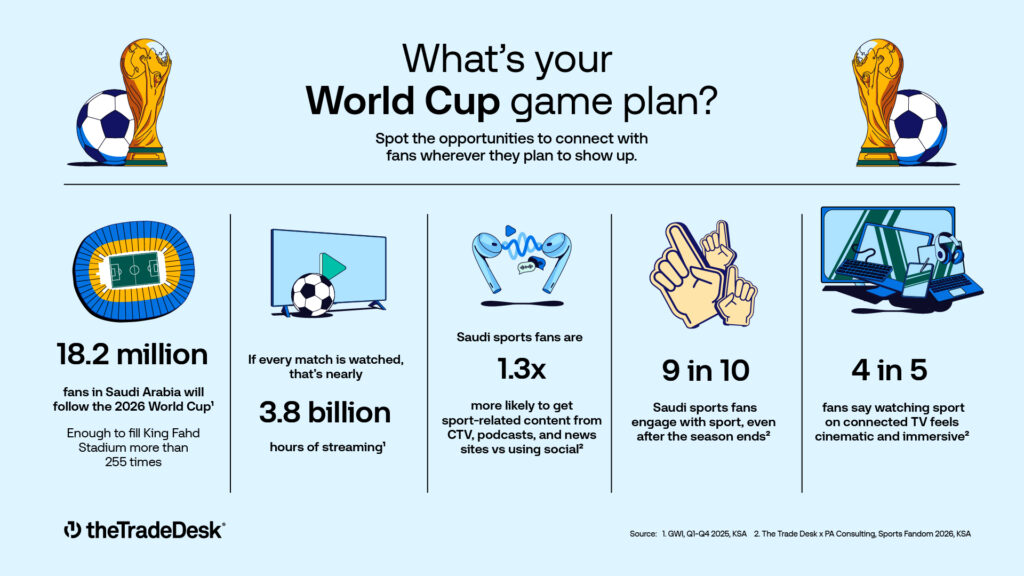
According to the findings, Saudi sports fans are now “1.3 times more likely to use connected digital channels over social media,” signaling what the report described as “a shift toward premium, immersive and cross-platform viewing behaviours.”
The research also found that sports engagement in the kingdom extends far beyond major tournaments, with “nine in ten Saudi sports fans” remaining connected with sports content even outside competition periods.
“This creates opportunities for brands to build sustained relationships rather than short-term spikes in visibility,” the report noted.
The study identified CTV as the “anchor of fandom” in the region, particularly as streaming consumption accelerates across Gulf households.
“With 82 percent CTV penetration in the UAE, and four in five Saudi sports fans saying CTV makes watching sport feel more cinematic and immersive, the channel is reinforcing its growing role as the anchor of live sports engagement,” the report said.
Key findings
• 84% live sports viewership in the UAE and 81% in Saudi Arabia
• 83% of sports fans say connected digital channels are central to how they experience sport
• 66% say CTV and podcasts deepen their engagement with sport
• 89% of fans continue moving across channels throughout the fan journey
• 9 in 10 Saudi sports fans remain engaged with sport beyond tournament periods
It added: “CTV puts fans back in control, allowing fandom to flex around their lifestyle; they can tune in live to watch a game unfold or catch up with highlights another day.”
The report stressed that audience attention during global sporting tournaments is now “highly emotional and highly intentional,” arguing that advertisers need more precise targeting strategies rather than relying solely on traditional sponsorships or mass-reach television campaigns.
“You don’t win by shouting louder. You win by showing up at the exact moment intent spikes,” the report said.
Beyond video, the research pointed to growing opportunities in streamed audio and podcasts, saying digital audio allows brands to remain connected to fans “between screens into commutes, gyms and everyday moments where audiences remain highly attentive and emotionally connected.”
The report added that “omnichannel World Cup campaigns that incorporate digital audio can access 18M+ sports fans across the UAE and Saudi Arabia alone.”
Digital out-of-home advertising was also highlighted as an increasingly important medium in Saudi Arabia, particularly in malls, entertainment districts and transit hubs.
“DOOH brings the stadium effect across cities, malls and transit hubs and builds buzz around big events, creating a sense of momentum and shared experience,” the study said.
The report argued that major sporting events such as the World Cup now create “a rare concentration of attention, intent and commerce across multiple touchpoints simultaneously,” requiring advertisers to connect audiences seamlessly across screens and physical environments.
Importantly, the study said brands no longer need official sponsorship rights to capitalize on major tournaments.
“Modern programmatic advertising is also creating opportunities for non-sponsors to participate intelligently through contextual targeting, agile media buying and measurable omnichannel campaigns,” it noted.
The research was commissioned by The Trade Desk and conducted by PA Consulting. It surveyed more than 2,800 sports fans across Saudi Arabia and major European markets, alongside qualitative diary-based research tracking fan media habits before, during and after live sporting events.