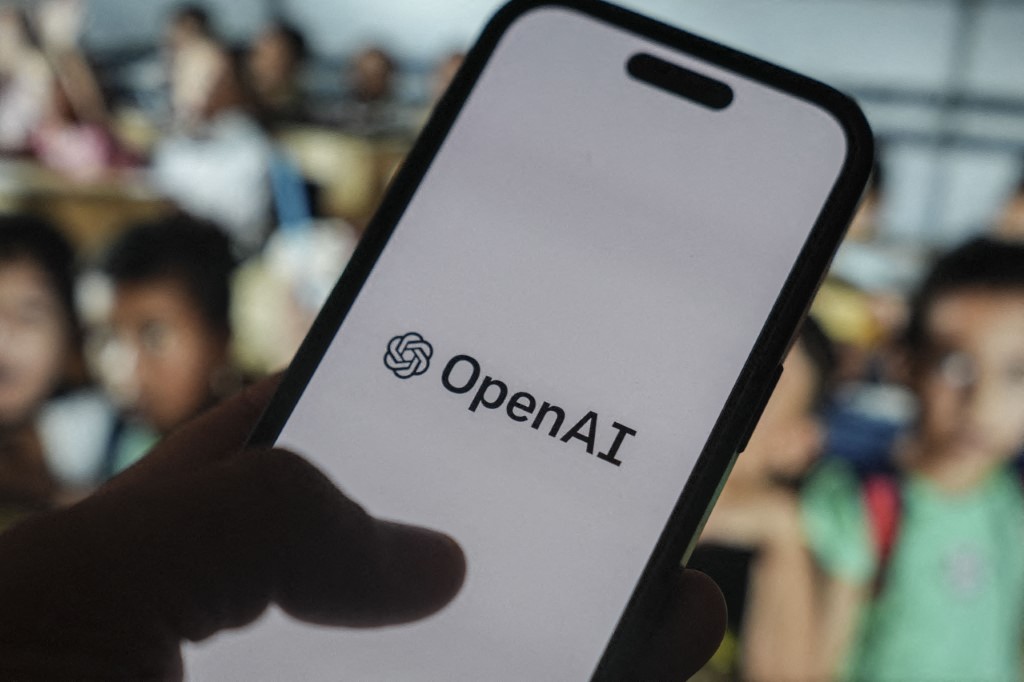
OpenAI has opened ChatGPT to advertising in India, marking a significant step in the company’s push to monetise one of the world’s most widely used AI platforms. The move is also likely to attract close attention from marketers across the Gulf, where AI-led search, commerce and personalised consumer journeys are rapidly becoming part of the digital landscape.
Ads will initially appear to users on the Free and Go versions of ChatGPT, excluding those under 18. Plus, Pro, Business, Enterprise and Education users will remain ad-free. WPP and Omnicom are among the first agency partners involved in the rollout.
OpenAI says more than 50 brands are expected to go live in India this week, with self-serve access scheduled to open on September 4, starting at daily budgets of Rs 725.
The proposition is straightforward: ChatGPT often knows more about what a consumer wants than a conventional search query does.
A user may ask, for example, which washing machine would work best for a family of four while using less water, rather than simply searching for washing machines within a particular price range. The conversation can reveal the user’s needs, preferences and circumstances before an advertisement is served.
For marketers, that context is potentially valuable.
But context is not necessarily purchase intent.
From “ask” to “buy”
The distinction could become particularly important as advertisers in India and the GCC begin experimenting with ChatGPT as a commercial channel.
That shift captures much of the attraction of conversational AI. A consumer can explain a problem, ask follow-up questions and narrow down options without moving through multiple search results.
Yet there is another step after recommendation: purchase.
Someone asking ChatGPT why an air conditioner is leaking may be researching a problem, while someone searching for an AC repair service nearby is much closer to taking action. Conventional search platforms have spent years developing signals to distinguish between those behaviours.
ChatGPT may have a deeper understanding of the problem, but advertisers still need to establish whether the user is curious, researching or genuinely ready to spend.
Early advertiser experiences reported outside India point to the uncertainty. Some marketers have described reasonable acquisition costs, while others have seen inexpensive clicks without meaningful conversions. Others have found traffic to be more information-oriented than solution-oriented.
For brands entering the GCC, that distinction will be crucial.
The region has some of the world’s most digitally sophisticated consumers, particularly in markets such as the UAE and Saudi Arabia. Consumers routinely move between search, social platforms, marketplaces, brand websites and increasingly AI tools before making a purchase. A new channel may therefore generate attention without necessarily generating incremental demand.
GCC marketers will ask the same question: where is the proof?
The biggest challenge for ChatGPT Ads may ultimately be measurement rather than reach.
Darshana Shah, former Group CMO of Aditya Birla Capital, has argued that marketers will expect the same level of dashboards, campaign controls and tracking infrastructure they receive from established digital advertising platforms.
That expectation will be particularly high among GCC advertisers accustomed to sophisticated performance marketing ecosystems.
Advertisers need to know which campaigns generated qualified leads, which audiences converted, which prompts produced commercial outcomes and, ultimately, how much revenue can be attributed to the platform.
Click-through rate alone will not be enough.
For a Saudi retailer, UAE travel company, financial services provider or automotive brand, the meaningful metric is whether ChatGPT users who interacted with an advertisement were more likely to book, enquire, subscribe or purchase.
This creates a potentially difficult measurement problem because the strongest feature of ChatGPT Ads — conversational context — is also protected by privacy restrictions.
The privacy paradox
OpenAI says advertisers will not have access to users’ conversations or personal information, and that advertising will not influence the answers generated by ChatGPT.
That privacy boundary is essential to maintaining user trust. But it creates a paradox for advertisers.
The commercial value, therefore, lies partly in the context.
But if advertisers cannot see the underlying conversation, they have to rely on OpenAI’s measurement systems to demonstrate that the right commercial signal was identified and that the resulting advertising exposure contributed to an outcome.
That makes the quality and transparency of OpenAI’s reporting infrastructure especially important.
For GCC marketers, this could determine whether ChatGPT Ads remains an experimental media buy or becomes a meaningful line in performance budgets.
Attribution could become even more complicated
There is another problem: determining whether ChatGPT actually caused the sale.
Consider a UAE consumer who researches a product on ChatGPT, subsequently searches for the brand on Google, sees a social advertisement and finally purchases through the brand’s website.
Which channel gets the credit?
If ChatGPT Ads is running alongside Google Search, SEO, social media and retail media, attributing the eventual purchase to one platform becomes difficult.
The problem is not unique to OpenAI, but conversational AI introduces another layer of ambiguity because marketers are simultaneously beginning to track organic visibility inside AI platforms.
Being recommended organically by ChatGPT, appearing as a cited source and appearing as a paid advertisement are fundamentally different outcomes. Yet as AI becomes part of the consumer journey, those distinctions could become increasingly blurred in marketing reports.
For GCC brands, where large campaigns frequently run across multiple digital touchpoints, disciplined attribution will therefore be essential.
A small increase in sales after launching ChatGPT Ads does not automatically mean ChatGPT generated that growth.
The users with the biggest wallets may not see the ads
OpenAI’s decision to keep paid plans advertising-free also creates an interesting challenge.
For mass-market consumer brands, reaching Free and Go users may provide a sufficiently large audience. But in categories such as enterprise technology, financial services, luxury, automotive and high-value travel, the most commercially attractive users may be executives, professionals and affluent consumers who are more likely to use paid tiers.
If those users remain outside the advertising pool, brands could find that the size of the ChatGPT audience does not necessarily translate into access to the audiences they value most.
That could have particular relevance in the Gulf.
The UAE and Saudi Arabia have significant concentrations of affluent consumers, business decision-makers and digitally active professionals. Luxury brands, financial institutions, property companies, airlines and premium hospitality businesses may therefore assess ChatGPT Ads not simply on audience scale but on who is actually reachable through the inventory.
The result could be a split advertising proposition: potentially powerful for mass consumer categories, but less straightforward for high-value or B2B advertisers.
AI search and commerce are converging
Despite these uncertainties, the underlying opportunity is difficult to ignore.
Conversational AI changes the traditional relationship between advertising and search. Instead of a consumer entering a short keyword and receiving a page of links, the platform can participate in a longer decision-making process.
That could be especially valuable in categories where consumers already spend considerable time researching before buying.
Those categories are also highly relevant to GCC markets, where consumers frequently research financial products, destinations, hotels, flights and products digitally before completing transactions.
A travel consumer asking ChatGPT to compare hotels for a family holiday in Dubai, for instance, is displaying a different type of signal from someone who simply searches for “Dubai hotels”.
The challenge is proving that the additional context produces additional commercial value.
The trust question
There is also a more fundamental issue OpenAI must manage: trust.
Users have largely learned to treat ChatGPT as an assistant rather than an advertising environment. That makes sponsored recommendations potentially more sensitive than conventional digital advertising.
The more users rely on ChatGPT for decisions — from what to buy and where to travel to which financial product to consider — the more important it becomes that advertising is clearly separated from the model’s answers.
OpenAI’s safeguards are therefore not simply compliance measures. They are central to the viability of the advertising model.
If users begin to believe that commercial relationships influence recommendations, the platform risks undermining one of its most valuable assets: credibility.
For GCC markets, where trust and brand reputation can carry considerable weight in categories such as luxury, banking, healthcare, travel and automotive, this will be particularly important.
A test, not yet a replacement for search
For marketers, the most sensible approach may be to treat ChatGPT Ads as a controlled experiment rather than an immediate replacement for established performance channels.
Brands should begin with limited budgets, dedicated landing pages and trackable links, while measuring qualified leads, completed transactions and downstream revenue rather than clicks alone.
They should also separate paid visibility from organic AI recommendations and compare exposed audiences against appropriate control groups wherever possible.
The question is not whether ChatGPT can influence a consumer’s decision. It clearly can.
The more important question is whether OpenAI can demonstrate that this influence creates incremental commercial value — and whether advertisers can independently measure that value with enough confidence to move serious budgets into the platform.
OpenAI has already demonstrated that people will ask ChatGPT what they should choose.
The next test, in India and eventually across markets such as the UAE and Saudi Arabia, is whether those conversations can reliably become purchases.
For now, the gap between prompt and purchase remains the biggest unanswered question in the ChatGPT advertising proposition.