Canva has unveiled Canva AI 2.0, its most significant product overhaul since launch, as it deepens its focus on the United Arab Emirates, one of its fastest-growing markets globally.
The move comes as the company expands its regional footprint, positioning the UAE as a central hub for its Middle East operations, amid strong adoption of AI-powered tools across the country.
The company has already announced plans to establish a regional headquarters in Dubai, in partnership with the Dubai Chamber of Digital Economy, aimed at supporting more than 250,000 SMEs and digital professionals over the next five years.
Regional momentum has been driven by the rapid uptake of Canva’s platform. Company data shows tens of millions of designs are now created annually in the UAE, with the adoption of its AI tools growing at nearly twice the global rate.
Ahmad Iqbal, MENAP General Manager, Canva, reportedly said the UAE has become one of “Canva’s fastest-growing markets, and continues to adopt Canva AI at almost twice the rate as the rest of the world.”
AI platforms gain ground as regional marketing scales up
For marketers in the Middle East, Canva’s AI 2.0 arrives as advertising and content creation become more complex and data-driven. Digital ad spend in the region is projected to reach $11.6 billion by 2026, driven by rapid growth in social, video and creator-led formats. The UAE alone is expected to see digital advertising spending grow 15.2% annually to $2.64 billion, reflecting the scale and speed of demand for high-volume, always-on content production.
At the same time, competition is intensifying, with GCC ad spending forecast at $7.23 billion in 2025 and increasingly shifting toward digital and programmatic channels. In markets like the UAE and Saudi Arabia, where influencer-led commerce, short-form video and multilingual campaigns dominate, tools that can automate design, localization and iteration at scale are becoming central to how brands execute marketing strategies.
From design tool to AI-powered workspace
Against this backdrop, Canva AI 2.0 introduces a major shift in how the platform operates, transforming it into what the company describes as a conversational, agentic system that allows users to move from an initial idea to a fully executed output within a single workflow.
“We’ve always believed imagination is the most powerful force in the world. Now, for the first time, it’s also the starting point for creation,” the company said in its official announcement.
At the core of the update is a structural transition from a design tool enhanced by AI to an AI-native platform that integrates design, productivity and automation.
The company said the new system is powered by its proprietary Canva Design Model, described as “the world’s first foundation model built for creativity,” capable of understanding layout, hierarchy and structure in visual content.
This allows users to generate fully editable, layered outputs — including presentations, documents and campaigns — from a single prompt, while maintaining flexibility for collaboration and iteration.
“Canva AI 2.0 transforms Canva into a conversational, agentic platform where teams can go from idea to execution in one place,” the company said.
The platform introduces a new architecture layer designed to reimagine the entire creative process, marking what Canva describes as its biggest shift since moving design software into the browser.
New architecture and intelligent workflows
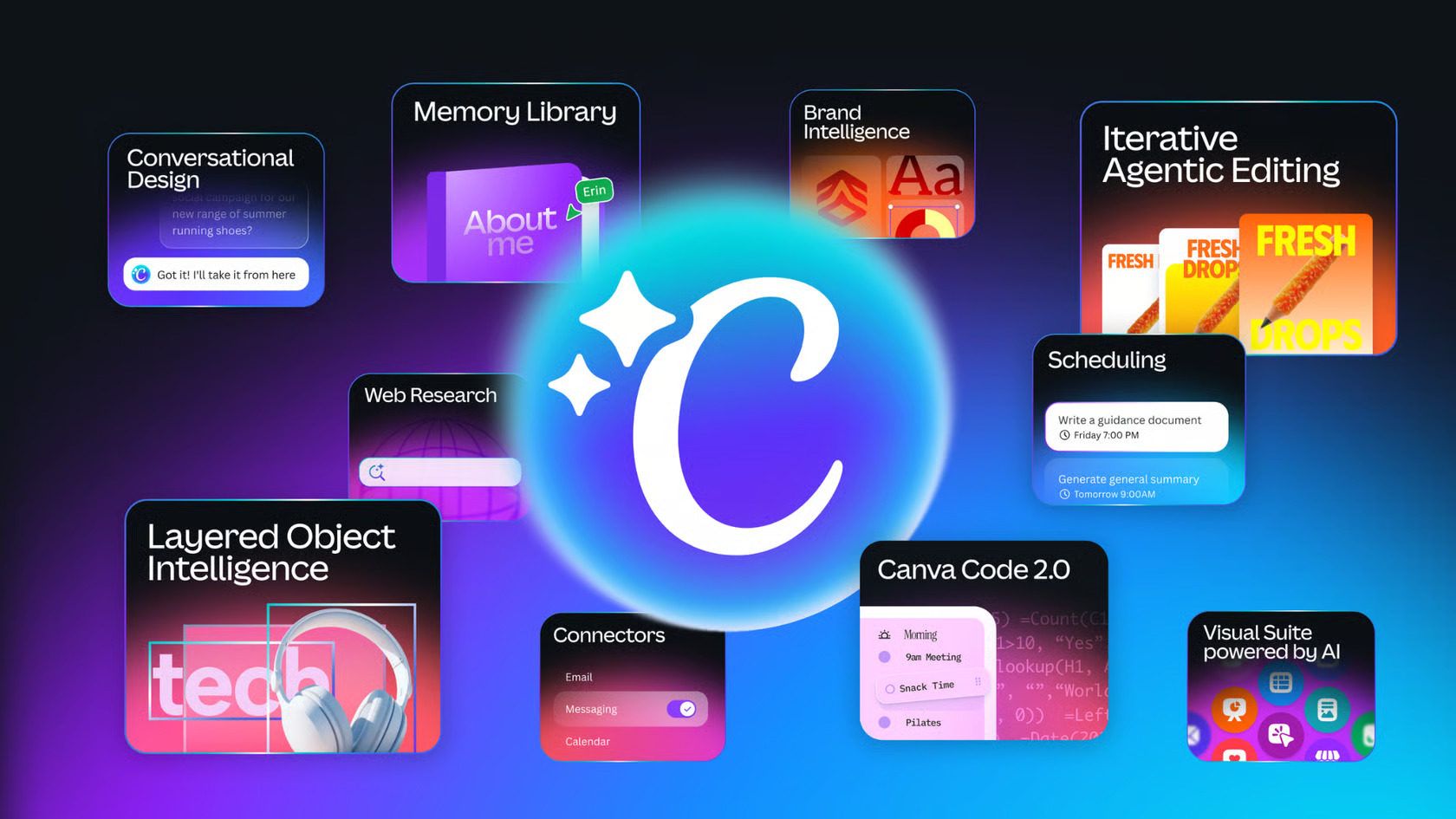
Key capabilities include conversational design, enabling users to create content from natural language prompts; agentic orchestration, allowing AI to coordinate multiple tools and execute complex tasks in a single workflow; object-based editing for precise adjustments; and “living memory,” which learns user preferences and applies brand consistency automatically.
“These capabilities allow Canva AI to stay present throughout the entire creative process, rather than producing a single output and stopping there,” the company said.
Beyond design, Canva is also expanding into workflow automation. New features include AI-generated spreadsheets, automated scheduling, built-in web research and integrations with enterprise tools such as Slack, Gmail, Google Drive, Notion and Zoom.
The goal, Canva said, is to bring “everything together in one place,” enabling users to generate outputs ranging from marketing campaigns to internal reports without switching platforms.
Canva AI 2.0 will initially launch as a research preview, available to the first one million users, before expanding globally in phases.
The release follows a multi-year effort to rebuild Canva’s underlying infrastructure, reflecting the scale of the shift toward AI-driven workflows.
Industry analysts say the move places Canva in more direct competition with major technology platforms such as Google and Microsoft, particularly in enterprise and productivity software.
Canva’s expansion in the UAE and wider Middle East comes amid intensifying competition among global technology companies to localize AI services for the region.
MAJOR AI AND TECH PRODUCT LAUNCHES IN MENA (2023–2026)
2023 — Microsoft x G42 collaboration expands
Microsoft deepens AI partnerships in the UAE, laying groundwork for cloud and AI infrastructure tailored to regional governments and enterprises.
2024 — Google expands Gemini integration globally, including MENA
Gemini replaces Bard and rolls out across Search, Android and Workspace, with Arabic language support improving access across the region.
2024 — Amazon introduces generative AI services in AWS Middle East regions
AWS expands Bedrock and AI tooling availability to Gulf data centers, enabling regional enterprises to build localized AI applications.
2025 — Google launches AI-powered Search features in MENA
New generative search experiences and AI summaries roll out across the region, including Arabic-language enhancements for local users.
2025 — Microsoft invests $1.5 billion in G42 (UAE)
The deal accelerates sovereign AI infrastructure and positions the UAE as a central hub for enterprise AI deployment in the region.
Late 2025 — Google rolls out Gemini upgrades with deeper regional integration
Advanced Gemini models expand into enterprise and productivity tools, with improved Arabic capabilities and regional deployment.
2026 — Google launches Gemini “Personal Intelligence” in the Arab world
The update introduces cross-app personalization across services such as Gmail and Photos, tailored for regional users.