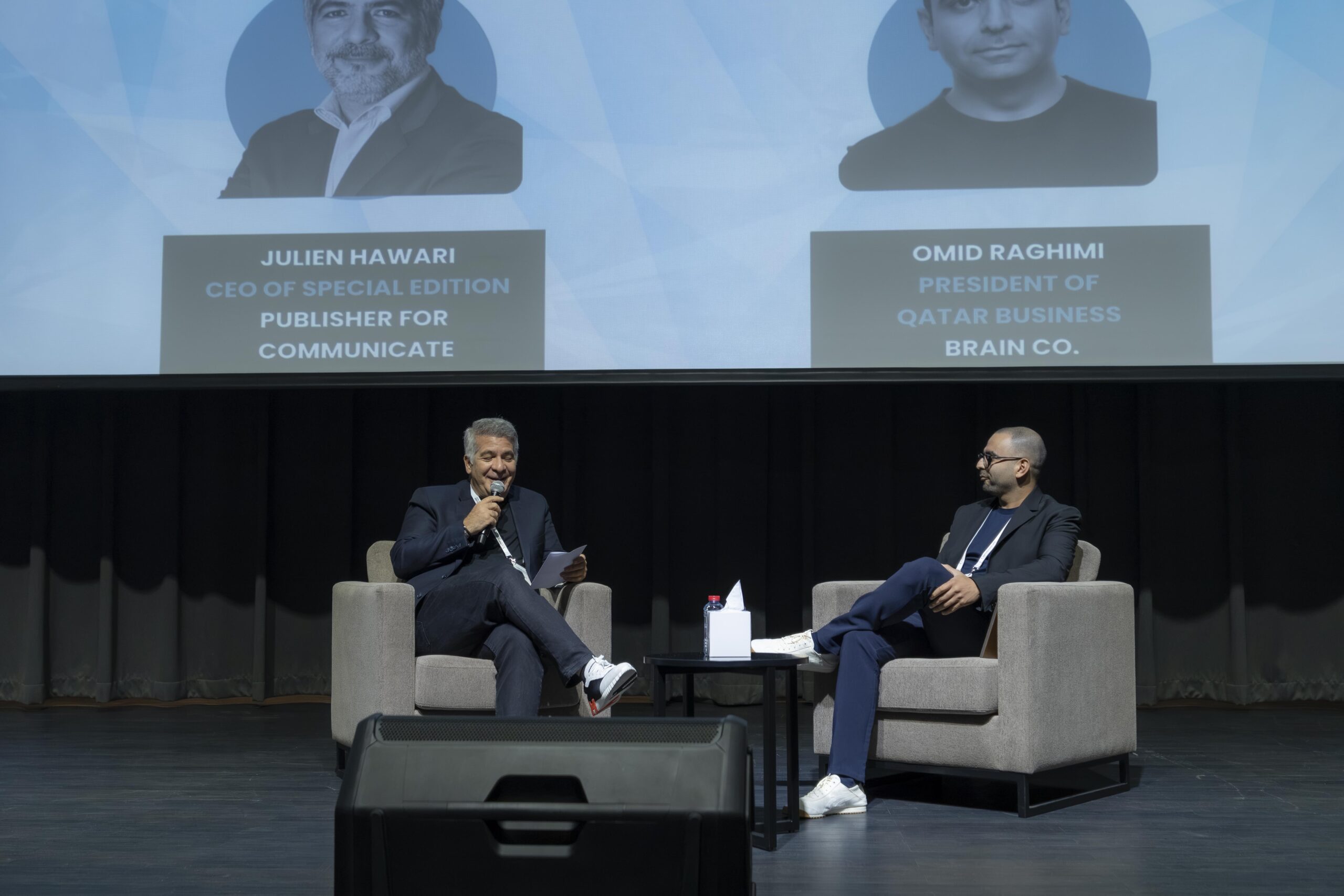
Businesses risk wasting their investment in artificial intelligence when they focus on deploying chatbots and AI agents instead of identifying the problems they need to solve, Omid Raghimi, who leads Brain Co’s business initiative in Qatar, said at the Communicate AI event in Dubai on September 29.
In a fireside chat with Julien Hawari, editor-in-chief of CommunicateOnline and TRENDS MENA, Raghimi argued that effective AI implementation begins with understanding how an organisation works, identifying bottlenecks and redesigning processes to deliver measurable results.
“The disaster comes in normally for our projects when they get fixated on the idea and we go in and they want a chatbot and we don’t know how,” he said. “Sometimes we are struggling to say, look, chatbot is not solving the problem, it’s just answering you.”
Raghimi, a former head of cyber practice and Qatar business at Palantir, leads Brain Co’s work on building AI systems for large organisations and governments. The company focuses on sectors including energy, healthcare, government, insurance and financial services, developing customised products around specific operational needs.
“We are very focused on a specific gap that was found in the industry, which is actually how you can turn AI applications to have impact right away,” he said.
The distinction, Raghimi suggested, is between adopting AI as a technology and using it to change how work gets done. Rather than simply adding another application to an organisation’s existing systems, Brain Co works with its teams to examine the entire process and determine where automation, machine learning or large language models can make a difference.
Hawari pressed him on whether organisations in the Middle East were prepared to make the changes required, particularly when established processes and multiple layers of management can complicate implementation.
Raghimi said the challenge was often contractual rather than technological. Brain Co typically deploys a team for a week or two to work with an organisation, its consultants or internal staff to examine the process and identify opportunities for improvement.
But winning approval from senior management alone is not enough, he said. Employees who understand the day-to-day workings of a process must also be involved.
“If we get the buy-in from the top, the people in the middle are not happy, then they won’t explain the process,” Raghimi said, adding that successful implementation requires action “from both top down and operational level”.
Employees at the operational level often possess the detailed knowledge needed to understand how tasks are performed, where delays occur and which steps can be eliminated or automated. Without their cooperation, even a project backed by senior leadership may fail to address the underlying problem.
The challenge becomes more complicated when organisations already use several applications to perform different parts of the same task. Raghimi said some processes involved six to 10 applications, making it necessary to assess the overall workflow rather than introduce another standalone tool.
To overcome resistance and uncertainty, Brain Co uses rapid prototyping to demonstrate what a redesigned process might look like in practice. Its teams develop working prototypes, gather feedback and refine the product through repeated iterations.
“We build it very quick, very small portion to give them a taste and then get their feedback, adjust, go back again,” he said.
The approach is intended to help organisations understand the potential benefits before committing to a larger deployment, while allowing developers to identify problems early and adapt the solution to operational realities.
Healthcare offers a wider measure of AI impact
Raghimi also highlighted healthcare as an example of how AI can deliver benefits beyond a company’s financial performance.
He described the process involved when patients require specialised treatment abroad through arrangements between governments and healthcare providers. Such cases can involve extensive reviews of medical records, treatment assessments, budgeting, appointment scheduling and travel coordination.
A patient with a lengthy medical history, for instance, may require doctors to review years of records before the case can proceed to the next stage. The administrative burden can consume substantial medical time and delay the process.
Brain Co’s approach is to map the entire journey, identify gaps and automate the steps where appropriate, creating a smoother experience for patients while reducing the workload associated with coordinating care.
“The impact is where it comes in,” Raghimi said, describing the goal as making the process more seamless rather than automating an isolated task.
The example illustrated a broader point in the conversation: AI’s value should be assessed by the outcome it enables, not simply by the presence of an AI-powered interface or the number of automated agents deployed.
Why more AI does not always mean better AI
Asked about the pitfalls organisations in the region should watch for, Raghimi recalled projects in which clients arrived with a predetermined idea of what they wanted to build.
In one government-related project, the immediate demand was for an agent-based workflow or a chatbot that could interact with customers or an organisation’s systems. In another case, involving a private holding company, the initial expectation was to deploy 300 agents to perform a range of activities.
Closer examination showed that the proposed scale of deployment was unnecessary.
“When we started digging into their environment, we were saying that it doesn’t need agent, you just need automated answers and it doesn’t need even AI,” Raghimi said.
Some tasks could be handled through conventional automation, with machine learning or large language models used only where they offered a clear advantage.
For organisations, the lesson is to resist the temptation to adopt the most elaborate or fashionable AI solution before establishing what the process actually requires. A simpler intervention may deliver the desired result without the cost and complexity of a large-scale agent deployment.
The discussion echoed the central question of Communicate AI’s third edition, held under the theme The Age of Abundance: when AI makes content and capabilities increasingly accessible, what creates real value?
For Raghimi, the answer lies in applying technology to the right problem. Successful deployment depends on understanding organisational needs, bringing decision-makers and operational teams together, testing solutions quickly and remaining willing to challenge the assumption that every problem requires AI.
As businesses across the Middle East move from experimentation towards implementation, the priority, his examples suggested, should be measurable impact rather than the number of AI tools they can put into operation.