
The World Economic Forum’s Travel & Tourism Development Index (TTDI) 2026 lands at an awkward moment for the region: the same report that ranks the UAE, Saudi Arabia and Qatar among the world’s fastest-moving tourism economies also singles out the conflict-driven disruption to Middle East aviation as the year’s starkest reminder of how exposed the sector remains — a tension GCC destination marketers will need to navigate carefully in how they position the region next.
Released this September with Zurich Insurance Group, the index places the UAE 22nd globally out of 110 economies, the highest-ranked destination in the GCC, with a score of 4.56 — though it slipped three places since 2024 even as its underlying score improved 0.5%, a sign that regional competitors are closing the gap. Saudi Arabia climbed three places to 29th on a 3.4% score gain, while Qatar was the bloc’s standout riser, jumping ten places to 47th on the back of a 6.0% score improvement — one of the sharpest gains among the report’s 110 ranked economies. Oman rose to 62nd, while Bahrain (55th) and Kuwait (88th) both slipped slightly despite improving scores.
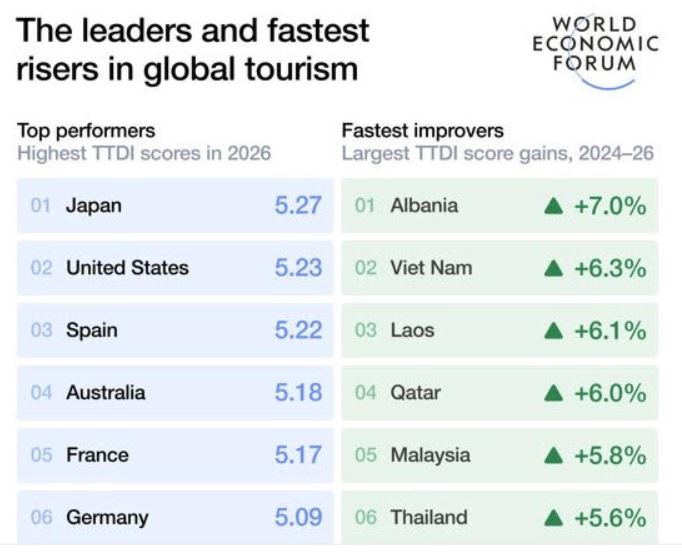
Regionally, the report notes that “the Middle East performs particularly well on Air Transport Infrastructure and ICT Readiness” — a validation of the aviation-hub and smart-destination strategies Gulf carriers and tourism boards have spent years building their brand campaigns around.
But the report’s foreword, co-authored by WEF Managing Director Kiva Allgood and Zurich’s Cara Morton, opens with a direct warning about the region’s fragility rather than its momentum: “Disruptions in the Middle East and North Africa (MENA) region closed a critical aviation corridor linking Europe, Asia, Australia and Africa, disrupting schedules, capacity, fares and traveller confidence.” The data behind that line is stark — in April 2026, traffic carried by Middle Eastern carriers “contracted by 46.6% year on year, dragging global air traffic down by 3.4%,” the first such global contraction since the pandemic recovery. Tellingly, the report notes that international arrivals grew “in every region except the Middle East” in early 2026, even as the rest of the world kept climbing.
For GCC marketers, the more useful chapter may be the one on positioning rather than crisis. The WEF’s “Compete on value, not price” section argues that with affordability sliding as a competitive edge worldwide, “what matters is not whether a destination is expensive or affordable, but whether travellers feel the experience and service justify the cost” — a thesis that maps closely onto Dubai, Abu Dhabi and Riyadh’s push toward premium, experience-led branding over volume tourism. The report adds that “reputation and brand remain central to this effort,” and that value “is shaped not only by the visitor experience itself but also by confidence that destinations can maintain” the qualities that make them attractive.
Saudi Arabia earns its own case study for workforce marketing rather than destination marketing: the report credits the Ministry of Tourism’s Human Capability Development Program, under Vision 2030, with pushing tourism employment to “nearly 1.03 million jobs in 2025,” with Saudi women now accounting for “approximately 47% of Saudi employees in tourism roles, up from 5% in 2018” — a statistic increasingly central to the Kingdom’s own brand narrative abroad.
The report’s broader message to the industry, GCC included, is that growth alone no longer tells the story: “growth is no longer the challenge. Managing it… is the opportunity.” For a region investing heavily in giga-projects and global visibility, the TTDI 2026 suggests the next competitive battle will be fought less on arrivals numbers and more on how credibly destinations can communicate resilience, value and substance behind the campaign.