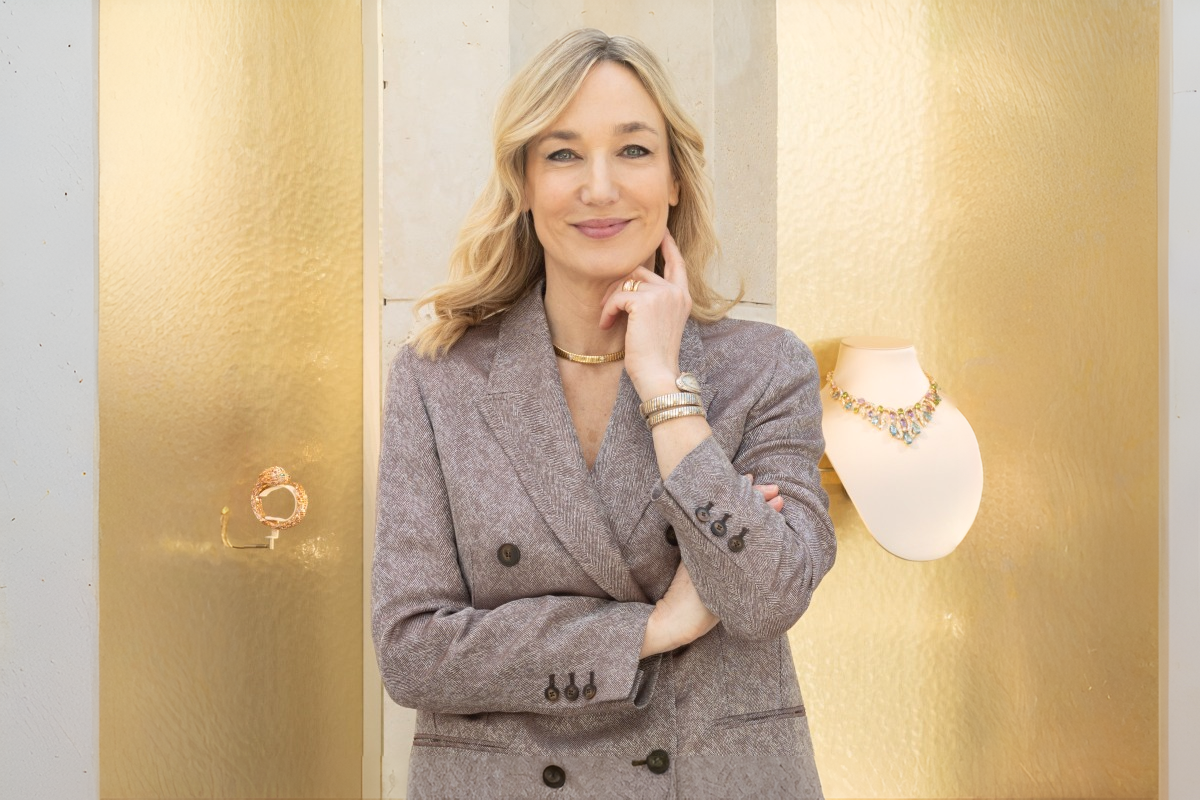
Bvlgari’s new chief executive Laura Burdese is betting on consistency rather than constant novelty as the Italian jeweller and watchmaker seeks to sustain growth in a luxury market that has become increasingly challenging.
In an interview with the Financial Times (FT), Burdese, who became CEO in July after serving as the maison’s deputy CEO for two years, said Bvlgari’s strategy would remain firmly anchored in its established product codes and iconic collections.
“We don’t have this anxiety to keep on launching things,” Burdese told the FT. “We have a solid healthy growth with our icons, and then we add a little bit of sparkle to make it a bit more vibrant.”
The approach comes as luxury brands contend with a post-Covid slowdown and changing consumer behaviour. Burdese believes that excessive product launches can leave consumers unclear about what individual maisons actually stand for.
“One of the reasons luxury has been a little bit weaker [in recent years] is that customers were confused about what brands stand for,” she said.
For Bvlgari, the answer is to strengthen recognition of its distinctive design codes rather than continually reinvent the brand.
“We have to be in the zeitgeist, but being very clear in the intention helps customers to get familiarity with the maison, to recognise the codes, to say, ‘Oh, but this is so Bvlgari.’”
Jewellery drives momentum
Burdese’s comments come at a particularly important moment for Bvlgari and the wider luxury industry, with jewellery currently outperforming watches across several major luxury groups.
According to the FT, LVMH reported 2% organic revenue growth for the first half of 2026, while its watches and jewellery division grew 9% to €5.2bn. LVMH said Bvlgari’s performance was supported by its iconic lines, while its Eclettica collection of high jewellery and watches generated record-breaking revenue.
Burdese said demand for some of Bvlgari’s established jewellery lines is currently exceeding production.
“We are out of stock everywhere in the world with Serpenti Tubogas and with Serpenti Seduttori,” she said.
The brand has been expanding its production capabilities, including through the opening of an enlarged 33,000 sq m jewellery factory in Valenza, Italy, which is expected to double its capacity by 2029.
Burdese sees the current strength of jewellery as more than a temporary market shift.
“Across the board, our performance is quite positive, driven by a bright moment in jewellery — and I’m super happy about that because it really deserves to be at this level,” she told the FT.
“Jewellery has this dual role as emotional investment and a financial one. [The market for jewellery] is very dynamic: it’s stylish, it’s competitive, it’s vibrant.”
Why the Middle East matters
Burdese’s strategy has particular resonance for the Middle East, where established luxury maisons and recognisable product icons remain central to high-end consumption.
The emphasis on jewellery also aligns with a market in which high jewellery, watches and luxury accessories occupy an important position within the region’s broader luxury ecosystem. Rather than relying solely on a constant stream of newness, Bvlgari’s strategy suggests that strengthening the desirability and scarcity of established icons could be an equally powerful growth lever.
That philosophy is already visible in the brand’s approach to watches. At Geneva Watch Days 2026, Bvlgari is presenting a series of titanium models, including the Octo Finissimo Dazzle and Bvlgari Titanio chronograph and GMT, alongside limited-edition Octo Finissimo Dual Time watches created with independent watchmaker Vianney Halter.
While titanium has become increasingly fashionable among watch brands, Burdese said Bvlgari’s use of the material is rooted in its own history. The maison introduced the Diagono Titanium in 2005.
Women’s watches offer another growth engine
Burdese also believes Bvlgari has an advantage in watches because of its long-standing strength in the female segment.
She said as much as 80% of Bvlgari’s watch offering consists of jewellery watches for women.
“[Other brands are] all jumping into this segment because it is the one that is growing the most, but we have been there since always, so we are really benefiting from this over-proportional growth of the female segment,” she said.
That positioning could be particularly significant in the Middle East, where jewellery watches can sit at the intersection of fine jewellery, watchmaking and personal luxury.
Expanding Bvlgari’s American footprint
Beyond products, Burdese is also overseeing an expansion of Bvlgari’s retail footprint, particularly in North America.
“We are experiencing a phenomenal growth — Americans love Bvlgari,” she said, adding that the brand historically had a smaller retail footprint in the US than some competitors.
Bvlgari currently has 59 stores in the US, with its first San Diego boutique opening in July. A Palm Beach, Florida, boutique is expected to follow by early November.
The expansion reflects a broader strategy of investing in physical retail while strengthening the Bvlgari universe around its most recognisable categories.
No revolution under the new CEO
Despite taking over as CEO in July, Burdese says consumers should not expect a dramatic change in direction.
“There won’t be a revolution at all,” she told FT. “We will keep on being very much grounded in the mission: creating this beautiful Bvlgari universe that people want to be part of.”
Her approach also extends to how the brand uses technology and artificial intelligence.
Burdese believes AI can provide companies with enormous quantities of information, but that the final creative decisions must remain human.
“Now, with AI, we have a generative portal that can give us all the information — even too much — but all the data doesn’t tell you what to do,” she said.
“The creative decisions are very much human-led and instinct-led. You have to connect the dots; you have to see possibilities and links where machines don’t see them yet.”
For Bvlgari, that philosophy ultimately comes down to emotion rather than algorithms.
“We have to keep on being profoundly human-centric, and speaking the language of emotion — especially in this world that looks like it’s led by algorithms,” Burdese said. “When you lead a company, you need to take risks.”