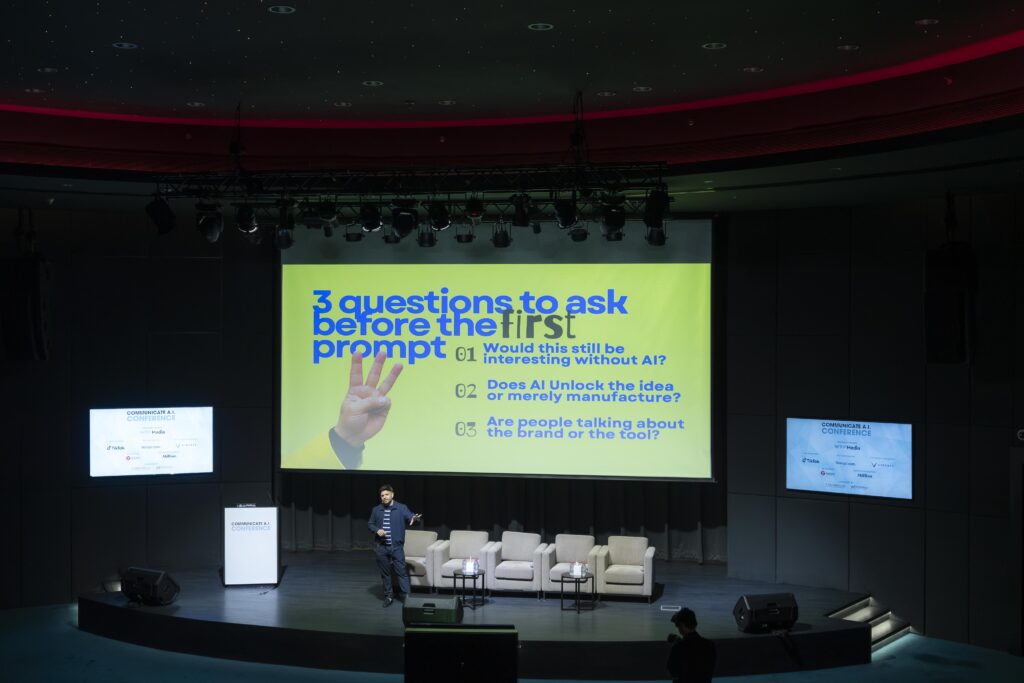
Artificial intelligence is moving rapidly from an experimental technology to an everyday tool in the Gulf’s advertising industry. In Saudi Arabia and the UAE, agencies and brands are using AI to generate content, analyse audiences, optimise media, personalise campaigns and accelerate production. Yet the region’s advertising industry is discovering an important distinction: adopting AI is easy; turning it into sustainable marketing performance is considerably harder.
The timing is significant. MENA’s digital advertising market reached $8.185 billion in 2025, up 17.8% year on year, according to IAB MENA. The region was the fastest-growing digital advertising market globally and remained among the top five EMEA markets by advertising spend. Saudi Arabia has been particularly important to this expansion: IAB MENA’s 2024 study recorded 23.5% growth in KSA digital advertising, ahead of regional growth.
That expanding digital ecosystem provides fertile ground for AI. But the most revealing picture comes from the advertising industry itself.
A 2025 study by Ipsos and the Advertising Business Group (ABG), based on more than 100 marketing and advertising professionals across the UAE and Saudi Arabia, found that 96% had used AI tools. However, only 26% were using them regularly. Meanwhile, 73% of companies were integrating AI, but primarily for content creation rather than strategic planning.
The numbers expose the GCC advertising industry’s AI paradox: experimentation is widespread, but deep integration is still in its early stages.
From copy generation to campaign intelligence
The first wave of AI adoption in advertising has largely focused on productivity. Generative AI can produce multiple copy variations, translate material, create images, summarise research and generate campaign concepts in minutes rather than hours.
For agencies operating across multilingual Gulf markets, this can be particularly valuable. A campaign may need to work simultaneously in English and Arabic, while also being adapted to different cultural contexts and consumer segments. AI can accelerate that versioning process, allowing creative teams to test more possibilities before committing significant production resources.
But the bigger opportunity lies beyond content production.
AI is increasingly being used to analyse consumer behaviour, identify audiences, optimise bids and predict which messages are likely to perform. Google, for example, has expanded AI-powered advertising tools that automatically identify valuable audiences and optimise campaigns towards business outcomes. Its own case study of a Saudi company using value-based bidding reported a 96% increase in return on advertising spend in just over a month.
This points towards a fundamental shift in the role of the media planner. Instead of simply deciding where advertising should appear, AI increasingly determines which audiences, messages, placements and moments deserve investment.
Saudi Arabia is becoming an AI advertising laboratory
Saudi Arabia’s wider AI transformation is helping accelerate this shift.
According to PwC’s 2025 Saudi Arabia CEO survey, 81% of Saudi CEOs said they had adopted generative AI during the previous 12 months. Two-thirds reported that GenAI had increased profitability, while an equal proportion said it had increased revenue. 57% said they trusted AI to be embedded in key business processes to a large or very large extent, compared with 47% among regional peers and 33% globally.
PwC’s latest 2026 assessment suggests Saudi Arabia is now moving from AI adoption towards AI maturity. The Kingdom ranks fifth globally and first in the region for AI sector growth under the 2025 Global AI Index, while organisations are increasingly embedding AI into operations, customer experience and decision-making.
For advertisers, this matters because the marketing function does not operate in isolation. As retailers, banks, airlines, entertainment companies and technology businesses become more AI-driven, agencies are being pushed to integrate AI into the entire customer journey rather than simply use it as a creative-production tool.
The human problem
Yet AI’s expansion comes with a warning.
The Ipsos-ABG study found that 70% of advertising and marketing professionals were concerned about overreliance on AI without human oversight, while 63% expressed concerns about bias and discrimination. Only 35% received regular AI training, with much of that training concentrated among marketing and content teams.
This is particularly important in the GCC, where cultural nuance can determine whether a campaign succeeds or fails. An AI-generated advertisement may be grammatically correct in Arabic but still miss local idioms, cultural references or sensitivities.
There is also a growing concern that if brands use AI to generate and optimise everything, advertising could become more efficient but less distinctive.
Ipsos’ global research on AI and advertising makes precisely this point. Its analysis of 18,000 advertisements warns that an advertising ecosystem in which machines continuously create, version and measure advertising could become highly efficient while losing the human creativity and audience response necessary to build brands.
That makes human judgement more valuable, not less.
The next battleground: AI-native advertising
The GCC is therefore entering a second phase of AI adoption. The question is no longer whether agencies and brands will use AI. It is how deeply they will redesign their organisations around it.
McKinsey’s research on AI adoption across GCC countries notes that governments and businesses are investing heavily in the infrastructure needed to scale AI, while companies still have significant room to improve adoption and convert it into value.
At the consumer level, the transformation is already visible. A 2026 Ipsos study found that AI has become an everyday tool for GCC users, with 47% using it for learning, 43% for work-related tasks and 42% for personal branding. Four in five users were also open to paying for advanced AI services.
For advertisers, this means the audience itself is becoming AI-native.
The winners in GCC advertising will therefore not necessarily be the brands producing the most AI-generated content. They will be the ones that use AI to understand consumers faster, personalise experiences intelligently and make better decisions — while preserving the human creativity, cultural understanding and emotional intelligence that make advertising memorable.
In the Gulf’s rapidly expanding digital economy, AI may become the industry’s most powerful engine. But the steering wheel is likely to remain human.