Artificial intelligence has become virtually inseparable from modern marketing, with 97% of marketing leaders now using AI in their daily creative work and 99% planning to increase AI investment in 2026. Yet as AI becomes embedded in advertising workflows, marketers face a new hurdle: convincing consumers that AI-generated advertising can still feel authentic and emotionally engaging.
Those are among the key findings of Canva’s third annual State of Marketing & AI Report, conducted in partnership with The Harris Poll. The global survey covered 1,415 marketing leaders at organisations with more than 500 employees and 3,547 consumers across the United States, the United Kingdom, Australia, France, Germany, Japan and India.
“AI is now standard in marketing,” the report says, adding that “the era of experimentation is over.” It argues that the more pressing question is “whether it’s working.”
AI goes mainstream
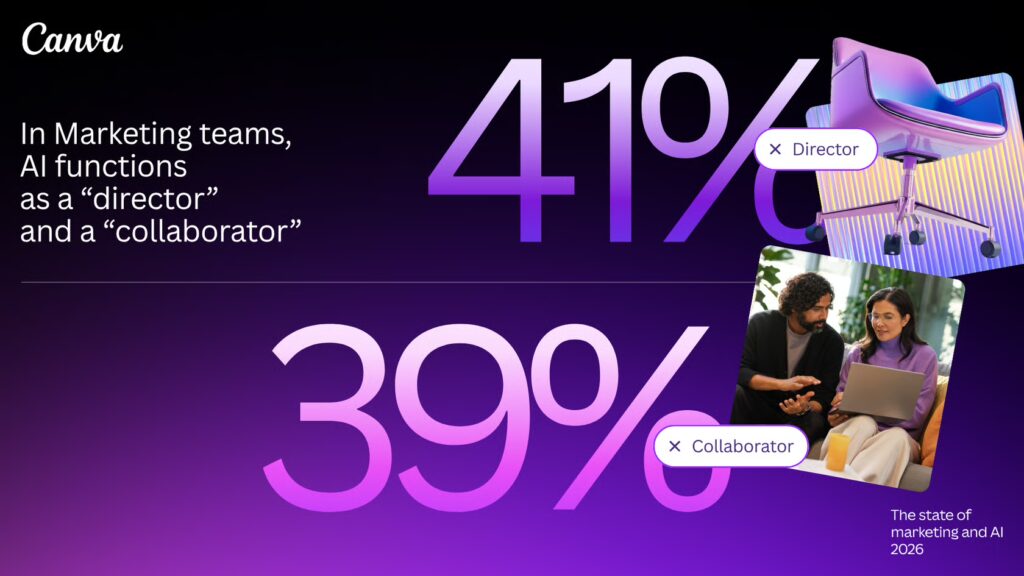
According to the study, AI has evolved far beyond a productivity tool. “What started as a promising add-on is now embedded in how campaigns are built, content is produced, and creative work gets done,” the report says. Among marketing leaders, 41% describe AI as functioning like a “director” on their team, while another 39% see it as more of a “collaborator.”
The technology is also reshaping the role of marketing within organisations. Canva found that 68% of marketing leaders say AI has increased the number of business decisions influenced by marketing, while virtually all respondents intend to raise AI spending this year.
However, the report warns that speed alone is not improving creativity. “Greater volume, however, does not always translate to stronger creative. As AI makes content production faster and cheaper, concerns about quality are growing alongside it,” it says. Canva notes that mentions of “AI slop” have increased ninefold in media monitoring data, while 41% of marketing leaders believe it is becoming a genuine problem.
Trust gap widens
Consumers, meanwhile, appear far less enthusiastic than marketers. Although 68% say they do not mind AI-generated advertising if it makes ads more helpful or relevant, 78% would still rather see advertisements created by people, even if AI could produce technically better results. An overwhelming 87% believe the best advertising still requires a human touch.
The report says consumers often respond more to emotional authenticity than to the technology itself. “Seventy percent say they can usually spot AI-generated ads because they feel like something is missing,” the study found. “That points to a meaningful insight: consumers are often reacting less to how content was made and more to how it makes them feel.”
The research also highlights growing discomfort with AI-powered personalisation. More than half of consumers, or 52%, say it feels invasive when an advertisement appears to know what they are about to buy before they have searched for it, while 58% say they do not want brands using AI to predict their needs.
Younger consumers show a somewhat different attitude. Among Gen Z and Millennials, 70% say they pay more attention to the “vibe” of an advertisement than how it was produced, while 69% are comfortable with AI involvement provided real people are featured.
Human edge endures
Marketing leaders themselves acknowledge that AI has limits. Asked what the technology will never fully replicate, 42% cited empathy and emotional intelligence, while 41% pointed to the human imperfections that inspire originality. Another 41% said brand intuition and creative judgement would remain uniquely human.
Reflecting that belief, three-quarters of marketing leaders expect creative roles to expand over the next five years, with greater emphasis on imagination, direction and judgement. As the report puts it, “the center of gravity for marketing work shifts toward the distinctly human.”
The study also suggests that transparency could become a major competitive advantage. Seventy percent of consumers believe it will eventually be impossible to distinguish AI-generated advertisements without disclosure, and 56% expect that to happen within two to five years.
Rather than rejecting AI altogether, consumers are asking for clearer safeguards. “Consumers aren’t rejecting AI outright. But they want transparency, disclosure, and control – and that’s becoming the new competitive frontier,” the report says.
Nearly three-quarters of respondents, or 74%, say they would feel more comfortable with AI in advertising if companies had formal policies governing its use. Four in five consumers want greater control over how personalised advertisements become, describing something like a “privacy slider.” More than half say stronger data protection and clear disclosure of AI use would increase trust, while many also want assurances that AI is not replacing jobs or the option to opt out of AI-generated advertising altogether.
Summing up its findings, Canva argues that the industry’s next challenge is no longer adopting AI but using it more thoughtfully. “The next step isn’t more AI. It’s better AI,” the report says.
While companies that fail to integrate AI into their workflows risk falling behind, Canva says “efficiency alone won’t set brands apart. As AI makes content production easier and more widely available, distinctiveness becomes more important, not less.” The report concludes that “the marketers who succeed will be those who pair the speed of AI with clear creative standards and a genuine understanding of what resonates with their audiences.”