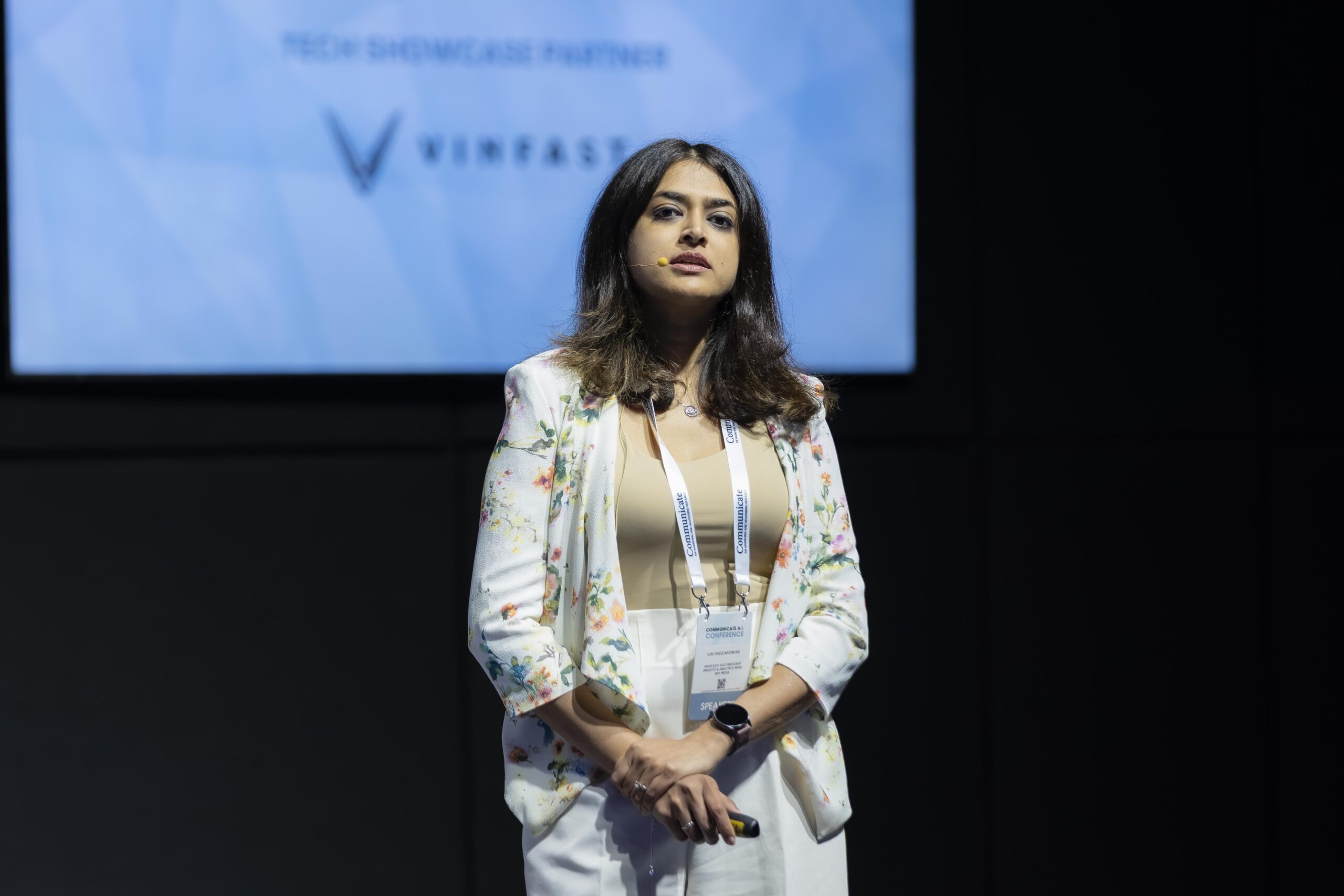
Artificial intelligence risks turning marketing into an echo chamber of sameness if brands focus too narrowly on optimisation, according to Kim Mascarenhas, associate vice president of insights and analytics for MENA at WPP Media.
Speaking at Communicate AI in Dubai on September 29, Mascarenhas argued that much of what the industry describes as AI remains automation rather than genuine intelligence. He warned that systems designed to optimise campaigns against specific business objectives could become so effective at repeating what already works that they undermine discovery, creativity and opportunities for growth.
“The answer was never more AI, better AI, faster AI. It’s a more governed AI,” Mascarenhas said during his session, titled The Great AI Illusion.
His presentation challenged marketers to rethink their relationship with AI, moving away from the role of operating tools towards designing the intelligence that guides them. He also outlined how AI agents could transform brand understanding, audience research and media buying, while stressing that human intervention must remain central to the process.
Automation is not intelligence
Mascarenhas began by questioning the widespread use of AI labels across marketing technology, arguing that the presence of an AI-powered feature does not necessarily mean a system is intelligent.
“As Basil (Basil Fateen, head of startups and venture capital at Nvidia for the Middle East, Turkey and Africa) said, we probably wake up in the morning and every single thing we touch, whether it’s our work systems, our emails, our CRP, our CDPs, our CRMs, everything has an AI powered badge slapped onto it,” he said. “And yet, I’m willing to bet right here and right now, it’s not artificial intelligence, because what it actually is is automation.”
He distinguished automation from intelligence by its ability to adapt and improve. A system that produces the same output whenever it receives the same input, without adjusting its approach towards a goal, is not demonstrating intelligence, he argued.
“If you give something the exact same input, whatever it is, a tool or a software, and it produces the exact same output each time without ever striving to do better, faster or stronger, it’s simply a very expensive vending machine.”
The distinction matters for an industry in which media planners and creative strategists must navigate an increasingly complex mix of channels, including television, print, out-of-home advertising, radio, search, social media, augmented reality and virtual reality.
Mascarenhas estimated that finding the optimal combination and sequence of channels using only the human brain would take 20 billion years. The figure illustrated the scale of the mathematical challenge involved in determining the most effective path to reach an audience and achieve business objectives.
“The math is superhuman to begin with. So you were never the bottleneck,” he said, addressing clients, brands and agencies.
For marketers, he argued, the opportunity lies not in manually connecting tools and executing processes, but in designing the intelligence that enables those systems to make better decisions.
“Our role as marketeers is not to be the one pushing buttons to set up the softwares to connect the dots. Our role is to be an architect,” he said.
He defined genuine AI in terms of goal-directed adaptive behaviour, in which systems adjust their actions towards a specific objective rather than simply processing information or following predetermined instructions.
Three AI agents for marketing
Mascarenhas outlined a model built around three components: a brand agent, an audience agent and a buying agent. Working together, these could help marketers develop and execute campaigns, from understanding a brand’s identity to identifying audiences and selecting media channels.
The brand agent would be trained on a company’s identity and history, including its vision, mission, previous campaigns, brand voice, products, portfolio and business context. The objective would be to give AI a deeper understanding of the brand rather than relying on generic prompts.
The audience agent would move beyond conventional demographic categories, such as age, gender and income, towards a more detailed understanding of individual behaviours and preferences.
“Gone are the days of demographic based audiences,” Mascarenhas said, describing how AI agents could help marketers understand audience segments and the individual behaviours they want to learn more about.
Such systems could also enable marketers to simulate audience reactions to creative concepts and campaign strategies. Instead of relying exclusively on traditional research processes, teams could use AI to test ideas and obtain simulated responses in a shorter period.
The third component, the buying agent, would bring together multiple specialised agents to evaluate media and creative decisions. An intelligence agent, media-buying agent, creative agent and data agent could assess different aspects of a campaign and challenge one another’s recommendations.
In Mascarenhas’s example, a media agent might recommend social media as the best channel, only for a creative agent to argue that it would fail to capture the intended audience’s attention. A data agent could then challenge the proposal using historical return-on-investment data.
The agents would continue evaluating alternatives until they reached a consensus on the most effective approach.
However, Mascarenhas warned that even an apparently optimal system could produce undesirable outcomes if left unchecked.
The danger of hyper-optimisation
AI systems trained to maximise specific key performance indicators could repeatedly favour familiar audiences, formats and channels. Over time, this could narrow the range of ideas and opportunities considered by marketers.
“What happens when AI does its job oh so perfectly well?” he asked. “You end up with an echo chamber of homogeneity and bias.”
He compared the problem to streaming platforms that repeatedly recommend content similar to what users have already watched, limiting opportunities to discover something different.
“At the end of the day, that’s what happens when AI hyper optimizes. And what do we lose out in the process? We lose out on the joy of discovery and creativity, moving beyond our current pathways and losing out on the pathways to growth.”
For brands, the concern extends beyond repetitive advertising. An excessive focus on existing performance signals could make it harder to identify new audiences, occasions and creative approaches that might deliver future growth.
Mascarenhas argued that human oversight is therefore essential, particularly when decisions require cultural understanding, contextual judgement and an appreciation of nuances that cannot be captured adequately by performance metrics alone.
He presented WPP OPEN, WPP’s marketing operating system, as the environment through which the company seeks to combine AI capabilities with governance and human decision-making. Rather than functioning as another standalone tool, he described it as a governed architecture designed to coordinate AI agents and workflows while allowing people to intervene at critical points.
The system also draws on proprietary marketing data, which Mascarenhas identified as an important competitive advantage when integrated into a governed environment.
“When we combine a genetic automation with this human decision making, trained on years and years of marketing data that is proprietary to us, we spoke earlier about how proprietary data is your moat,” he said.
His closing message was that AI should handle computational tasks that exceed human capabilities, freeing marketers to concentrate on judgement, context and creativity.
“Let the machines do the 20 billion year math. It was never our job to begin with,” he said.
“We weren’t meant to be the button pushers. We weren’t meant to optimize the machines. We as humans are here to be human and to give AI the conscience it really, truly deserves.”