From new retail media standards to an influencer guide that looks beyond follower counts, the message at the Marketing + Media Alliance’s NEXT conference at Atlantis, Dubai, was clear: the region’s marketers want evidence, not promises.
If one theme ran through the Marketing + Media Alliance’s (MMA) NEXT conference at Atlantis, Dubai, it was measurement. Across sessions on retail media, influencer marketing and AI, speakers kept returning to the same question: how do marketers prove that what they spend is actually working?
The MMA came with some answers of its own. Linda Kender, the alliance’s MENA Regional Director, said its Retail Media Task Force, founded just two months ago, has identified two needs for the region: a measurement standard agreed by brands, agencies and technology providers, and an education and accreditation programme. Later in the day, Odette Van Wyk, Founder of Brand Scan, who moderated the retail media panel, said the task force would be implementing retail media measurement standards in the region. “Watch this space,” she said.
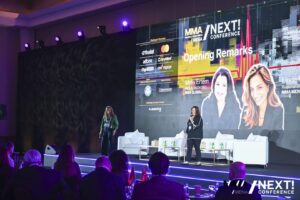
Kender also flagged new research on brand accountability being run with Kantar, and walked through the four committees the MMA runs in the region, covering education, influencer marketing, retail media, and AI and data. “I know we sound like Panadol,” she joked.
Earlier, Melis Ertem, MEA & DACH CEO of the MMA, described an alliance present in 16 countries with more than 800 corporate members. “We don’t talk about opinions, we talk about real facts,” she said.
The whole funnel, not just the bottom of it
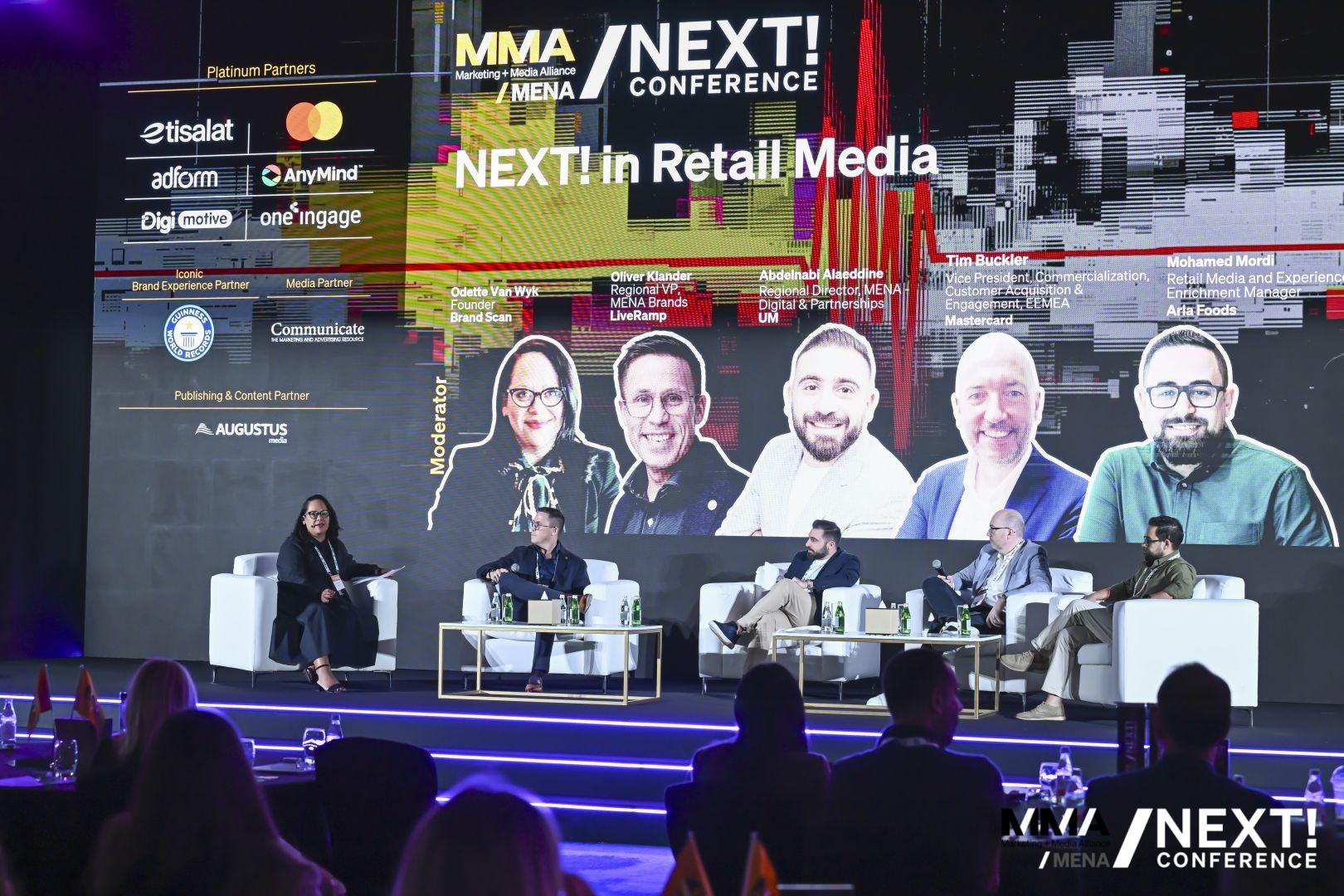
The appetite for proof was sharpest on the retail media panel. Abdelnabi Alaeddine, Regional Director MENA – Digital & Partnerships at UM, said retail media is no longer just a lower-funnel channel. A digital screen in a mall, he explained, might drive awareness, but it might also drive engagement or even conversion.
He recalled years of agency presentations full of personas and high-value audiences that could not actually be reached. “Today we are able to activate these people,” he said, describing a shift to precision at scale. CPG brands that once relied on TV to reach mass audiences can now be far more targeted, and he saw no reason why non-endemic brands should not activate on retail media too.
Van Wyk pointed out that the region’s large conglomerates, operating across multiple retail banners and categories, open the channel to advertisers in financial services, automotive, telecoms, travel and entertainment. Oliver Klander, Regional VP, MENA Brands at LiveRamp, added that these groups have a 360-degree view of the customer, from grocery to leisure.
Tim Buckler, Vice President, Commercialization, Customer Acquisition & Engagement, EEMEA at Mastercard, said the conversation is shifting away from inventory and towards the customer experience. He pointed to data showing that many people spend 15 minutes socialising at a fuel station before driving off, a first point where brands can meet them. For financial institutions, he sees an opportunity to use retail media networks to reach segments such as SMEs, ultra-high-net-worth customers and Emiratis.
But brands are not writing blank cheques. Asked what retailers would need to do for him to invest more, Mohamed Mordi, Retail Media and Experience Enrichment Manager at Arla Foods, kept it short: “Incrementality measurement, in one word.” Arla wants to know whether its retail media spend delivers incremental growth, or whether those sales would have come anyway. More data is not the goal either, he added; what matters is an audience the brand can act on.
Standards are the missing piece. As Van Wyk noted, every retailer has its own reporting methodologies, attribution windows and definitions of success. Alaeddine agreed the industry needs a common framework for what ROAS and ROI mean. Klander, who is part of the MMA’s retail media task force, sees the region’s stage of development as an advantage. “This region has an opportunity to outplay every other region,” he said, because the standards are being discussed now, with everyone at the table.
Beyond the follower count
The same push is reaching influencer marketing. Alongside Kender, Juanes López Bedoya, Account Manager & Creative at InFlow, presented the MMA Influencer Committee’s new guide, which condenses its recommendations into 14 pages covering transparency, consistency and measurement. He noted that creators in the UAE are now licensed, a sign of how far the industry has matured, and that the guide aims to move brands past vanity metrics.
He asked the audience who saves Instagram or TikTok posts. Saves and shares, he argued, are the real measure of relevance: a spike in saves suggests people found something worth coming back to, or a product they want to find in store.
He also made the case for nano creators, who bring relevance, community and authority, along with higher engagement relative to their following. His example was a sports camera launching in Turkey that was given to swimmers, runners and Ironman athletes, so it was seen every Saturday among the runners along the Bosphorus.
Measuring AI, too
Even the AI debate came back to accountability. On the Arabic-first AI panel, Christelle Abou Anny, Head of Content and Marketing at Digital Media Services (DMS), challenged the idea that AI simply saves time. “Have you considered the time put in to improve the output?” she asked, adding that brands should factor this in when measuring how efficient their tools really are.
That evening, the MMA celebrated the ninth edition of its Smarties MENA Awards and the third edition of its Smarties KSA Awards. According to Ertem, the programme looks at how creativity built with technology translates into effectiveness and business results.