Over the past few weeks, something has shifted.
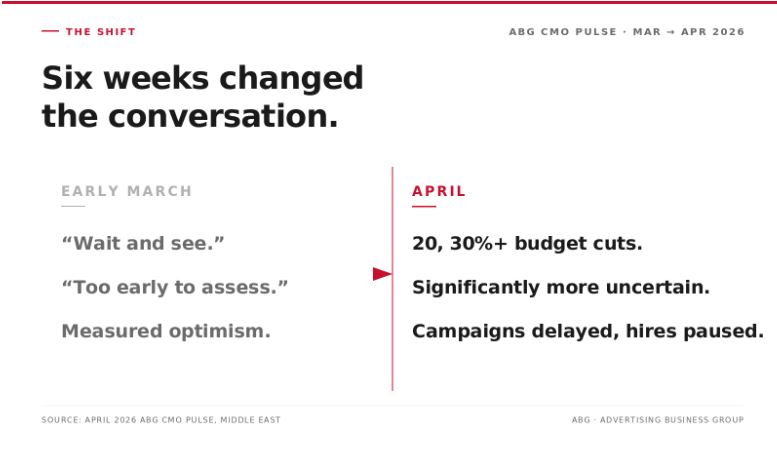
In early March, marketing leaders across the Middle East described a cautious environment. The dominant language was “wait and see,” “too early to assess,” and measured optimism.
Six weeks later, that ambiguity disappeared.
The April follow-up to the ABG CMO Pulse shows a transition from uncertainty to action. Marketing leaders are no longer assessing the environment. They are actively adjusting to it.
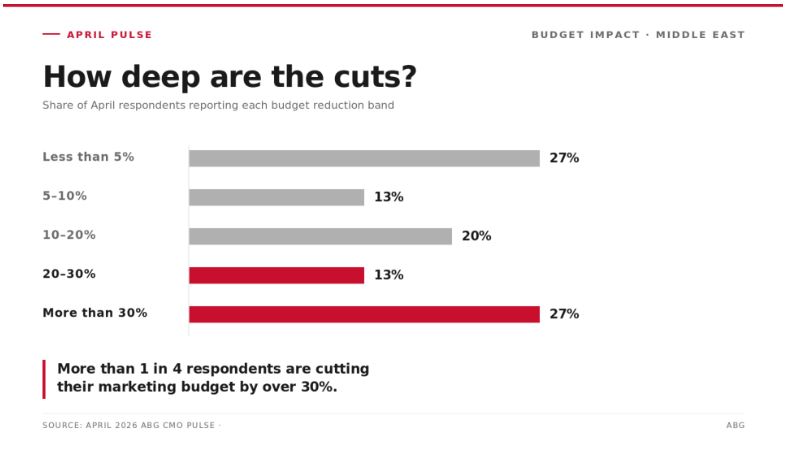
Budget cuts are now explicit and, in many cases, deeper than expected. Where March responses spoke in general terms about “adjustments,” April respondents are naming cuts of 20, 30, and in several cases more than 30 percent. Leaders are delaying campaigns, pausing hires, and rebalancing investment toward measurable performance channels. The window for observation has closed.
The nature of the challenge itself has also evolved.
In March, leaders spoke about increased sensitivity to brand messaging and tone. This was a communications challenge. In April, the dominant signal is different: consumers are becoming more cautious and value-driven. This is no longer about tone. It is about proposition, pricing, and perceived value.
Inside organizations, the pressure is showing up differently.
Between the two waves, one priority rose sharply: internal alignment with CEOs and CFOs. Marketing leaders are being pulled more directly into financial conversations, expected to justify investment decisions with greater precision.
The role of the CMO is evolving. Less a functional leader, more a translator between growth ambition, financial discipline and brand sustainability.
The role of the CMO is evolving. Less a functional leader, more a translator between growth ambition, financial discipline, and brand sustainability.
A quieter but equally important shift is emerging alongside it.
Team dynamics are changing.
Where March responses focused on clarity and faster decision-making, April responses introduce a more human dimension: maintaining morale, managing distributed teams, and supporting people through uncertainty. One respondent summarised the moment in a single line: “Morale, psychological and emotional support and safety.” These are not secondary concerns. They are becoming central to leadership effectiveness.
This is no longer just a question of strategy. It is a question of how teams operate under pressure.
Speed and agility have replaced clarity as the dominant leadership priorities. Decisions are being made faster, often with less certainty. Campaigns are being adapted on shorter cycles. Governance is tightening, particularly around brand safety and risk.
And yet, one tension remains unresolved.
Marketing leaders continue to identify the balance between short-term performance and long-term brand building as the most difficult challenge they face. Budget allocation, meanwhile, is shifting further toward measurable performance channels. Leaders are aware of the long-term implications. But in the current environment, financial pressure is driving more immediate decision-making.
This is not a contradiction. It is the reality of operating under constraint.
AI sits under all of this.
Ambition remains high, with AI-driven capabilities continuing to rank as a top priority. The conversation, though, is evolving. Questions around governance, risk, and control are becoming more prominent. The initial push toward adoption is now meeting a need for discipline.
Taken together, these shifts point to something broader.
This is no longer a marketing adjustment cycle. It is a reflection of wider business pressure moving through the organization, with marketing as one of the first functions where that pressure becomes visible.
The mandate has not changed. Growth, brand, and AI-driven capability remain at the core.
What has changed is how they must now be delivered. Faster, under greater scrutiny, and inside a more constrained operating environment.
This is the context shaping the conversations at the upcoming ABG CMO Forum — not to redefine strategy, but to understand how these decisions are being made in practice, and how leaders are navigating them in real time.
In this environment, competitive advantage is less about strategy than about speed of adaptation.
(The author is the CEO & Executive Director, Advertising Business Group)