Dubai has built its reputation on speed, scale, and making ideas happen. And increasingly, it does AI with a side of pragmatism.
That much was clear at the latest Creative Brunch organized by Dubai Media City, the Middle East’s leading hub dedicated to the media and content creation sector, in collaboration with NordStella. Hosted at in5 Media, TECOM Group’s entrepreneurship incubator focused on the media vertical, and part of the wider in5 platform supporting startups across tech, design, science, and media, the session brought together a hall full of marketers, creatives, and strategists who spent three hours doing what the industry keeps talking about and increasingly putting into practice: building with AI.
The morning session included a hands-on workshop led by Tiago Bastos, Head of Creative at Think Human Creative, and it set the tone quickly. This wasn’t a “here’s what GenAI could do” session. It was “here’s a campaign, now go make one.”
Using tools like Claude, Freepik, and CapCut, participants moved from a blank page to fully formed campaign territories in less than two hours. Concepts, messaging, visuals, even rough-cut assets. Done.
The uncomfortable realization hit fast. The bottleneck is no longer production. It’s judgment. Because if everything can be made quickly, the real question becomes: what should be made?
That question carried neatly into the second session, where Mohamed Hayek, Creative Effectiveness Lead at Kantar Middle East tackled the part the industry often avoids when it gets excited about AI: effectiveness. “How can I ensure that this creative is actually going to work?” he asked. “How do I bring the insight and the signal from the consumer back?”
For years, research has had a reputation problem. Slow. Restrictive. Hayek pushed back hard on that narrative. “Maybe 15 to 20 years ago it was,” he said. “But now things are evolving.”
What he laid out was a version of creative testing that feels less like a checkpoint and more like a co-pilot. LINK AI, trained on millions of real human responses, doesn’t just score ads. It dissects them. It predicts how they will perform on sales and brand equity. And crucially, it tells you what to fix. “It’s not about creative appeal. It’s not about just attention,” he said. “It’s about the impact on the human, and it’s about the impact on your business.”
In an era where AI can generate infinite variations, that ability to evaluate at scale becomes the difference between noise and effectiveness. As Hayek put it, “the amount of creatives you can evaluate within minutes is uncountable.”
That scale unlocks something bigger. Pattern recognition across entire categories. What actually makes a coffee ad work. What signals drive response. And perhaps most importantly, it embeds the consumer back into the process. Not at the end, but throughout. “You can bring that consumer element… within every part of your creative journey,” he said.
If the workshop showed how fast things can be made, and the Kantar session showed how they can be refined, the opening panel pulled things back to reality. Not tools. Not platforms. People.
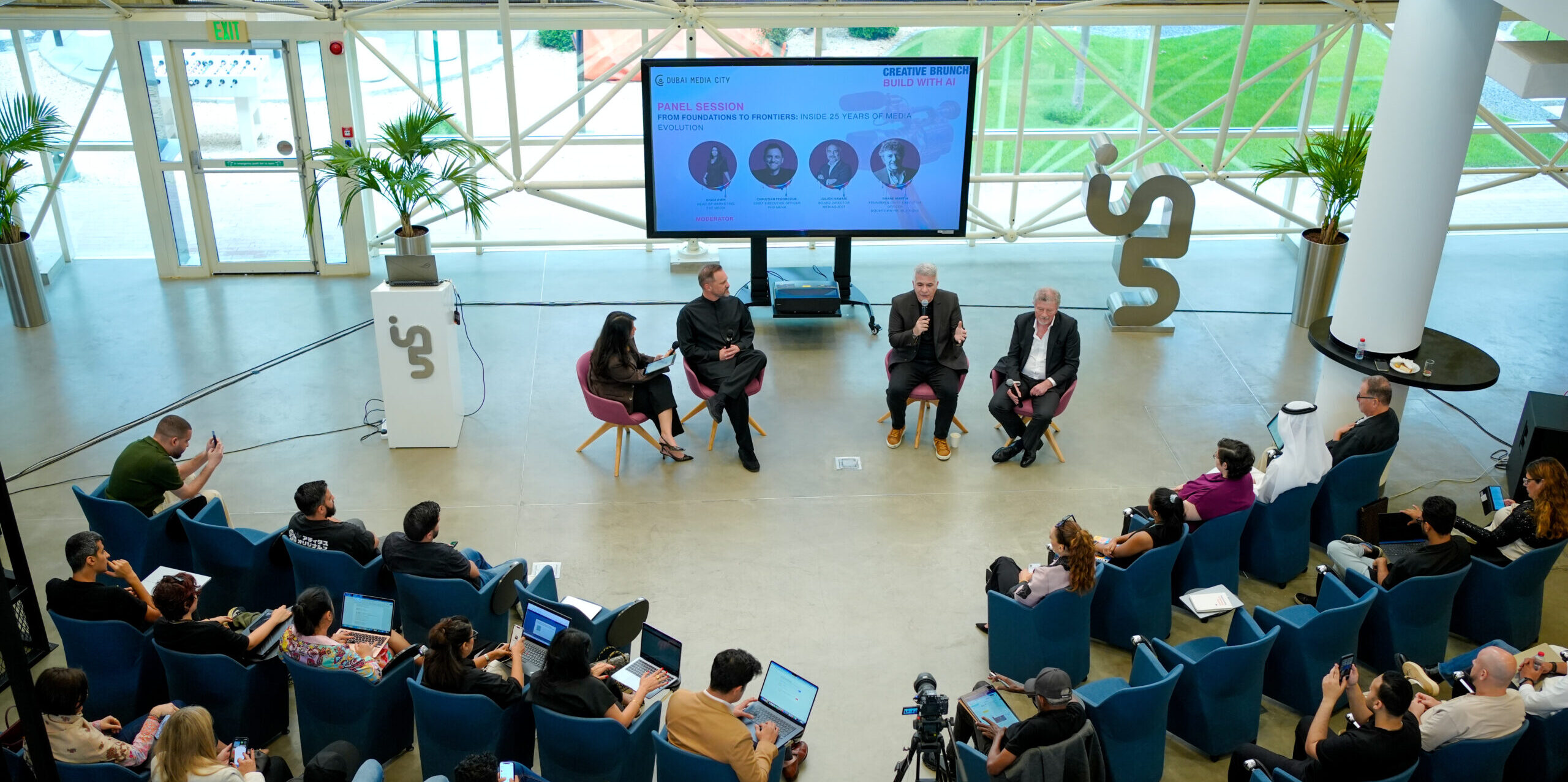
Featuring Julien Hawari, Board Director of Mediaquest, Christian Fedorczuk CEO of PHD MENA, and Shane Martin, Chief Executive Officer and Founder of Boomtown Productions, moderated by Anam Amin, Head of Marketing at TXT Media, the conversation unpacked 25 years of media evolution in the region. Less nostalgia, more reality check.
Because while the industry loves to talk about innovation, the bigger shift has been behavior. Audiences have changed faster than the playbooks built to reach them. Attention is fragmented, consumption is constant, and the fight is no longer just for eyeballs but for actual engagement.
That shift has forced a rethink of how content gets made. The industry moved from big, polished productions to always-on output, chasing scale and speed. Now, there’s a sense it’s recalibrating again. More content does not equal better content. And cutting through takes more than volume.
AI naturally entered the conversation, but not as the headline act. More as the tension running underneath everything. Yes, it unlocks speed. Yes, it enables scale. But it also raises bigger questions around originality, authenticity, and what audiences actually connect with.
The panel underlined something important. In a market like MENA, where speed and agility are already built into the system, the real advantage is not just adopting new tools. It’s knowing when to use them and how.
Because if there’s one thread that ran through the discussion, it’s this: the industry may be evolving at breakneck pace, but the fundamentals have not shifted as much as we think. Good ideas still matter. Human insight still matters. And in a world of infinite content, judgment is becoming the most valuable skill in the room.