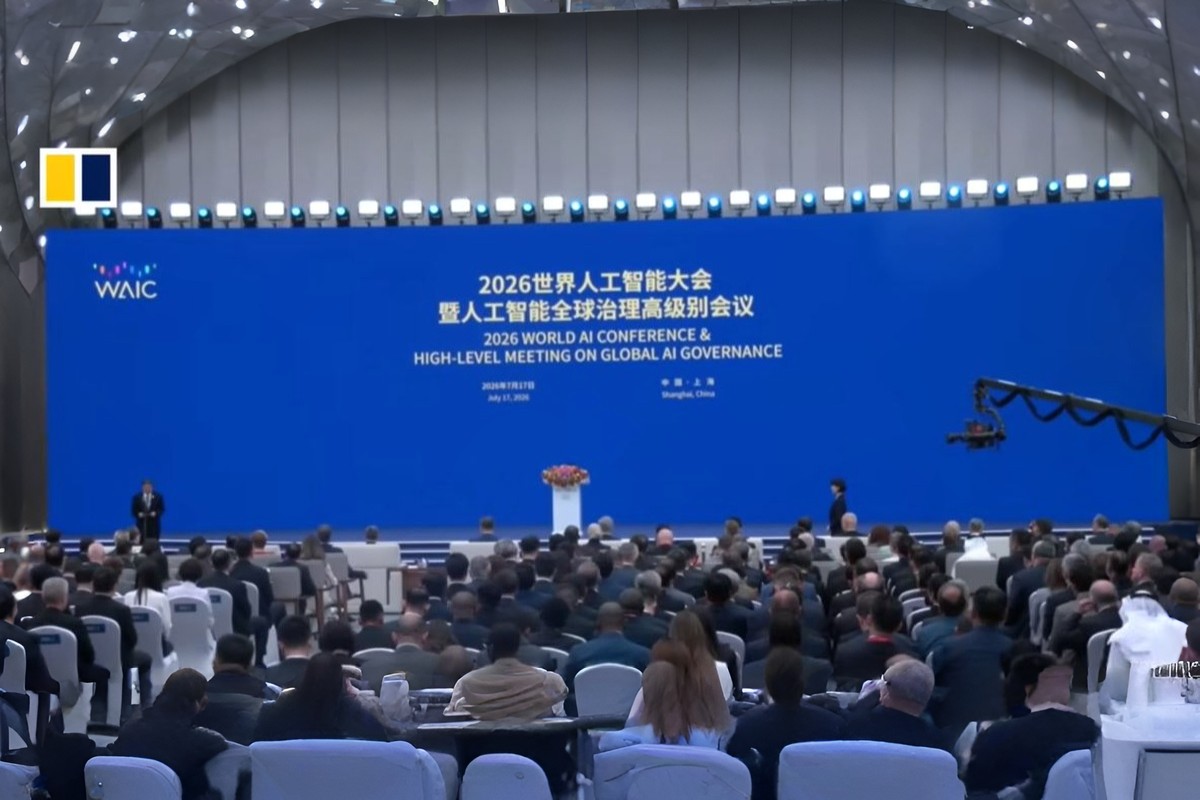
Chinese President Xi Jinping used the World Artificial Intelligence Conference (WAIC) in Shanghai to outline Beijing’s vision for a new global artificial intelligence (AI) order, urging countries to embrace open-source AI, deepen international cooperation and ensure that developing nations are not left behind in the race for advanced technologies.
Addressing the annual AI summit, Xi called on the international community to seize the “historic opportunity” presented by open-source AI, warning that unequal access to digital infrastructure could create “new historical injustices.” He said AI development should be a collective global effort rather than being dominated by a handful of countries.
Global AI governance
Held from July 17 to 20 in Shanghai, WAIC brought together government leaders, technology companies and delegates from more than 100 countries and international organisations to discuss the future of AI development and governance.
The conference also saw the launch of the World Artificial Intelligence Cooperation Organisation (WAICO), a China-backed initiative designed to promote international collaboration, technology sharing and common AI standards. Beijing has positioned the new body as a platform to foster equitable access to AI technologies, particularly for developing countries.
Xi described AI as a transformative technology comparable to the steam engine and electricity, saying China was prepared to share its expertise and technological capabilities with countries across the Global South while helping shape international rules governing AI.
Open-source push
A key theme of the conference was China’s promotion of open-source AI as a global public good. Xi argued that AI development should not become “a solo performance by a single country” but rather a “symphony of international cooperation.”
He also stressed the need for a people-centred approach to AI, saying governments should establish safeguards, regulatory frameworks, monitoring systems and emergency response mechanisms to ensure AI remains under human control.
China announced plans to provide 5,000 AI training opportunities for developing countries over the next five years. It also pledged to establish international AI cooperation centres for organisations including ASEAN, the African Union and BRICS.
Technology showcase
Alongside policy announcements, WAIC showcased China’s rapidly advancing AI ecosystem.
Chinese firms unveiled a range of new technologies spanning large language models, humanoid robots, autonomous mobility systems and smart-city infrastructure.
Among the highlights was Beijing-based startup Moonshot AI’s launch of Kimi K3, which the company describes as one of the world’s largest open AI models. Designed for advanced reasoning, coding and knowledge-intensive applications, the model reflects the rapid progress Chinese companies have made in developing increasingly capable open-weight AI systems.
Industry observers say China’s AI firms are narrowing the gap with leading American developers by releasing powerful models that can be deployed at significantly lower cost.
Growing rivalry
The conference took place against the backdrop of an increasingly intense technological rivalry between China and the United States.
While Washington has promoted its own AI governance framework through the AI Opportunity Statement and tightened controls on advanced AI technologies and semiconductor exports, Beijing has sought to position itself as an advocate of open-source AI and broader technology access.
Chinese officials argue that restrictions imposed by the United States risk creating barriers to global innovation, while portraying China’s AI strategy as a more inclusive model for international cooperation.
Strategic competition
China’s AI ambitions form part of a broader strategy to build a self-reliant technology ecosystem encompassing semiconductor manufacturing, computing infrastructure and AI applications.
Despite continuing restrictions on access to advanced US chips, China has invested heavily in domestic AI capabilities while leveraging advantages in electricity generation and critical mineral production essential for semiconductor manufacturing.
As artificial intelligence becomes central to economic growth, industrial competitiveness and national security, the contrasting approaches unveiled by China and the United States at a time of intensifying geopolitical competition signal an increasingly divided global landscape for AI governance.