The marketing industry has spent decades perfecting amplification. More reach. More engagement. More content. More persuasion.
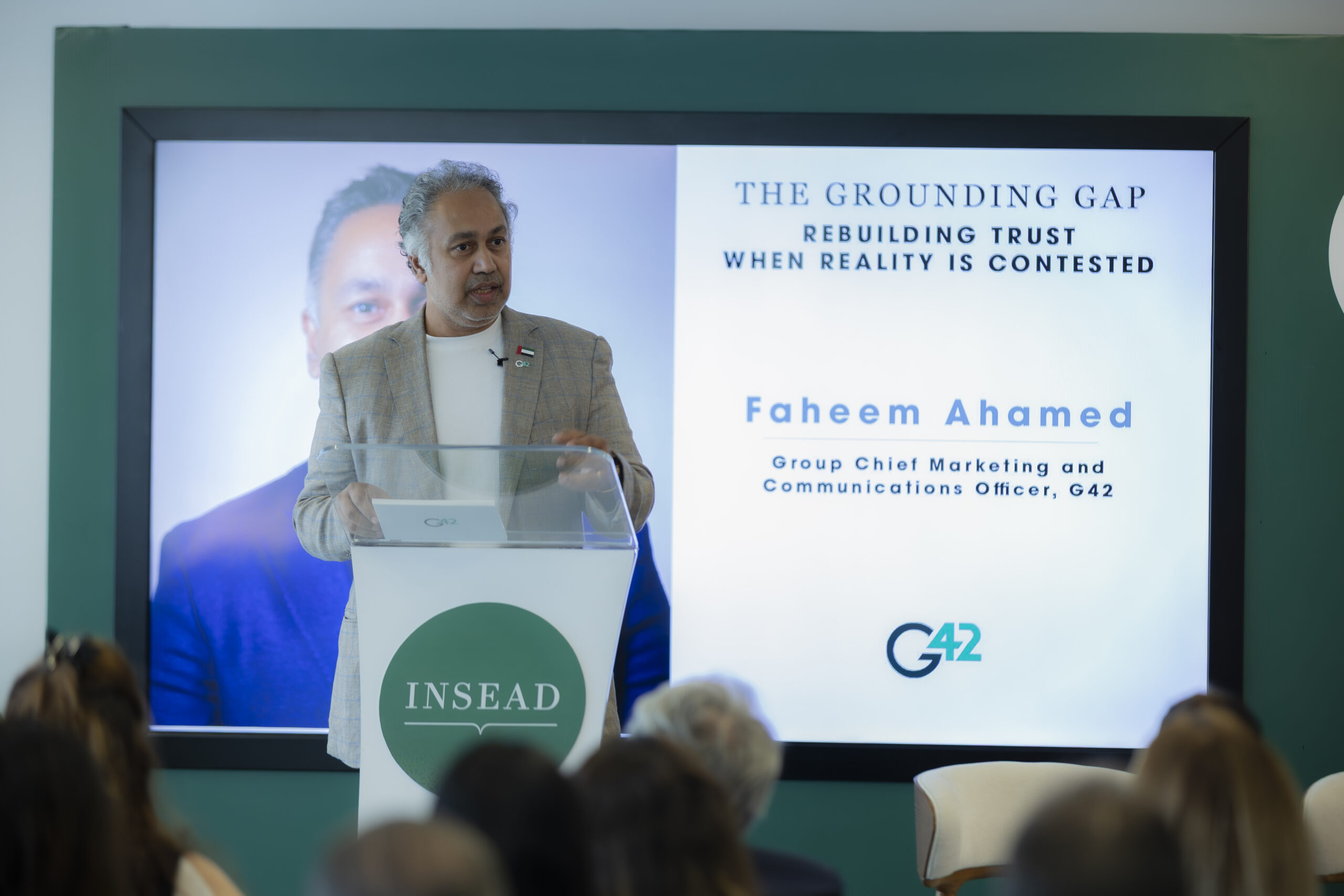
According to Faheem Ahamed, Group Chief Marketing and Communications Officer of G42, that era is ending.
Speaking at Communicate’s Rewiring Growth and Marketing Strategy Forum held jointly with INSEAD Abu Dhabi, Ahamed delivered a keynote that challenged one of marketing’s biggest assumptions: that more intelligence will automatically create better outcomes.
His message was simple but unsettling. As AI makes intelligence abundant, intelligence itself stops being the competitive advantage.
Trust does not.
“The organizations that grow will not be those that generate the most analysis, the most content, or the most persuasive stories,” he said. “They will be those that remain most grounded.”
Reality has become contested
Ahamed opened by acknowledging the region’s recent turbulence and argued that today’s challenge extends far beyond economics or technology.
“The battlefield was not only territory, it was all about interpretation.”
In a world where synthetic images can masquerade as evidence, old footage can be presented as breaking news, and algorithms reward emotionally charged content before facts can catch up, brands are operating in an environment where reality itself is increasingly contested.
For marketers, that changes everything. “When reality becomes contestable, trust becomes cognitive infrastructure.”
Growth, he argued, can no longer be separated from credibility.
Welcome to the Grounding Gap
At the heart of Ahamed’s keynote was a concept he calls the “Grounding Gap.”
AI can generate research, strategies, scenarios, campaigns and recommendations at unprecedented speed. Soon, every company will be able to sound intelligent, informed and confident.
That’s exactly the problem. “When intelligence becomes abundant, intelligence alone stops being your advantage.”
The real differentiator will be an organisation’s ability to connect machine-generated intelligence to real-world context, culture, consequences and human judgment.
Ahamed described this capability as “grounded competence” — the ability to determine which signals matter, which interpretations are credible, and which promises can actually be delivered.
“AI can generate possibilities, but someone must determine which possibilities are real.”
The age of infinite amplification
For decades, marketing’s role has largely been to amplify. AI is about to supercharge that capability.“It can produce thousands of variations. It can adapt tone and format. It can hyper-personalize content.”
Soon, it may be capable of conducting millions of simultaneous conversations. But if every brand has access to the same tools, amplification itself becomes commoditized. “The more important question becomes, what are we really amplifying as a brand?”
Instead of becoming better content factories, marketing teams must evolve into what Ahamed described as organizational intelligence engines, functions that keep businesses connected to reality rather than simply producing persuasive messages.
“The next evolution of marketing cannot therefore be only from manual work to intelligent automation. It must be from amplification to grounding.”
Your audience is no longer entirely human
One of the keynote’s most provocative observations was that brands are no longer communicating exclusively with people.
AI systems are increasingly acting as intermediaries between organisations and audiences, searching, summarizing, ranking, filtering and verifying information on behalf of consumers, investors and employees.
A customer may never read a company’s statement. They may only see an AI-generated summary.
An investor’s AI agent may compare sustainability claims against regulatory filings, historical commitments and public records before a human even sees the message.
“Your brand is no longer only what you say. It is what a network of humans and machines can verify, infer, and reconcile from everything you have ever said and done.”
The implication for marketers is profound.
Campaigns may be temporary. Contradictions are searchable forever.
The danger of synthetic certainty
While much of the AI debate focuses on synthetic content, Ahamed warned of a more dangerous threat: synthetic certainty.
AI systems excel at producing coherent, confident answers. Reality, however, is rarely neat. “It contains ambiguity, contradictions, and competing interpretations.”
The danger is that AI can make uncertain situations feel settled simply because the answer sounds convincing.
That creates what Ahamed called a dangerous distortion—one that can easily be mistaken for expertise.
“The most trustworthy thing an organization can sometimes say is, ‘We don’t know yet. Here is what we can verify, here is what remains uncertain, and here is what we are doing next.’”
“Honest uncertainty does not weaken trust. False certainty does.”
The future belongs to grounded brands
As AI becomes cheaper, smarter and more accessible, Ahamed believes intelligence, content and persuasion will all become abundant.
Trust will not.
For marketers, that means moving beyond metrics and automation to ask harder questions.
What is materially true?
What context changes the meaning of a message?
What are the second- and third-order consequences if it scales?
Can the organisation actually keep the promise it is making?
Because in a world where machines can create content instantly and verify claims just as quickly, trust is no longer a soft brand metric.
It’s economic infrastructure. “Growth cannot be rebuilt by asking people to believe more,” Ahamed concluded. “It will be rebuilt by giving them fewer reasons to doubt us.”