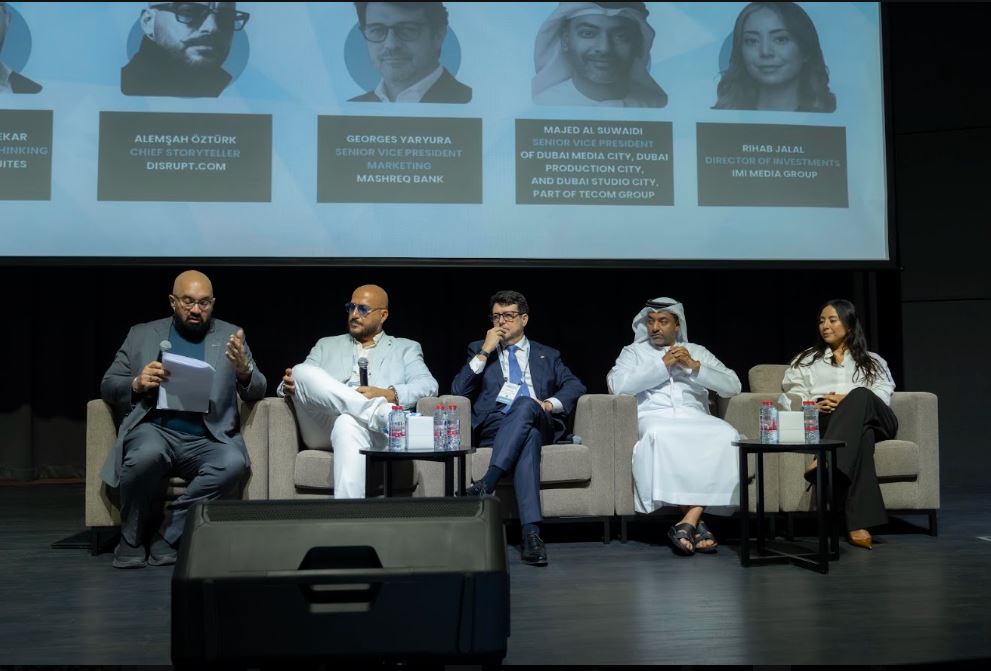
As artificial intelligence makes content creation faster and cheaper, the real value in media and entertainment will lie in human creativity, distinctive intellectual property, trusted brands and experiences that audiences connect with, panellists said at Communicate AI in Dubai on September 29.
Speaking at a session titled Investment in AI & Entertainment, executives from media, finance and the creative industries discussed where investment opportunities are emerging as AI reshapes content production, business models and consumer experiences.
The discussion brought together Rihab Jalal, director of investments at IMI Media Group; Alemşah Öztürk, chief storyteller at Disrupt.com; Georges Yaryura, senior vice president of marketing at Mashreq Bank; and Majed Al Suwaidi, senior vice president overseeing Dubai Media City, Dubai Production City and Dubai Studio City at TECOM Group PJSC. Anand Vengurlekar, a strategic design thinking advisor to C-suites, moderated the session.
A central argument was that while AI is lowering the barriers to producing content, it is making human judgment, taste and the ability to create meaning more valuable.
“The judgment becomes the most critical power,” Öztürk said, arguing that creative agencies are valued not simply for generating ideas but for identifying those most likely to deliver results for a brand.
“When producing music becomes easy, then we need tools to choose which music is better,” he said, suggesting that future AI-powered creative tools would increasingly help people select content according to their tastes, preferences and brand histories.
However, Yaryura cautioned against treating the transformation as merely another technological upgrade.
“AI can scale content for sure, but it will not scale meaning,” he said.
He argued that the industry risked viewing AI through the same digital-transformation lens that had shaped marketing over the past 25 years, when organisations focused on digitising processes, creating touchpoints and collecting data.
“It is not digital transformation, it’s human transformation,” Yaryura said, calling for a fundamental rethink of how people learn, work, create and approach marketing.
Human creativity remains central
For Jalal, the investment case for media and entertainment increasingly rests on distinctive intellectual property (IP), established creative talent and the ability to extend successful concepts across multiple formats and markets.
“What creates the value proposition is differentiated IP, premium IP, trusted brands, trusted talent,” she said.
A successful property, she argued, should offer opportunities beyond its original format, potentially expanding from a television series into a film or a live experience. Such extensions can create additional revenue streams while strengthening audience engagement.
Jalal cited the international adaptations of The Traitors to illustrate why cultural understanding remains essential even as technology makes content easier to distribute.
“The Traitors show in the UK is not the one in the US,” she said, explaining that adaptations require an understanding of the cultural references and sensibilities of different audiences.
“You can’t just take dubbing through a guy or just simplify that kind of, yes, we will make it travel through technology,” she said. “No, that is the taste and the creativity that will continue to endure and create that kind of compounding value.”
She also stressed the importance of proven talent when evaluating investment opportunities. Established writers, directors and producers bring track records that can help investors assess whether a creative property has the potential to succeed.
AI, she said, can support development and production across the value chain, but should complement rather than replace the creative people responsible for building stories and worlds.
Öztürk similarly argued that meaningful creative work begins with understanding human behaviour.
“In any creative process, it always starts with the human truth,” he said.
Whether developing a startup, television series or advertising campaign, the process begins by identifying the tension between people and a product or service, he explained. That insight then informs the brand narrative, campaign idea and choice of channels.
Öztürk said AI was opening creative opportunities to people who previously lacked access to the tools needed to turn their ideas into businesses or productions.
He pointed to the emergence of solo entrepreneurs and the potential for small creative teams to produce work that previously required much larger operations.
One opportunity, he said, lies in “micro studios”: individual creators equipped with AI tools that allow them to develop sophisticated productions around their own storytelling ideas.
Investing in people and experiences
Al Suwaidi said the expansion of AI should not be equated with a shrinking workforce. Instead, he argued, the technology could allow people to move into new roles and create opportunities across interconnected industries.
“We don’t want people to or don’t want companies to shrink due to technology,” he said. “So we push very hard for the fact that more technology is coming in. That doesn’t mean less people in agencies. That means more people in other things within agencies.”
He said TECOM Group’s media, technology and education communities demonstrated the importance of an ecosystem in which companies and individuals could share knowledge, develop skills and find new opportunities.
For Al Suwaidi, AI’s contribution includes making workflows faster, accelerating time to market and helping businesses identify opportunities they might otherwise overlook.
He argued that the next phase of growth would depend on how effectively people and companies collaborated across industries rather than operating in isolation.
The panellists also highlighted investment opportunities in experiences that bring audiences together physically, potentially creating value that cannot be replicated by the unlimited supply of digital content.
Jalal said the combination of media, live events, fan engagement, sponsorship and hospitality could create multiple revenue streams around a single intellectual property.
“When you have one fan, one audience and you provide them all these kind of different, I would say, verticals of monetization,” she said, describing an approach that connects content with a broader entertainment ecosystem.
She cited sporting properties such as the Miami Open and entertainment franchises such as Peaky Blinders as examples of IP around which additional audience experiences can be developed.
Yaryura, meanwhile, argued that businesses should direct more investment towards people, brand strategy and the value they deliver to customers rather than concentrating exclusively on technology and infrastructure.
“The job is not the task. The job is an outcome,” he said, arguing that marketers should focus on results such as business growth, brand differentiation and stronger customer relationships rather than simply completing individual tasks.
He also questioned whether businesses should give AI systems too much decision-making authority.
“Do I really want a technology to take a decision on behalf of me?” he asked, emphasising the need for people to retain control as organisations integrate AI into their operations.
Finding value beyond abundance
The panel’s discussion of investment opportunities returned repeatedly to a distinction between producing more content and creating something audiences consider worth their time.
Öztürk identified three areas of opportunity: helping businesses translate technology into practical human applications, combining AI’s analytical capabilities with human expertise, and enabling individual creators to operate as small production studios.
He described a creative strategy engine being developed by his team that analyses more than 100,000 award-winning campaigns to identify human insights, psychological triggers and creative approaches for specific briefs.
The tool, he said, can generate insights and ideas in about 30 minutes for work that might otherwise take an agency a week.
Yaryura argued that the industry’s challenge would be to ensure that greater efficiency translated into more meaningful work rather than simply higher volumes of output.
“It’s not more, it’s less,” he said. “So it’s less of technology, more of human.”
As businesses and investors navigate the next phase of AI adoption, the panellists suggested that the strongest opportunities would emerge where technology enables human creativity, distinctive intellectual property and experiences that audiences trust and value.