Artificial intelligence has spent the past few years being marketed to marketers. In the Gulf, however, the more interesting story is what happens when marketers start using AI to market.
The GCC is emerging as one of the world’s most aggressive test beds for AI-led marketing, with Saudi Arabia and the UAE in particular combining sophisticated digital consumers, ambitious brands and rapidly expanding advertising ecosystems. McKinsey’s 2025 GCC AI survey found that 84% of surveyed GCC organisations had adopted AI in at least one business function, up from 62% in 2023. Marketing and sales remain among the functions where AI is most regularly deployed.
The shift is also happening against a rapidly expanding digital advertising market. According to IAB MENA data reported by Communicate, MENA digital advertising reached $8.185 billion in 2025, up 17.8% year on year.
But adoption is not the same thing as success. The real AI winners are the brands that have used the technology to solve specific marketing problems — personalization, localization, production speed, targeting or conversion — rather than simply using AI because it is fashionable.
Coca-Cola: personalization at scale
One of the clearest Saudi examples comes from Coca-Cola.
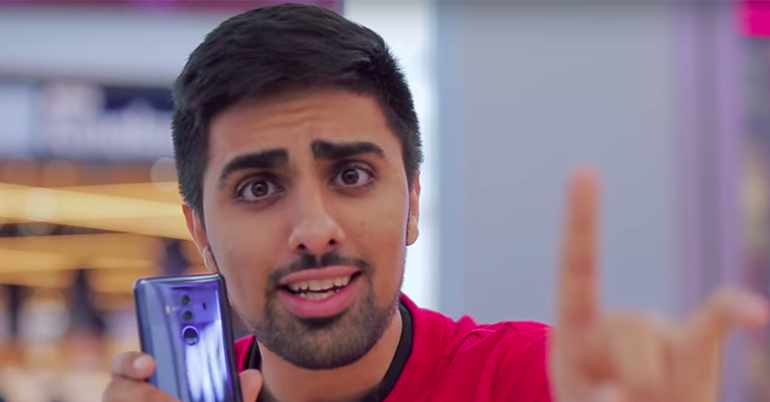
For a World Cup campaign, Coca-Cola worked with Saudi Gen Z comedy creator Mohammed Shamsi to create a single base video. Using Google’s AI-powered Ads Creative Studio, the brand subsequently generated 32 personalized video ads from that one piece of content, with visuals and messages automatically adapted to different audience interests.
The impact was substantial. Coca-Cola reported a 46% video view-through rate against a planned 30%, while reducing its planned cost-per-view budget by 42%. More importantly, during the promotion, Coca-Cola’s market share in Saudi Arabia increased by 10%, while sales volume rose 22%.
Google’s Coca-Cola case study
The lesson is important: AI did not create the idea. It multiplied the number of relevant executions that could be produced from the idea.
Air Arabia: from creative production to conversion
Air Arabia offers another compelling GCC example, this time showing how AI can connect creative production with performance marketing.
The airline used TikTok’s AI-powered tools, including Smart+ and Symphony, to localize and optimize a global campaign across 12 markets. The program generated 44 localized TikTok-first assets, combining automated production, dubbing, audience targeting and performance optimization.
The results included more than 50 million people reached, 227 million impressions and more than 80,000 flight-related searches in the UAE. TikTok’s case study also reports that the campaign generated twice the ROAS of standard web-conversion activity for its UAE Travel Ads activation.
TikTok’s Air Arabia case study
Here, AI’s advantage was not simply cheaper content. It was the ability to connect the right creative with the right audience and then optimize towards an action.
Saudi Arabia: AI makes localisation faster
Perhaps nowhere is the GCC’s AI opportunity more obvious than Saudi Arabia, where global brands routinely face the challenge of adapting creative to a market with its own cultural codes, visual language and consumer behaviour.
A 2026 case study published by Google on OHM’s Saudi market-entry campaign describes how an AI-driven workflow was used for a mobile trading platform entering Saudi Arabia.
The approach allowed the agency to generate and test multiple Saudi-specific creative iterations without conventional on-location production. The production timeline was cut by a month and the client reportedly saved $180,000 in production costs.
The campaign also delivered a 25% higher conversion rate for new app registrations, while cost per acquisition was 25% lower than the brand’s average across its markets.
This points to one of AI’s most commercially valuable capabilities in the Gulf: compressing the distance between insight, production and market response.
Coca-Cola again: when AI finds the moment to sell
Coca-Cola has also demonstrated how AI can move beyond creative personalization into consumer insight.
For its Saudi campaign “Oops, AI caught you craving”, the brand used AI to analyze social-media data and identify food preferences and unconventional meal occasions where Coca-Cola could become relevant.
The campaign used AI-driven targeting and personalized advertising to reach consumers around those moments. According to WARC’s case study, AI-generated targeting accounted for 68% of all claimed coupons while consuming less than 10% of the overall investment. The conversion rate reached 79%, compared with a benchmark of 23%.
That is a particularly revealing AI success story because the technology was not used merely to make an advertisement. It was used to identify when the advertisement should exist.
The GCC’s AI advantage — and its catch
The region’s consumer environment makes these applications especially powerful. Deloitte’s 2025 Digital Consumer Trends study found that 58% of surveyed consumers in the UAE and Saudi Arabia had used generative AI tools such as ChatGPT or Google Gemini.
At the same time, the UAE presents marketers with an unusually complex audience. INSEAD research on GenAI personalisation in the UAE notes that the country has roughly 200 nationalities, with expatriates accounting for around 85% of the population. Traditional demographic segmentation can struggle in such an environment; AI can potentially deliver much more granular personalisation.
Yet the biggest danger for Gulf marketers is assuming that adoption automatically creates value. McKinsey’s latest GCC research found that only 31% of respondents considered their organisations mature enough to have scaled or fully deployed AI, while just 11% qualified as “value realisers” — organizations able to attribute at least 5% of earnings to AI.
That distinction may define the next phase of the Gulf’s AI marketing story.
The winners will not necessarily be the brands producing the most AI-generated images, films or copy. They will be the ones using AI to make marketing more relevant, more local, faster to produce and easier to optimize — and then proving that it moved a business metric.
The GCC’s biggest AI marketing wins already point in that direction. Coca-Cola used AI to personalize. Air Arabia used it to scale and optimize. Saudi campaigns have used it to localize faster and reduce production costs. The common denominator is not the technology itself.
It is the outcome.
The real AI revolution in Gulf marketing begins when AI stops being the campaign and starts making the campaign work better.
CTA >>>>>>