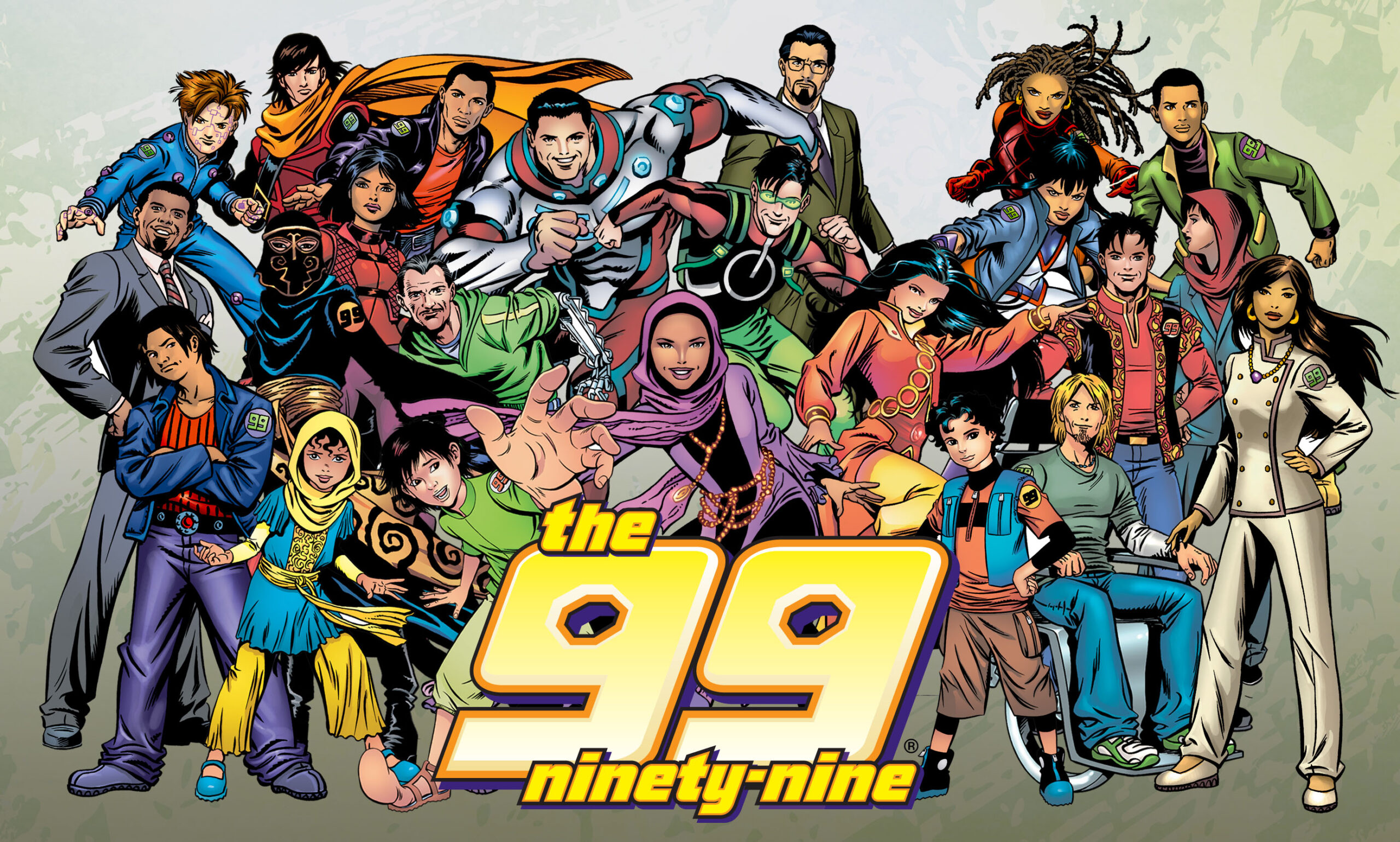
When the series first appeared in 2006, it was an unlikely cultural experiment: a group of superheroes from across the Muslim world whose powers reflected values such as generosity, wisdom and courage.
By Hoda Rizk
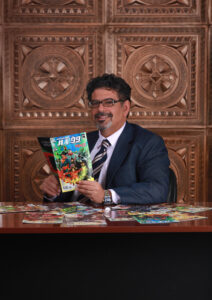
“My fictional heroes had real-world bad guys come after them, not just the fictional bad guys. That’s the irony,” revealed Dr. Naif Al-Mutawa, clinical psychologist and creator of The 99.
When the series first appeared in 2006, it was an unlikely cultural experiment: a group of superheroes from across the Muslim world whose powers reflected values such as generosity, wisdom and courage.
Within a few years, the franchise grew into dozens of comic books, an animated television show watched by hundreds of millions, and licensing deals with Netflix and DC across several continents.
Then it disappeared.
Now, after more than a decade in limbo, The 99 is returning, after closing of a $5 million Series A funding round led by Exponential Ventures to reboot the franchise.
The comeback comes at a curious moment.
The world has grown more polarized, not less, since the show’s debut. Yet the premise that once stirred controversy feels oddly contemporary again. In an interview with Dr. Naif Al-Mutawa, the author and creator of The 99, reveals it all to Communicate.
A comic born from a question
The idea emerged from a simple frustration. In the early 2000s, extremist groups had successfully weaponized religious narratives for political ends.
Al-Mutawa, a clinical psychologist by training, believed storytelling could reclaim the cultural imagination.
“I wanted to reposition Islam to Muslims, not to the West,” explained Al-Mutawa.
Instead of sermons or political debate, he turned to comic books.
The premise drew inspiration from the 99 attributes traditionally associated with God in Islamic theology, with qualities such as wisdom, generosity and justice.
Each hero embodies one of those virtues. Yet the stories themselves contain no religious rituals or preaching.
“What I did is pretty much what Hollywood has done with the Bible for over 100 years; I did it with the Qur’an. Leading by example,” said Al-Mutawa.
The characters were designed to be global: a team of heroes scattered across continents who must work together in teams of three to solve problems.
Yet the project’s roots were less in modern geopolitics than in medieval history.
Baghdad, book, and a lost civilization
The mythology of The 99 draws on a deep historical memory.
In the Abbasid era, Baghdad’s House of Wisdom, or Dar Al-Hikma in Arabic, served as a hub where scholars translated texts from Greek, Persian and Indian traditions into Arabic. Legend has it that when the Mongols destroyed Baghdad in 1258, manuscripts were thrown into the Tigris River, turning the water black with ink.
Al-Mutawa rewrote that ending.
“I just changed one thing,” he said. “What if all that ink had been saved in 99 stones?”
In the fictional universe, fragments of humanity’s knowledge survive within mystical gems scattered around the world. Whoever finds one inherits extraordinary abilities and a duty to use knowledge wisely.
“We never lost that tolerant civilization that had knowledge from all cultures,” Al-Mutawa explained. “That was the message.”
From Kuwait to the world
The idea proved unexpectedly exportable.
By the late 2000s, The 99 had produced 47 comic books, 52 animated episodes, licensing deals across several continents and even a theme park in Kuwait.
At its peak, the show ran on Cartoon Network in Mandarin in China. In the United States, it appeared on Netflix.
Hollywood soon joined the project. In a rare collaboration, DC Comics paired Al-Mutawa’s characters with the Justice League in a series featuring Batman, Superman and Wonder Woman.
“Six books came out having my characters work with the Justice League,” recalled Al-Mutawa.
The collaboration sold out.
“It was the first and only intellectual property ever from the region to go global,” said Al-Mutawa.
Recognition followed. The franchise was studied at Harvard Business School and cited by Forbes as a global cultural trend.
But visibility came with consequences.
When fiction meets politics
In 2009, the series found itself swept into geopolitics.
The project had received an unexpected boost when an article about The 99 appeared in the Chicago Tribune on the day of Barack Obama’s presidential inauguration.
Later that year, DC Comics released the Justice League crossover just months before Obama delivered his famous Cairo speech aimed at resetting relations with the Muslim world.
“I was actually in the audience,” recalled Al-Mutawa. “During Obama’s 14-minute speech, 2 minutes were dedicated to The 99”.
The timing was uncanny. Yet the attention also brought trouble.
Criticism arrived from all sides.
“In America, I was called an Arab-American terrorist,” Al-Mutawa said. “Back home, I was called Zionist or Masonic.”
The pressure soon affected the show’s future.
The Hub, then a joint venture between Discovery and Hasbro, had purchased the rights to broadcast the series and helped finance its second season. But as political controversy grew, the network hesitated.
“They paid for it, but they wouldn’t air it,” Al-Mutawa said.
Threats followed. Eventually, the project halted.
“Season two finished ten years ago,” revealed Al-Mutawa. “It was never released because of the death threats I got.”
A decade of silence
Al-Mutawa, now a father of six boys, stepped away from writing.
“I had to stop writing to protect my children,” he said.
The project remained dormant for nearly ten years. Then, two years ago, his fourth son stumbled across his father’s earlier work.
“He said, ‘Baba, why don’t I know you write like this?’” Al-Mutawa recalled.
The question proved harder to ignore than the threats.
A new generation of heroes
The reboot will begin with the release of the original 52 animated episodes, half of which have already reached an estimated 500 million viewers worldwide.
Season three is now being developed, expanding beyond the original 37 heroes introduced in the early comics. The structure remains the same.
Yet the way audiences encounter those stories will change.
Today’s children consume narratives through games, short-form videos and interactive platforms rather than traditional television. Gaming, Al-Mutawa believes, will become a central part of the franchise’s next phase.
Meanwhile, artificial intelligence will allow children to shape their own narratives while interacting with the world of The 99.
“We’re building on the best-in-class AI‑powered creative tools, together with some proprietary ideas that allow fans to shape their own stories using safe, guided systems similar to those in popular gaming communities,” Al-Mutawa shares.
For example, a child in Canada might set a story around pond hockey in winter, while one in Indonesia could weave in elements of their local culture — a temple, a festival, or even favorite local sports.
“We’re supported by some of the best minds in AI, including advisors like Salim Ismail and community experts from OpenExO. We’re experimenting boldly, but also building responsibly, making sure that creativity and safety advance together,” Al-Mutawa reveals.
Doing well by doing good
Despite the commercial ambitions, Al-Mutawa insists the project was never primarily about profit.
“It’s always been a double-bottom-line project,” he said. “Doing well by doing good.”
The themes of justice, empathy, and courage remain deliberately universal.
“Hollywood tells the same story again and again,” he argued.
What matters, he believes, is who gets to tell them.
For decades, globally recognised characters from the Middle East have often been filtered through Western studios. Local creators rarely export their own stories.
“We think we’re protecting our culture,” Al-Mutawa said. “But sometimes we end up diluting it.”
The return of The 99, then, is an attempt to prove that stories from the region can travel just as far as the superheroes that inspired them.
“My project is inspired by Islam. It’s not Islam,” he said. “One of the biggest compliments I get is when people from around the world say, ‘This feels like us.’ That’s the point. We’re all human.”
The 99 heroes are returning. And this time, their creator hopes the world may finally be ready for them.