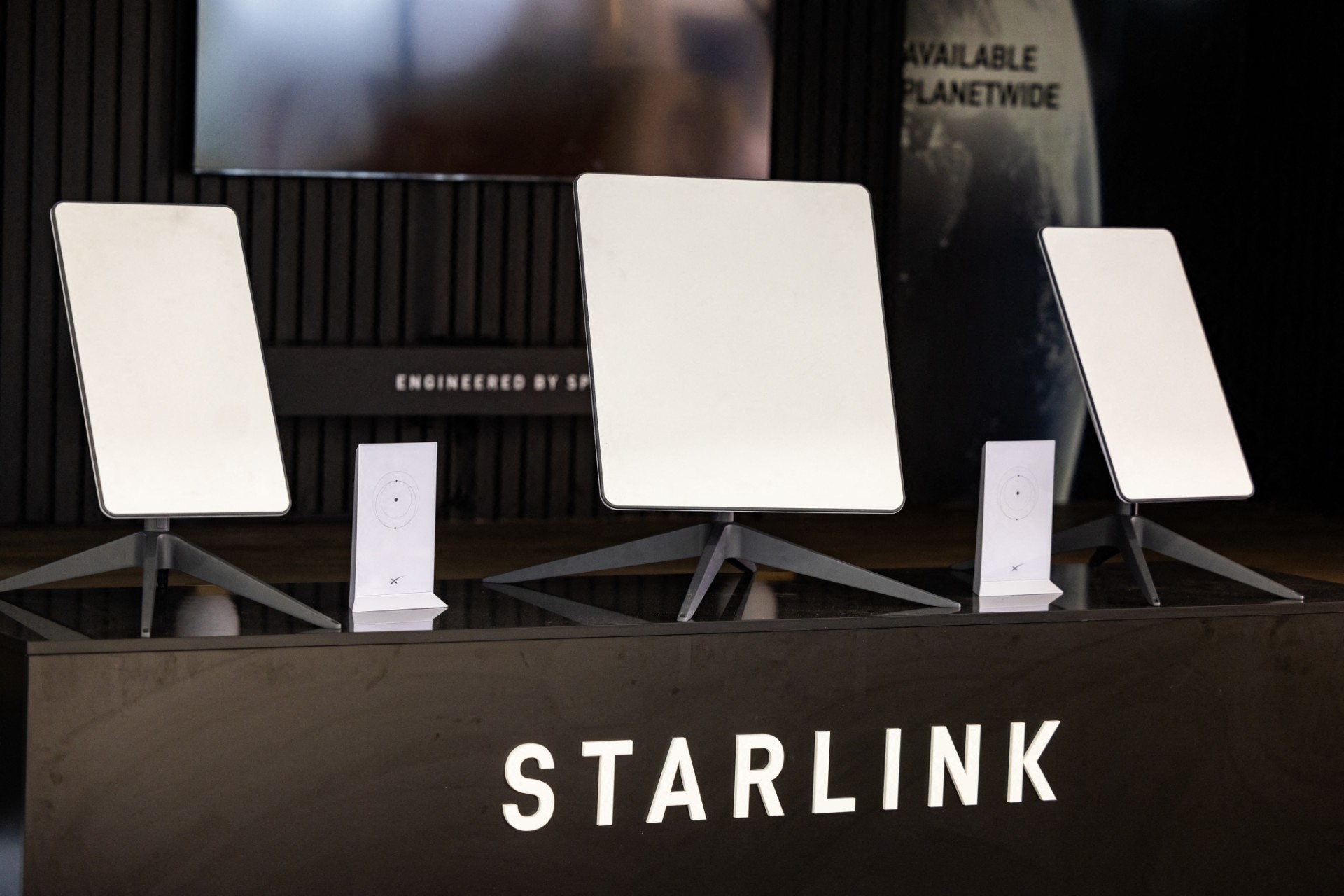
Elon Musk’s Starlink has gone live in the United Arab Emirates, marking its entry into one of the world’s most highly connected digital markets.
The service—developed by SpaceX—is now available to residents with monthly plans starting at around Dh300 ($81.69), including a lower-cost “Residential Lite” tier priced at Dh230, according to a Gulf News report.
Business packages are also available, signalling early enterprise interest in alternative connectivity solutions.
The UAE launch follows Starlink’s appearance on its global availability map and builds on its earlier aviation partnerships with Emirates and flydubai.
The service uses a constellation of low-Earth orbit satellites to deliver lower latency and higher speeds than traditional satellite internet, positioning it as a premium complement rather than a replacement for fibre and 5G networks in advanced markets.
On March 14, Musk announced on X that “Starlink’s high-speed, low-latency internet is now available in Kuwait!” The announcement comes amid heightened tensions in the Middle East, with both UAE and Kuwait being the targets of Iranian attacks.
On Wednesday, Alghanim Industries (Kutayba Alghanim Group), announced the official launch of Starlink services in Kuwait through its technology venture Sama X. In a statement, it said that as an authorized global reseller of Starlink, Sama X provides access to high-speed satellite connectivity that delivers fibre-like performance without relying on traditional ground infrastructure.
The service offers reliable internet on land and at sea with typical latency as low as 20 milliseconds, supporting remote operations, critical applications, and everyday connectivity needs.
In Kuwait, Sama X will offer a range of subscription plans with download speeds exceeding 300 Mbps, along with fast delivery, professional installation, and local support, including a 24/7 bilingual call centre.
“The launch of Starlink services in Kuwait through Sama X marks an important step in strengthening the country’s digital infrastructure,” said Kutayba Y. Alghanim, Executive Chairman of Alghanim Industries.
“At a time when reliable connectivity has become essential for business continuity and the effective functioning of key sectors, this technology provides advanced connectivity that helps organizations, governments, and communities stay connected wherever they operate — from remote worksites to critical sectors such as healthcare and education.”
Gulf aviation adoption
The 2025 edition of the Dubai Air Show kicked off with a bang, as Emirates announced a fleetwide contract with Starlink, giving the U.S. satellite operator another major customer in the region alongside Qatar Airways. This was immediately followed by news that Starlink had secured a 100-plus aircraft deal with flydubai.
Starlink now has more than 500 commercial aircraft in the Middle East committed to its service, cementing its place as the vendor with the largest backlog — and the largest number of committed aircraft — in the region.
Less about access, more about augmentation
Therefore, for the Gulf, where connectivity levels are already among the highest globally, Starlink’s role is less about access and more about augmentation.
Analysts and industry bodies such as the GSMA have emphasized that even in advanced markets, network resilience and redundancy are becoming critical as economies digitize. In this context, satellite broadband adds a second layer of infrastructure—particularly valuable for sectors like energy, maritime, aviation and logistics that operate beyond dense urban fibre grids.
Regional industry platforms such as the SAMENA Telecommunications Council have also highlighted the growing role of non-terrestrial networks in supporting next-generation connectivity. In the Gulf, this translates into use cases less about rural inclusion and more about mission-critical uptime—from offshore rigs and desert operations to smart city back-up systems and large-scale events where uninterrupted bandwidth is essential.
There is also a competitive and commercial dimension. Starlink’s entry introduces a premium, performance-driven benchmark that could push incumbent telecom operators to differentiate further on speed, service guarantees and bundled digital offerings.
EMB Global, a B2B Platform that provides managed marketplace for digital services including digital marketing, Starlink’s high-speed connectivity allows businesses to upload high-resolution content effortlessly, attracting larger, more engaged audiences. Additionally, the low-latency internet offered by Starlink is a boon for programmatic advertising — advertisers can place ads in real-time, optimising their reach and effectiveness.
Starlink works anywhere with a clear view of the sky, including boats, desert camps, and construction sites where traditional providers struggle. For marketers, this could be the opening line: new audiences in previously dark zones are now reachable.