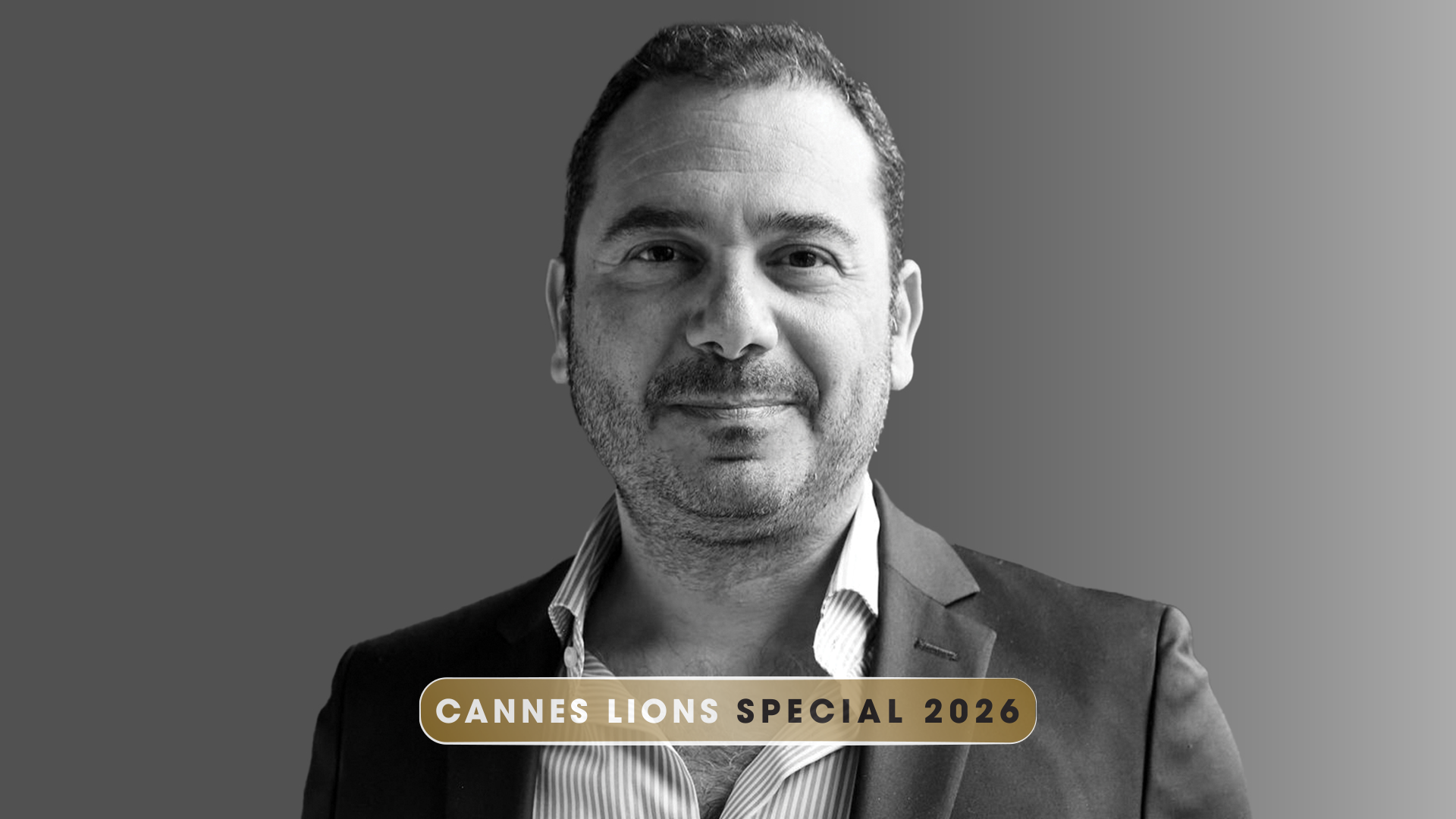
As the CEO of FP7 McCann MENAT and a jury member in the Creative Business Transformation category at the 2026 Cannes Lions International Festival of Creativity, Tarek Miknas believes the most impactful work is often the simplest. In this interview with Communicate, he discusses what will stand out at Cannes this year, the Middle East’s growing creative influence, and why commercial impact and creativity must always go hand in hand.
What do you think will actually stand out at Cannes Lions 2026?
Simple, Smart, relevant creative solutions that enabled tangible results and ideally that make the world a better place while at it. I also think that work that will stand out will be work less reliant on technology and more about the creative mechanisem to solve a big problem. Genreally work that makes you think ‘why didn’t I think of that’.
Creative Business Transformation is your category this year, so what does “transformation” actually look like in the work today?
It’s all in the title of the category. It’s work that redefines the way things have always been done that creates/created significant impact or solved a significant business issue using a creative solution. One that breaks categroy norm and did/will or could scale and achieve meaningful results.
When you look at the Middle East right now, what kind of work is really breaking through, not just winning awards, but shifting perception?
When I look at the Middle East today, there has rarely been a time when creativity has carried more practical value. With the region operating in the shadow of geopolitical tension, and our major markets – particularly the UAE and Saudi – feeling the knock-on impact through proximity and sentiment, categories like tourism, hospitality, aviation and real estate have all had to adjust in real time.
The work that’s truly breaking through isn’t just “award-friendly” – it’s work that responds with utility and empathy. We’re seeing brands shift strategy quickly: prioritising local residents with staycation-led offers, rebalancing toward internal and regional travel, and rewarding communities for loyalty at a time when confidence is fragile.
There are strong examples of this kind of creativity in action. Talabat’s support for 100 rent-free UAE cloud kitchens created a meaningful operational lifeline for SMEs. Parkin’s Spots for Shops turned everyday parking into a commercial incentive for neighbourhood businesses in Dubai. Majid Al Futtaim’s Ma’an platform created pathways for UAE entrepreneurs and emerging brands to scale, aligned with broader economic support initiatives. And Emirates’ flexible rebooking and refund policies reflected the same principle – remove friction, support people, and keep mobility moving responsibly.
That’s what’s shifting perception: creativity that is culturally aware, economically supportive, and built to help people navigate the moment – not ignore it.
What creativity output is expected from the ME region at Cannes Lions this year?
Every year, we see the Middle East punching well above its weight at Cannes Lions — more work, more entries, more shortlists, and more Lions. I expect no less this year.
The strongest volume will continue to come from the UAE and Saudi Arabia, and increasingly the cases will be tied to real brands – both global and regional – that are willing to push for creative excellence, not just safe execution.
If you look at the broader context, Cannes Lions received around 26,900 entries in 2025, broadly consistent with 26,992 in 2023 and 26,753 in 2024. Cannes itself has highlighted that the Middle East took home roughly 2.7% of all Lions in 2025 – which is broadly in line with the global conversion rate. That matters, because it shows the region isn’t just showing up more. It’s converting, and proving that the quality is there as well as the ambition.
Creativity, media, AI… everything feels like it’s blending together. In reality, is that making ideas better?
100%. The left hand is speaking to the right hand, and our creative becomes far more targeted and far more effective.
There’s so much pressure now to prove impact. Where do you draw the line between work that performs and work that actually pushes creativity forward?
For me, there has always been pressure to prove impact. I’ve always said that we work in the field of creativity, but advertsing is a commercial art. It has to be both creative and commericialy impactful to be meaningful. It should always be about real work for real brands with real impact. Your biggest clients should get your best talent and benefit from your best ideas.
You’ve been leading across a rapidly changing region; so, how has that changed the way you think about creative leadership day to day?
Since I’ve been a creative leader, I have never had the burden of anyting being static. In 2010/11, we had the Arab Spring, which was fueled by social media, which continued to drive change through most of that decade. In the Middle, around 2014, we had a real estate crash, meaning that our biggest clients dropped and we had to pivot fast to continue growing. By 2016, Saudi Arabia had announced their Vision 2030 and entertainment was opening up, giga projects were being announced and a local voice in the work was becoming stronger than ever. By 2018, Saudi’s social reforms provided even greater opportunities. We’re proud to have been the first agency to feature a woman driving just a week after the ban had been lifted, for Coca-Cola. Then we had Covid. And then the World Cup in Qatar in 2022, and today, we are navigating a rapidly changing industry with consolidations, martech advancements amidst a war that is affecting the majority of markets where we operate.
Change has been consistent and constant, but leading a creative enterprise is pretty straight forward. Set a culture of creative and commerical excellence and build an environment where people can thrive and have a bit of fun along the way, embracing every curve ball that comes your way.
What’s still holding the region back from consistently producing work that can compete at the very top globally?
I don’t think that any part of the world is being held back today. Any creative, anywhere in the world, has access to the same technolgy and access to the best work to provide inspiration. Work that wins isn’t because of a big budget, but rather because of a creative solutions to big challenges. We are competing at the very top globally from our part of the world already. We’re just going to get better and better at it.
When you’re sitting in the jury room, what actually makes you sit up and say: this is the one, beyond just a strong idea?
It’s typically just jumps out at you. ‘The One’ typically doesn’t have to try to hard to be the one. It just is. It’s super smart. Super simple. Bold. It’s probably got a bit of humor to it. It’s lovable, and it makes a difference. And everyone instictually knows that ‘it’s the one’.
Do you think the industry is playing it too safe right now because everything has to be measurable & optimised?
Not at all. It should always be measureable. Again, advertising is a commerical art. It’s not made to serve us as an industry, it’s made to serve brands who more and more, are challenged to make the world a better place, while resulting in something tangible for their businesses at the same time.
What kind of creative leadership do you think this region needs moving forward & what are the opportunities?
We need leaders who care. Care about our industry, but more so, care deeply about our part of the world. We positioned ourselves as the ‘Voice of the Middle East’ in 2011. It was/is a reference to us knowing and understanding our people better than anyone else, as well as a challenge to represent the voice of ambition of our host nation. Our part of the world wants to be the very best globally, and we owe it to the region to deliver on that within our industry.
This interview was originally published in the latest Cannes Lions special issue of Communicate. To explore more interviews, insights, and analysis from global leaders in marketing, media, creativity, and innovation, access the full issue here.