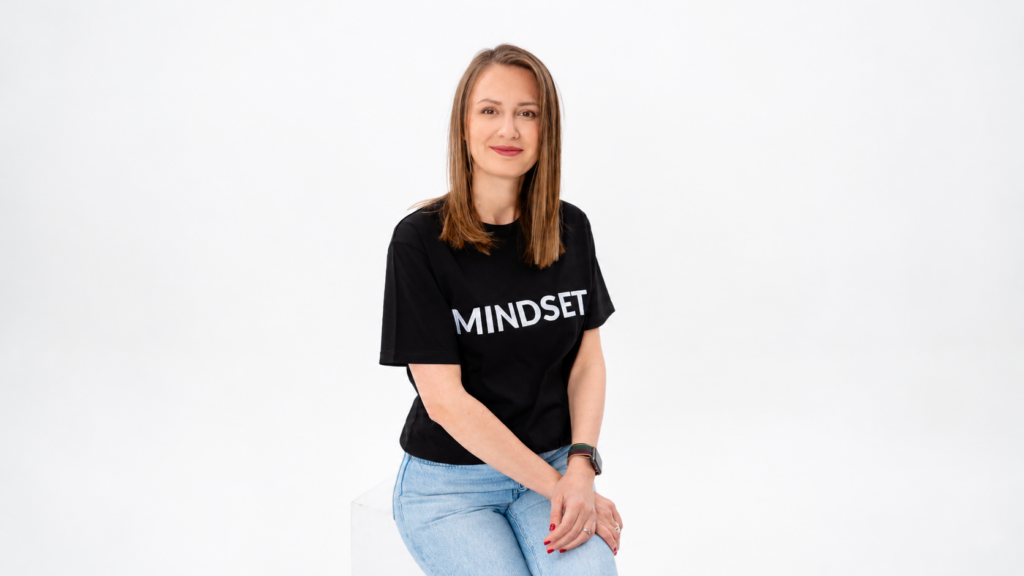
Tell a candidate it’s two days a week in the office and no meetings on Fridays, and Chelly Megale can watch their face change.
Megale is People Director at Incubeta MENA. Communicate spoke with her earlier as we were researching industry salaries for Communicate’s 2026 GCC Advertising & Marketing Salary Survey, and she walked through what’s driving her hiring decisions right now: M-shaped talent, why flexibility can still outweigh salary, a market recruiters describe as “really, really quiet,” and why she believes agencies will win on product, not services, in the AI era.
How would you describe hiring at Incubeta right now? Selective, paused, wait-and-see?
I would say it’s selective. What we are focusing on right now are key roles that are critical to operate the business. When we hire, we think of the future as well. Of course, you have an immediate role to fill for the work that is here right now. But when we are filtering talent and screening, we are thinking of the future as well. We search for M-shaped roles: people that have depth in their core craft, but can also operate across disciplines through tech and AI, obviously the most in demand at the moment.
Which roles are most in demand?
From what we do as a service, we are focusing on roles related to tech. Data roles, and that goes from a senior manager that knows how to operate with data and measurement, but also AI engineers. These are some of the critical roles that we have at the moment. Also, client service. We usually don’t say client service, because I think it’s more a partnership. So the way we hire client teams is through client partnerships. We want client partners, and these are key roles as well to ensure that we’re operating the business properly.
Is it an employer’s or an employee’s market compared to a year or two ago? Are candidates still prioritizing flexibility and work-life balance?
I still see that. It depends on the role as well, on the seniority of the role. I think more mature, more senior talents know how to ask, right? But I’ve seen candidates rejecting roles if there is no flexibility, there is no hybrid model. Sometimes the benefits package is a component. Salary, again, depending on the role, is there, but it is not as crucial as those benefits and those flexibilities. I still see candidates openly asking about remote working, the six weeks or four weeks away from Dubai or from whatever market they are working in, that flexibility, the hybrid model.
We do two days in the office and three days from home. We have operated like that since forever. We do believe in that model, and we say we are not a school, right? We evaluate and we manage employees through output, not raising your hand at 9 a.m. and closing your computer at 6 p.m. We also don’t foster long working hours. That’s not how we operate. We believe in a model where you give that flexibility and trust.
When a candidate turns down an offer, what’s usually the reason?
I think mainly it’s the benefits, from what I’ve seen today. I see talent still going to big networks. I think the sense of job security, or the sense that they will get better benefits, is there, right? But I also see talent that really wants a changing environment. They’re really focusing on [avoiding] that bureaucracy that sometimes comes with big networks, so they’re shifting toward more independent agencies. It’s a mix.
Are candidates drawn to independent agencies for the flexibility and boutique feel, or do they still prefer the big networks?
Honestly speaking, they don’t usually say those things to me when I’m recruiting. But I do see a preference when we talk about what we as indies can offer in terms of those flexibilities, but also close proximity to leadership, to decision-making. To be really part of the change, right? You do have a process, you do have an operating model, but right next to it, we have a blank canvas where we are open to getting your input, your collaboration.
How are you using AI in recruitment?
We don’t use AI to do our recruitment for us. We use AI to help us filter some of the profiles. You receive hundreds of applications, right? But AI can be biased and can hallucinate as well. So we still go through the process of scanning the CVs. If it’s a CV that the AI has said is not within the job requirements, or only a few components of the profile fit, that is a watch-out. We do go back and we scan it. We still believe in the human element, where you go through it and you really understand the candidate’s experience.
The screening is important, because the majority of CVs are now written through AI, right? So a lot can be skewed. We do a thorough interview process where there is a screening, there is a conversation, there is a task, and usually the task shows the gaps, or the watch-outs, that we faced on the CV and during the screening process. So we don’t rely on AI only.
Has AI eliminated any role at the agency?
No. It has changed a few things within some roles, to support — not just about being faster, but being more effective and productive.
In the GCC, mainly the UAE and Saudi Arabia, do you see a permanent shift in how agencies are structured and staffed, or is this cyclical?
I think companies in general are a bit more cautious about who they hire, really being selective. Our industry has been quiet for a while. I see some small movements, some hiring happening. But when I speak to recruitment companies, they openly tell me it’s really, really quiet in both markets, the UAE and Saudi. Sometimes I share profiles with them and say, ‘Look, in case you’re looking for this kind of profile, this is a candidate that is available.’ And they come back to me and say, ‘Yeah, but the industry is really, really quiet.’ So I see some movement, but from recruitment agencies, it is a very slow pace at the moment. I think it will pick up, but I still think the focus will be on those key critical roles that will support the operations.
As clients do more in-house with AI, does the agency model itself need rethinking? And is your hiring built for today’s agency or the one five years from now?
I think it’s a very real question. And our hiring strategy is definitely geared toward the agency model of five years from now rather than simply fitting what we require today. When we hire, we are looking for talent that will help us stabilize our growth right now, but we are also thinking of scalability and growth three to five years from now. We are increasingly hiring M-shaped roles, people who have depth in their core but can also operate across disciplines. That’s important because I think the boundaries between those roles are going to continue to blur.
Agencies are all talking about AI-enabled, data-integrated or whatever the latest terminology is. There are hundreds of agencies talking about AI, or providing the services that we provide, for instance, right? Paid search, creative, etc. But I don’t think the differentiation for our industry is what services you offer, because anyone can claim it or provide it. I think the differentiation will be in the product. By product, I mean the combination of people, technology, data, IP and proprietary ways of working, and the disciplines you build around them. For me, that’s ultimately how it all comes together to deliver better, faster and more valuable outcomes to clients, and that’s much harder to replicate than simply having a particular service or skill set.
I think the agency model will evolve. I don’t see (clients) moving in-house, even though you see some trends. And I don’t think AI will necessarily eliminate the need for agencies. I see AI supporting, not by being faster, but by being more effective and productive.
Gen Z candidates are said to negotiate differently from millennials. Do you actually see that in interviews?
I can say they are more outspoken. They really ask what they want. They don’t shy away from asking, especially when it comes to well-being benefits, flexibility and hybrid work. But I also see their ambition in terms of career growth. They are very open about it: ‘If you hire me for this role, what is next for me in 12 months or 18 months?’ They don’t shy away from asking that. So I think that is a key component that I see them integrating into their interview approach. But obviously, well-being is still a key component as well.
What trend stands out to you in the Saudi and UAE markets, whether among indies or big networks?
It sounds cliché, but it’s AI. Everyone is talking about AI, and some companies are still very much in the exploration phase. They are really trying to define how AI will support them. I think the trend will be how agencies embed AI as an operating model. It’s not just about working faster, it’s about rethinking how teams will work: what the team structure will be, how the work will be delivered using that tool to your benefit. I think agencies are really going to try to define themselves through that. All agencies provide similar services, and AI will be one of them. How you differentiate yourself is going to be the key element for companies to really go and grab you to do their work.
Do you get a lot of CVs that sound the same?
Yes. I don’t mind if someone used AI. Even I can use AI to tweak, sharpen or flesh out an idea or a phrase. But your touch still needs to be there. Otherwise, it becomes too robotic. We hire people for their knowledge and expertise, of course, but the soft skill element must be there as well. Sometimes that soft skill comes across on a CV, right? By the way a person writes their profile, you can start getting a sense of them. When it’s done through AI, you lose that element.
So what do you look for in a CV to see the person behind it?
The first thing that I spot is the skills. I want to make sure I really understand the skills. If I don’t see the skills, sometimes I don’t even progress, because, like I said, there are hundreds of applications, right? Once I identify that someone has worked in media and has paid experience, for example, I go through the profile. I usually check results and outcomes. Sometimes there’s a list of key responsibilities, but those who put outcome-driven results are the ones that really pop, in my opinion, and really catch my eye. If profiles are too similar, I look at the companies they worked for, if they are reliable companies, and go into a little bit more depth on the experience. Sometimes I check the company profile.
And obviously, sometimes they add some personal touch, which is great. Hobbies, or sometimes even catchy phrases, really help differentiate. That shows a little bit more of the human element. These are the ones that I usually go for. Then, obviously, we go through the full interview process.
Flexibility, benefits or base pay, what is the market actually offering? Communicate’s 2026 GCC Advertising and Marketing Salary Survey breaks down what agencies and brands across the region are paying, role by role and level by level. Read the full findings HERE.