Niall Sallam
As cities become more connected and behaviour around public spaces becomes more predictable, Digital Out of Home has entered a new phase. The value of DOOH is no longer defined by screen size, reach, or frequency. The competitive edge now lies in how well a campaign aligns with the environment around it. Attention is no longer the challenge. The real advantage lies in contextual relevance
Industry research supports this shift. The Out of Home Advertising Association of America (OAAA), referencing benchmark analysis from Solomon Partners, reported that out-of-home advertising consistently delivers some of the highest consumer recall levels compared to other traditional media formats. As measurement improves, the difference increasingly lies in how well creative aligns with the environment.
This shift matters for media leaders responsible for directing brand investment and ensuring accountable, cross-channel performance. The more intelligently a campaign responds to audience behaviour and environmental context, the stronger and more accountable its impact becomes.
- Context Has Become the New Creative Multiplier
Creative excellence drives performance, but only when it fits the space it appears in.
Further, research OAAA further shows that 76% of consumers have taken action after seeing a DOOH ad, and 73% view DOOH advertising favourably, reinforcing that relevance within real-world environments translates into measurable behavioural response.
Across Elevision’s network, campaigns that adapt to their surroundings consistently outperform generic creative. Messages that prioritise clarity and trust perform best in business districts, expressive creative resonates in cultural and creative hubs, while residential environments respond more strongly to narrative and educational messaging.
Context does not substitute creative quality. It increases the effectiveness of strong creative. This is why advertisers who treat location as a strategic input, not an afterthought, gain a measurable advantage.
2. Beyond Placement: The Environment Shapes the Story
A DOOH screen does not operate in isolation. It sits within an environment shaped by distinct routines, audience profiles, and patterns of attention. A message in DIFC reaches time-constrained professionals during transitions in the workday. In creative districts such as d3, audiences are more visually literate and expect originality. In residential environments like Dubai Marina, messages appear within the rhythm of everyday life, where familiarity and repeated exposure shape how they are absorbed.

When campaigns are designed with these behavioural patterns in mind, performance improves. Business districts reward clarity and strong brand cues. Residential environments favour narrative and product education. Creative districts respond to distinctive visual language. These differences are not stylistic preferences. They reflect shifts in mindset and available attention across urban environments. For example, Stake’s campaign in DIFC applied this approach through time-specific creative, designed to reflect changing audience mindsets. Morning screens emphasised credibility and financial trust, midday messaging focused on simplicity and ease of use, while evening creative leaned into aspiration and long-term growth. The visuals and tone shifted with the pace and energy of each daypart, resulting in a campaign that felt responsive to its environment rather than repeated within it.
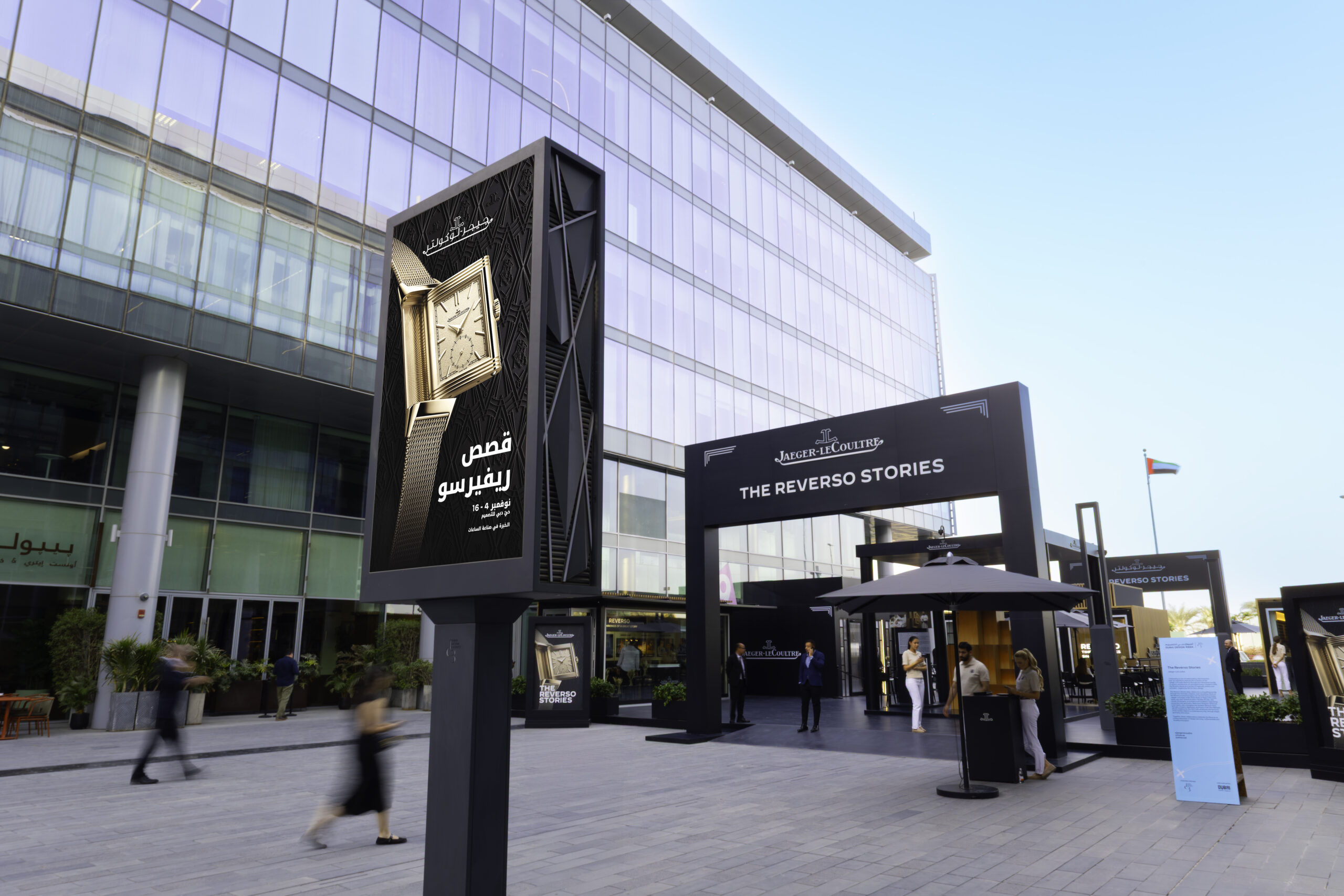
Another example came during Dubai Design Week in d3, when Jaeger-LeCoultre hosted a pop-up installation while simultaneously advertising across nearby DOOH screens. During the event, the district attracts designers, architects, collectors, and culturally curious visitors who arrive with an active mindset of exploration rather than passive media consumption. The campaign aligned placement, audience, and timing within the same moment. As visitors engaged with the brand’s installation, surrounding screens reinforced the message in real time, demonstrating how media can extend and amplify a physical brand experience.
Both examples illustrate the same principle: when media planning reflects the environment people are in and the mindset they bring with them, communication becomes more relevant and more memorable.
For media teams, location should be treated as a core planning variable alongside audience, timing, and frequency, rather than simply as inventory selection. Creative that matches its environment achieves higher recall, stronger comprehension, and more efficient media spend. Context-aware planning turns placement into strategy.
- People Experience Brands Sequentially, Not in a Single Moment
DOOH is uniquely positioned to follow real human movement. A story can unfold from an elevator screen to a lobby to an outdoor façade, each moment building on the last.
This sequential exposure is one of DOOH’s most underused strengths. Instead of relying on one high-impact moment, brands can create a structured journey tied directly to audience behaviour patterns. The objective is not maximum coverage. It is structured exposure aligned with real movement patterns.
- Data Now Allows Storytelling to Adapt in Real Time
The introduction of real-time impression data, dayparting, and behavioural analytics means storytelling is no longer static.
Through Elevision’s analytics platforms, marketers can see how long people watch, how behaviour changes throughout the day, and which locations drive the strongest engagement, alongside access to audience-level insights that add further depth to performance measurement. This enables campaigns to adjust tone, simplify messaging, or shift creative timing based on live performance, a capability that did not exist in DOOH a few years ago.
As a result, DOOH is evolving from a static broadcast medium into a responsive, audience-aware channel that delivers measurable, real-time value for brands and asset owners alike, reinforcing investment confidence through transparent reporting and accountable performance measurement.
- DOOH Works Best When Connected to the Digital Journey
Brands no longer think in channels, they think in systems. DOOH is becoming a high-value anchor in omnichannel planning because it influences consumers at physical moments of decision in trusted, real-world environments where brand presence is tangible, visible, and harder to ignore.
When integrated into broader media planning frameworks, DOOH strengthens overall media performance. It anchors brand presence in the physical environment and reinforces it across digital channels, creating continuity between real-world exposure and online engagement. In highly connected markets such as the UAE, where internet penetration exceeds 99 percent, physical exposure and digital action increasingly operate together. A DOOH impression can now translate into immediate search, app interaction, or social engagement, strengthening attribution and cross-channel performance
For advertisers, this means DOOH is no longer the top-of-funnel channel it was once perceived to be. It is now a connector, and in many cases, a catalyst.
The Bottom Line: Context Wins
The future of DOOH belongs to brands and media teams that treat context as a strategic planning variable, not a creative afterthought. The more precisely campaigns respond to audience mindset, location character, and time-of-day behaviour, the stronger and more measurable their impact becomes.
As screens become smarter and cities more dynamic, context will define the brands that stand out, not because they shout the loudest, but because they show up in ways that make sense. This is not a passing creative trend but a structural shift in how media is planned, measured, and valued, driven by more precise data and rising expectations around accountability, where relevance is no longer a differentiator but a baseline requirement.
Context is no longer a creative advantage. It is becoming the baseline for effective DOOH planning.
(The author is the Founder & Chief Executive Officer, Elevision)