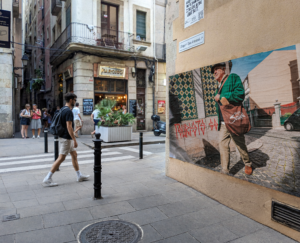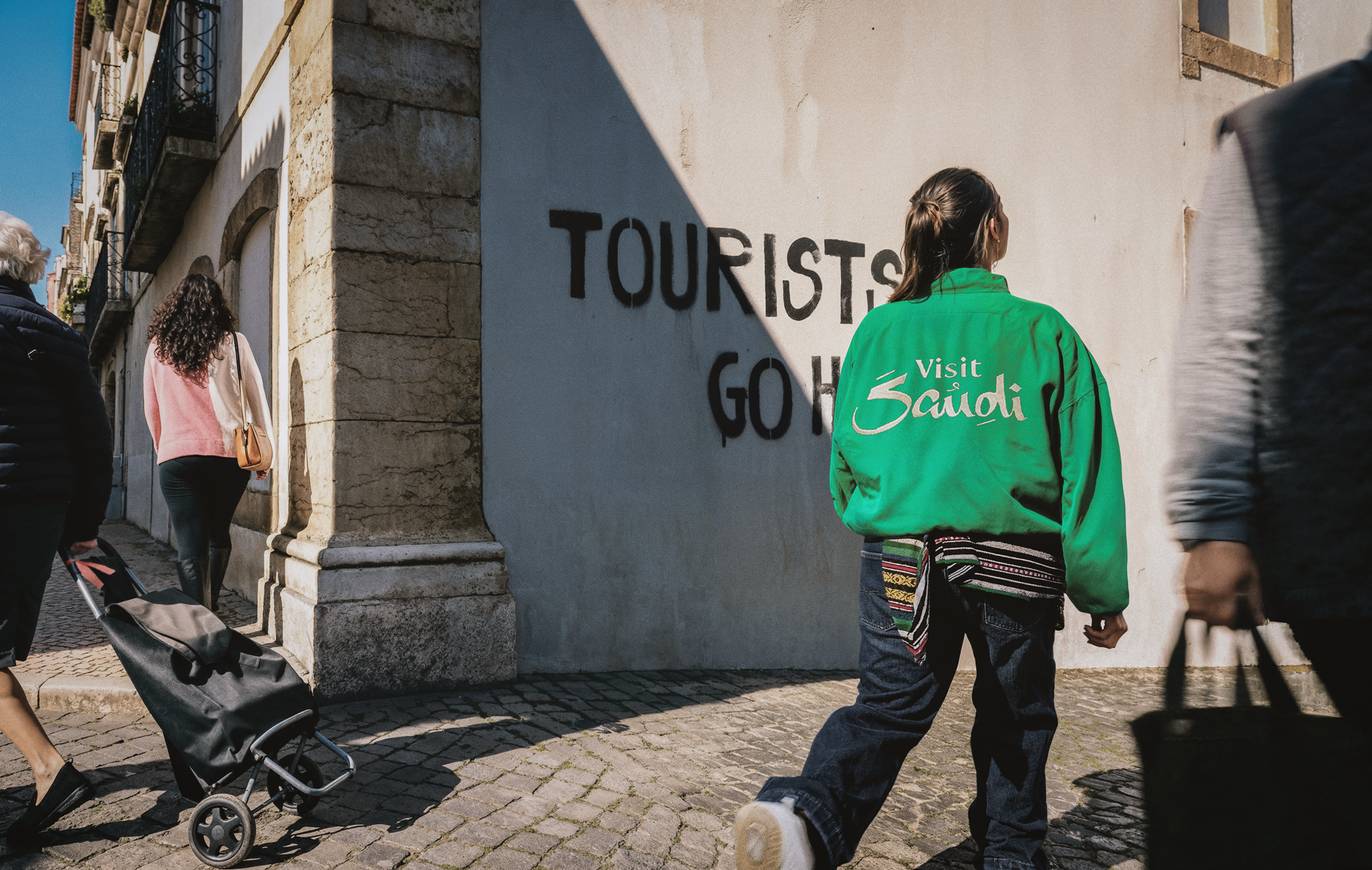
Walk through Barcelona’s El Raval this summer and you will find the same scrawled warning on wall after wall: “Tourists Go Home.” It has become the unofficial slogan of a continent pushed to its limit, sprayed on shutters in Lisbon, chanted at protests in Rome, printed on placards outside overwhelmed landmarks. It is angry, it is visible, and until recently, nobody had thought to answer it.
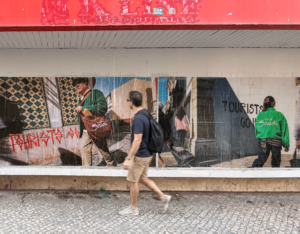
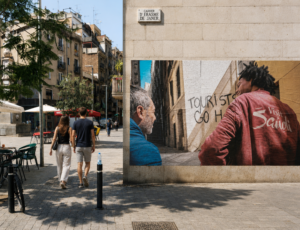
Then, a few weeks ago, something strange started showing up next to the graffiti. A model stood in front of a “Tourists Go” tag wearing a green jersey stitched with “Visit Saudi.” A man in a burgundy bomber jacket turned his back to a “Tourists Go Home” wall, the words “Visit Saudi” stitched across his shoulders instead. The rejection was still there on the brick behind them. But someone had walked straight into it and finished the sentence differently.
That someone is the Saudi Tourism Authority, working with SRMG Labs on a campaign called Tourists Go Visit Saudi. Rather than building a glossy destination film from scratch, the team went looking for a conversation that was already raging and planted their brand directly inside it.
“The starting point wasn’t a data point in a deck, it was the streets themselves,” says Ciaran Bonass, Executive Creative Director at SRMG Labs. His team scouted real graffiti across Barcelona, Lisbon and Rome, cities where the “Tourists Go Home” message had appeared organically over the past couple of years, and used those exact walls as the canvas for the shoot.
For an industry that spends most of its energy chasing trends after they have already peaked, that timing matters. Bonass is clear that none of the graffiti was commissioned or staged for the campaign. “The graffiti itself is real, well-documented, and was already there, it wasn’t created or commissioned by the campaign,” he says. The creative work was simply positioned in front of it, letting the tension between rejection and invitation do the talking.
There is a brief lesson in here for anyone building brand strategy right now. Saudi Arabia is mid-transformation as a tourism destination, and the wider “Saudi, Welcome to Arabia” platform has been steadily building that identity. Instead of shouting over the overtourism story with another polished montage of dunes and skylines, the team chose to stand inside a genuinely uncomfortable cultural moment and offer a counter-argument with a straight face. It is a reminder that in a market this noisy, entering an existing argument can land harder than starting a new one.
It also reflects a shift in how earned media gets engineered rather than hoped for. “Our strategy was deliberately designed to generate earned conversation around the intervention,” Bonass says, and the campaign leaned on street intervention first, with social and PR built to extend its reach rather than carry the whole idea. For CMOs and brand leads watching budgets get squeezed, that ordering, physical idea first, amplification second, is worth studying on its own.
Early signs suggest the bet is paying off. Bonass says the work has already started travelling on its own, with audiences picking it up and sharing it well beyond the original locations. Reaction from the cities themselves has also been warm rather than defensive. “The campaign has received positive sentiment so far, particularly around the playful way it reinterprets a familiar piece of street culture,” he says.
Whether Tourists Go Visit Saudi converts headlines into actual travel bookings is still an open question, and the team is watching earned media, engagement and sentiment rather than declaring victory this early. But as a piece of creative bravery, it does something a lot of destination marketing forgets to do: it reads the room before it tries to change the subject.
For an agency world constantly told to “join the cultural conversation,” this is a rare case of a brand actually finding one already in progress, standing inside it, and turning a message meant to keep people out into one built to bring them in.