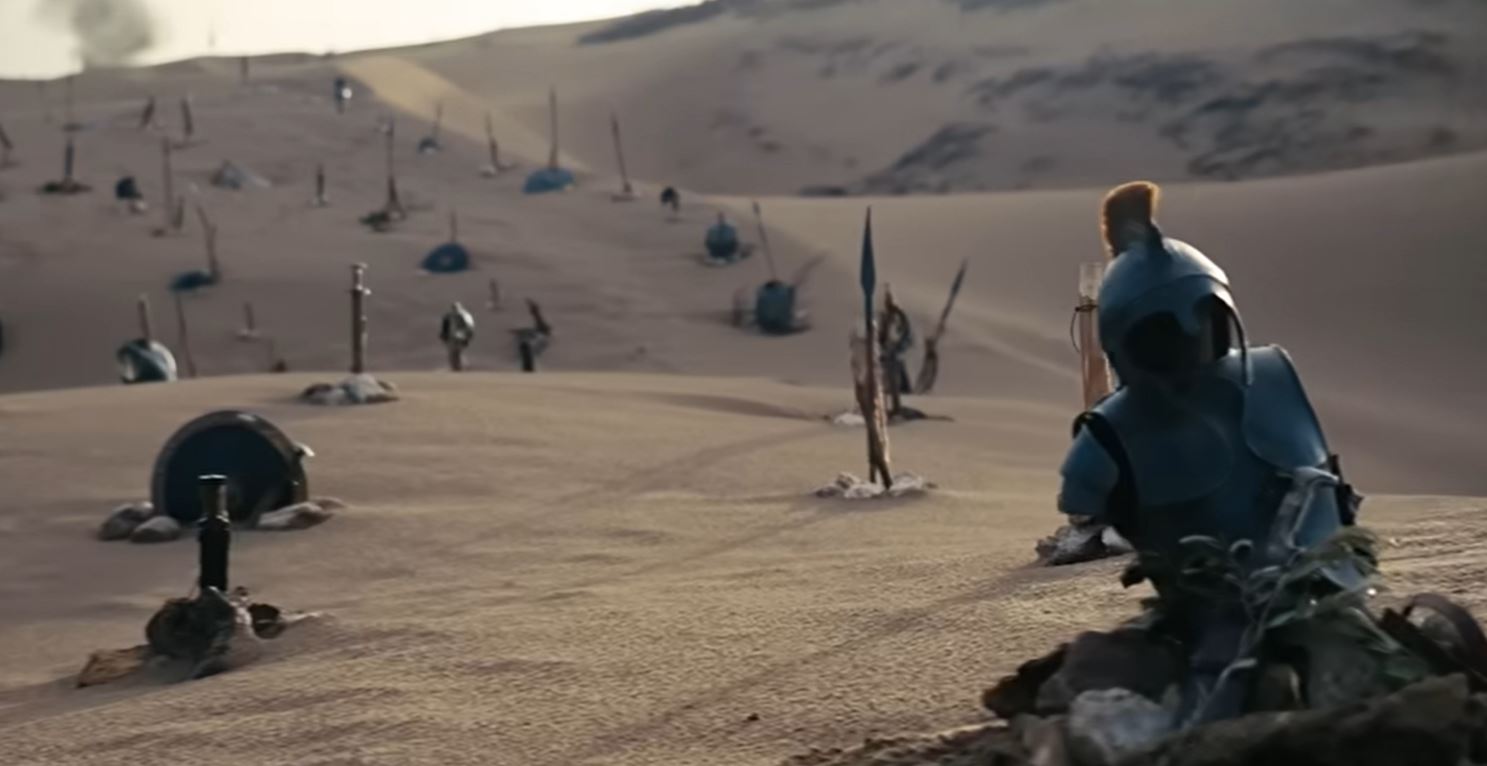
Christopher Nolan’s The Odyssey is taking the idea of a movie billboard beyond simply displaying a film poster, with Universal Pictures Middle East using an eye-catching outdoor campaign in Dubai to turn the film’s advertising into an experience.
The campaign, which appeared on Dubai’s uni-poles in the fourth week of July, uses die-cut billboards that break out of the conventional rectangular advertising format. According to outdoor media platform INSITE OOH, the execution was created for Universal Pictures Middle East and supported by Vox Cinemas, Majid Al Futtaim and BackLite Media.
The creative approach is particularly suited to a film built around mythology and spectacle. Rather than using the billboard simply to communicate the film’s release, the campaign makes the physical advertising format part of the creative idea. Its three-dimensional, die-cut treatment is designed to attract attention from different viewing angles — and, importantly, to encourage people to photograph and share the outdoor execution.
That social-sharing potential is increasingly important for out-of-home advertising in a market such as Dubai, where high-impact roadside and retail environments compete for consumers’ attention. In the case of The Odyssey, the billboard effectively becomes another piece of content in the film’s wider marketing campaign.
The regional push comes as Nolan’s $250 million epic was positioned as one of the biggest cinematic events of 2026. The film stars Matt Damon as Odysseus, alongside Tom Holland, Anne Hathaway, Zendaya, Robert Pattinson, Charlize Theron and Lupita Nyong’o.
The Middle East has also proved to be a significant market for the film. The Odyssey opened in Saudi Arabia on July 16, and during its first 10 days sold 428,700 tickets, generating SAR26.1 million (around $7 million). It accounted for 54% of all Saudi box-office revenue during its first full week, according to the Arab Gulf States Institute in Washington.
Globally, the film opened to $264.1 million, including $139.6 million internationally, according to Reuters. Its production budget was approximately $250 million.