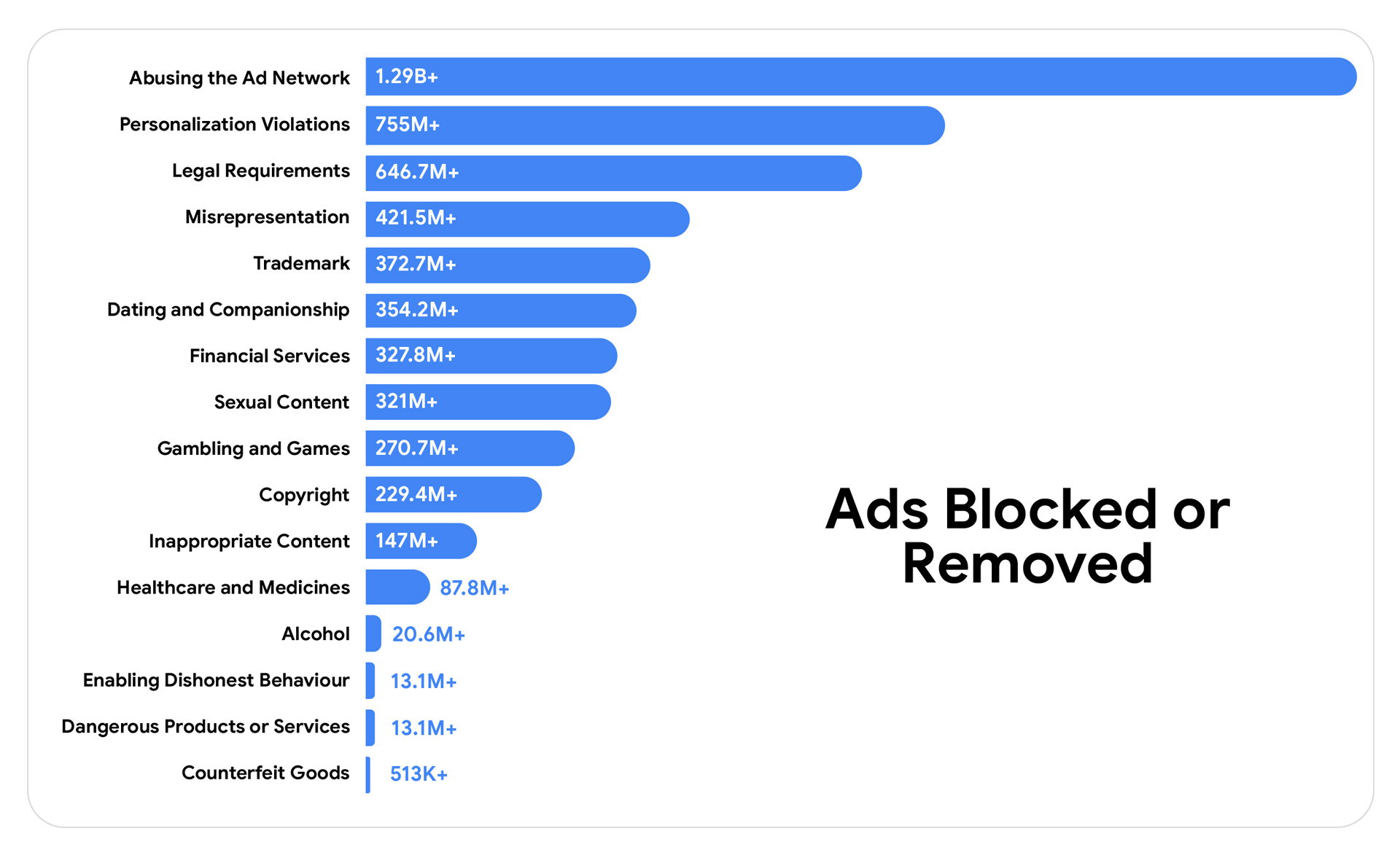
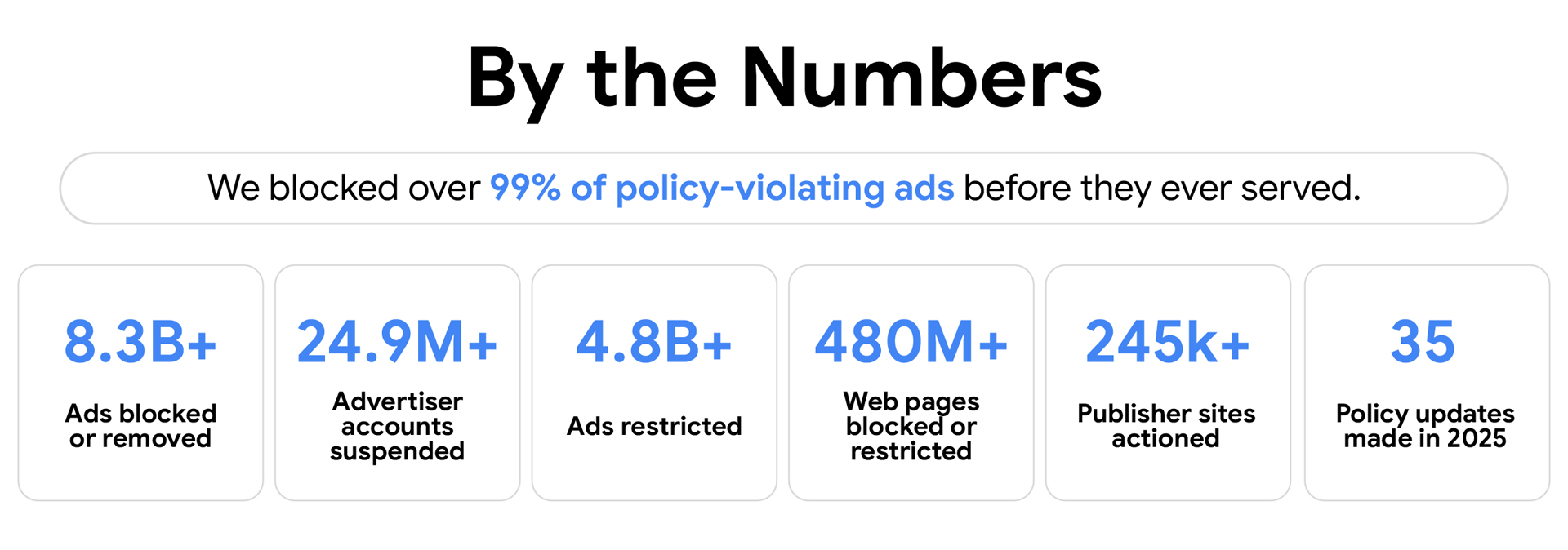
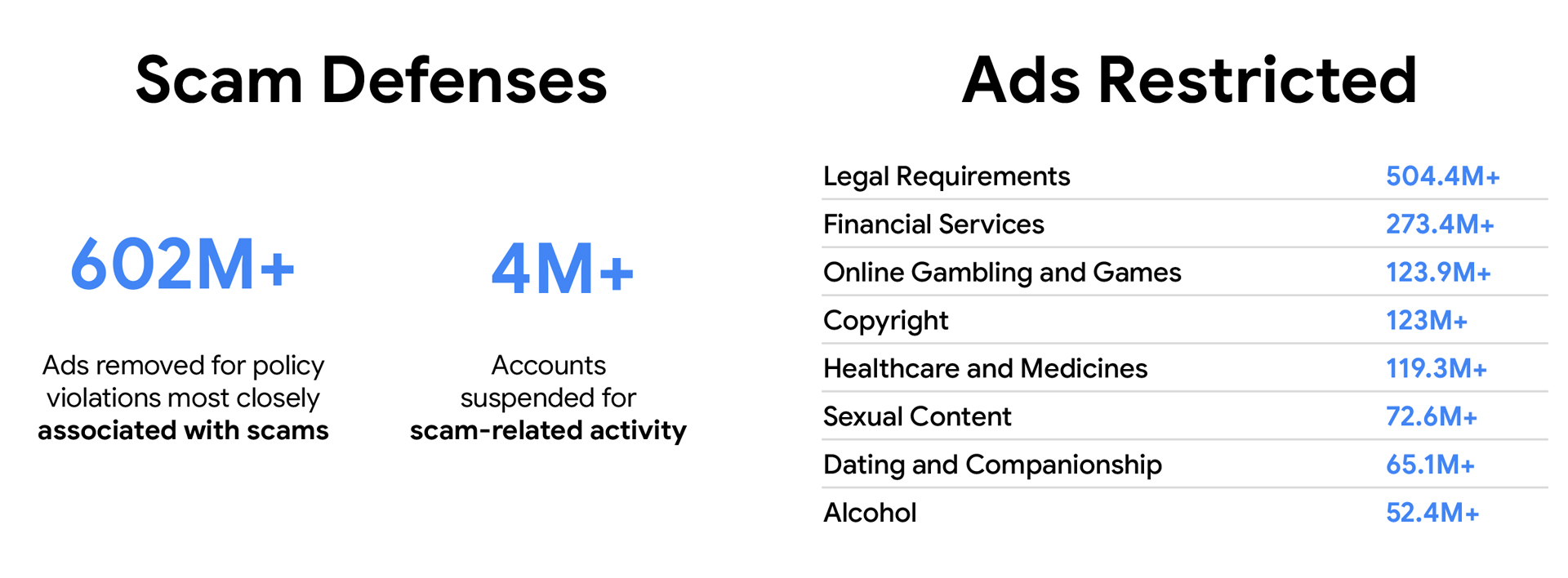
Google said its Gemini-powered ad safety systems blocked or removed 8.3 billion advertisements and suspended nearly 25 million accounts in 2025, as the company disclosed the results of what its top ads safety executive described as a ground-up rethinking of how it polices the ads that reach its users.
In a presentation accompanying the release of the company’s annual Ads Safety Report, Keerat Sharma, Google’s Vice President and General Manager for Ads Privacy and Safety, said the headline figure for the year was that more than 99% of policy-violating ads were blocked before they were ever served to a user — a threshold Sharma called the company’s North Star.
“Our goal is to stop badness before it is ever exposed to any user,” Sharma said. “And 99% is the benchmark that we’ve set from 2025. There’s room for us to continue improving, and we will.”
A rethink from the ground up
Sharma was emphatic that Google had not simply added Gemini on top of its existing systems. “We took a step back and really rethought how we wanted to build ad safety from a ground-up perspective,” he said, “in a world where we have an asset like Gemini that can really power things in a way that is different and gives us a lot more flexibility.”
The result, he said, was a system capable of combining hundreds of billions of signals simultaneously — drawing on an ad’s creative content, the advertiser’s landing page, account history, and the behaviour of customers managing that account — to build a picture of intent that earlier, keyword-based systems could not approach.
“All of that put together gives us a really nuanced perspective as to whether the intent of a specific ad is positive or potentially harmful,” Sharma said. “This has allowed us to operate at a much more granular level, at the creative level, than we’ve been able to before.”
Speed as a weapon against scammers
Central to the overhaul was a dramatic acceleration in how Google reviews ad creative. Historically, newly created or uploaded ads were fed into an asynchronous policy pipeline that could take many seconds or even minutes to return a verdict. For responsive search ads — Google’s most common text ad format — that pipeline has been replaced with a system that now operates in milliseconds.
“As content is being created, we are able to give the advertiser direct feedback about whether there are policy violations,” Sharma said, “and more importantly, we’re able to stop that content in milliseconds as it’s being created if the advertiser has bad intent.”
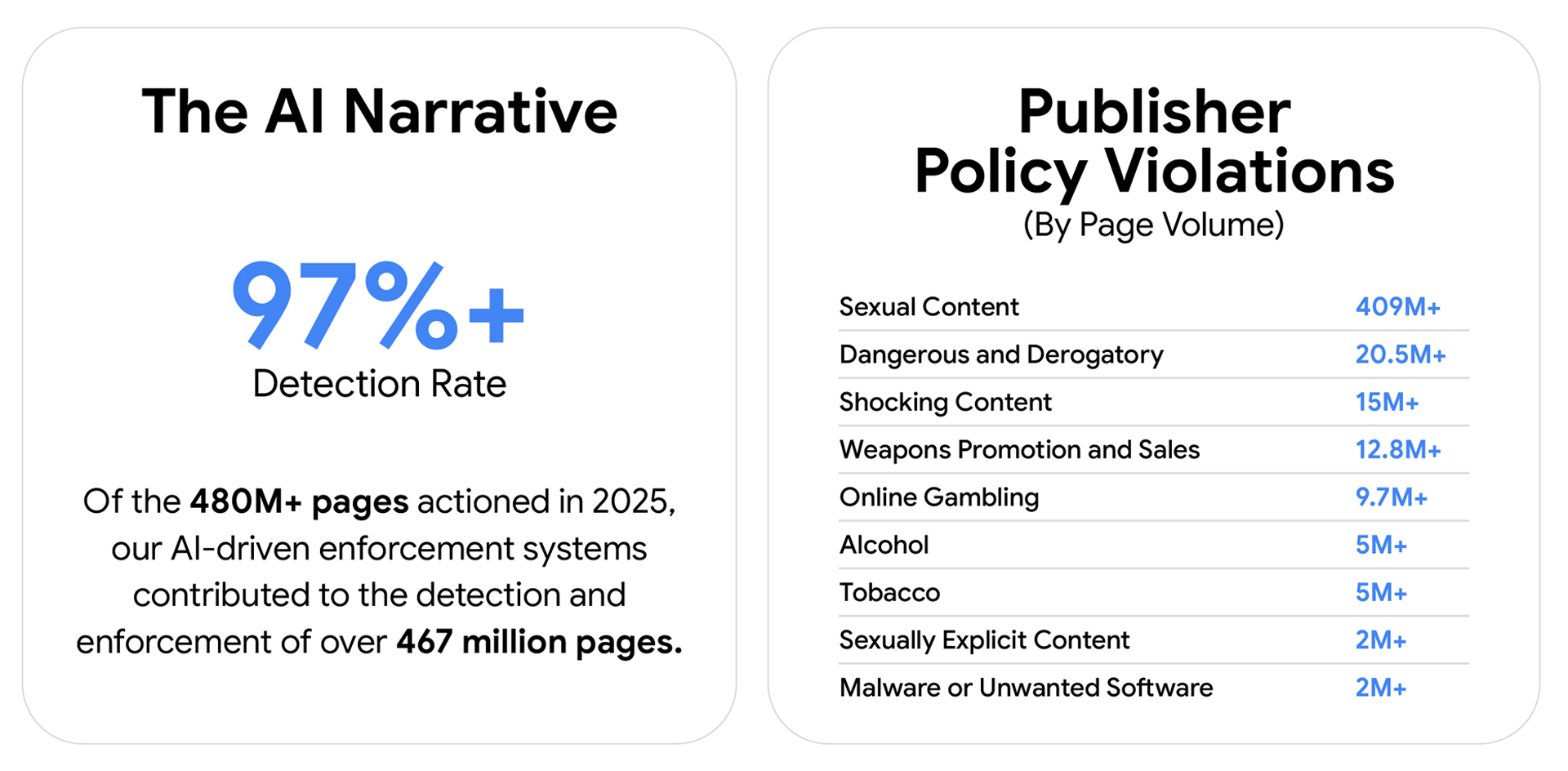
By the end of last year, the majority of responsive search ads created in Google Ads were being reviewed instantly, with harmful content blocked at the point of submission. The company said it plans to extend the capability to additional ad formats during 2026.
Gemini also enabled Google to process user feedback more efficiently, allowing its teams to act on more than four times as many user reports in 2025 than in the previous year, according to the company’s blog post accompanying the report.
“Scammers are very quick to find new things that they can experiment with. We stay up to speed on all of these developments and update our infrastructure and our policies as needed.” (Keerat Sharma)
Verification and the fight against deepfakes
Alongside the AI-driven detection systems, Sharma pointed to advertiser verification as a second critical layer of defence. Today, he said, more than 90% of the ads seen on Google come from verified advertisers — a figure he described as a good benchmark, but one the company intends to keep pushing upward.
Verification, he acknowledged, is not a uniform process. “Verifying a flower shop is a very different exercise than verifying an online-only bank,” he said. “In one case we have Street View imagery; in another we may need to seek documentation from a financial regulator.”
Asked during the briefing how Google handles AI-generated deepfakes in which a public figure appears to endorse a product, Sharma said the company’s systems combine creative review, advertiser verification, and detection of public figure impersonation. When pressed on whether that detection could extend to lesser-known individuals, he was candid about its limits. “We have an evolving corpus of public figures,” he said. “So I’ll say — that’s a maybe for now.”
On the broader question of how effective AI tools are proving for scammers — not just defenders — Sharma said the combination of signals was Google’s most powerful countermeasure. “A scammer rapidly creating a site that is brand new, that has very little reputational currency, may have indicators in content or calls to action that our signals are able to filter as potentially scammy,” he said. “It’s the combination of these signals — things like age of account, type of content on page — that has really helped us mitigate a lot of these new adversarial actions.”
Fewer false positives, better outcomes for legitimate advertisers
Google said the same infrastructure that is catching more bad actors is simultaneously reducing harm to legitimate businesses. Incorrect advertiser suspensions — cases where a legitimate account is wrongly penalised — fell by 80% last year.
Sharma attributed that improvement directly to the precision of the new systems. “The new infrastructure does a lot more filtration of good intent versus bad intent,” he said, “and the areas where there’s human judgement needed is a lot smaller — and we can really exercise thoughtful judgement on that.”
He also addressed concerns about whether Google’s own ad creation tools could inadvertently become instruments of fraud. “Tools that we build for our customers, we’ve been building them in a way where they remain aware of our policies and provide outputs that are compliant,” he said. “We also thoroughly test our tools in a very adversarial manner to ensure that they cannot be subverted and used in a way that is policy-violating.”
“Over the course of last year we made 35 policy changes — an indicator that we are tracking the evolution of things and updating our policies to ensure that we are doing so.” (Keerat Sharma)
Looking to 2026, Sharma outlined three priorities: expanding real-time creative review to more ad formats; continuing to grow the advertiser verification programme across new regions and industry categories; and evolving policy to keep pace with new technologies.