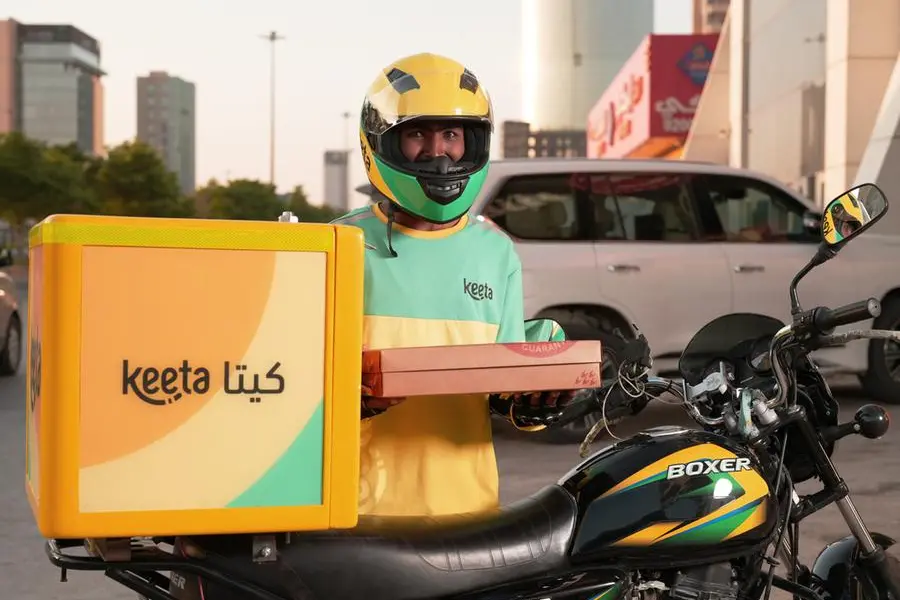
On a busy Saturday night in Dubai, Sajju (not his real name) races to deliver his tenth order for the day, the target that unlocks his daily bonus. Anything above that earns him an extra AED20 per order, a bonus he says is “worth working twice as hard for.”
It’s only his first month with Keeta, the fast-rising food delivery service from China’s Meituan, but he already speaks about the job with a sense of security he hasn’t felt in years.
His story is becoming common. Across the GCC, hundreds of riders are beginning to say (and feel) the same–and that is exactly one of the pivots Keeta is betting on.
In just weeks, the company has flooded the market with yellow bikes, eye-catching app takeovers, 50 percent promotions, and a level of riders’ compensation that is forcing other incumbent giants in the Gulf to reconsider their strategies. What looks like an App launch is a well-engineered attempt to refocus power (and market share) in a very competitive digital sector
Waseem Afzal, Founder and CEO of Platformance, a performance-driven growth technology platform, tells Communicate that Keeta’s entry move “is a classic, high-precision market penetration strategy: aggressive launch offers, hyper-local partnerships, and in-your-face marketing that captures attention fast in an already crowded landscape.”
“It’s bold, it’s calculated, and it’s backed by serious budget deployed with intent – compressing the time it usually takes for a new player to matter”.
Expansion
The expansion follows earlier rollouts in Qatar in August 2025 and Kuwait in October 2025, and builds on the launch in Saudi Arabia last year. Its UAE expansion in 2025 builds on the lessons learned from those markets where the company used aggressive customer incentives, free delivery, and merchant onboarding programs to capture attention quickly.
Keeta drivers told Communicate that the company is offering more structured compensation to riders, better fixed pay, better routes and potentially better earning potential than incumbent platforms. For many riders, this structured model is changing how delivery work is perceived.
In a short period of time, Keeta has become a coveted employer of choice for long-term drivers. “In my previous role, I would make a maximum of AED 4000 a month and the gas would be deducted from my earnings. On days I chose to rest, I would not make a living. At Keeta, the incentive is to deliver the daily ten orders and add a bonus for every subsequent order.”
“Plus, the AED 4,200 monthly fixed pay and gas money that amounts to AED 800 gives drivers a sense of security. I have been on the job for a month, and I look forward to increasing my monthly income,” says Sajju.
He is not alone. Ahmed has completed the training and is eagerly awaiting a shift from his current employer to Keeta at the start of the month.
“I will work six days a week and work twice as hard to get a bonus on orders, he says. I can triple my current income with the opportunity Keeta provides. All my friends are trying to shift and join Keeta,” he explains.
The Growth Strategy
“Keeta entering the UAE isn’t just another launch – it’s a masterclass in engineered market dominance at speed. We’ve already seen how they executed in Saudi Arabia, and the same playbook is unfolding here: infiltrate every touch point, both physical and digital,” said Waseem Afzal.
The Business Case
Keeta’s entry timing is no coincidence. The GCC’s online food-delivery market is expanding rapidly, valued at $3.93 billion in 2023 and projected to reach $11.18 billion by 2030, according to MarkNtel Advisors. With internet usage rising, mobile adoption accelerating, and a growing working population turning to convenient takeaway options, the region has become one of the most attractive delivery battlegrounds globally.
A recent Morgan Stanley research note reported that Keeta aims to cover all six GCC markets within months, adding Bahrain and Oman to its footprint in Saudi Arabia, the UAE, Qatar, and Kuwait. That wider plan reflects the ambitions of its parent company, Meituan International, which operates one of the world’s largest on-demand delivery networks, handling more than 150 million daily orders. Beyond the consumer-facing value, Keeta seems to be leaning on Meituan’s global logistics and technology muscle. In its UAE launch announcement, the company framed itself as blending local dynamics with Meituan’s global scale.
For restaurants, Keeta is also competing on commissions. Keeta’s regional expansion in Saudi Arabia (where it launched in 2024) featured a low-commission model pitched to restaurants, which gave it significant competitive leverage. While Keeta hasn’t publicly broken down exact commission rates in the UAE, its “value-first” narrative suggests that it’s willing to accept thinner restaurant margins for scale, a bet on volume and long-term dominance.
To stand out, Keeta has introduced a “Founding Vendor” program, designed to attract restaurants and retailers early by providing marketing and technology support at no cost before the public launch of the app. In a showcase of Meituan’s global expertise, the company has also initiated drone delivery trials in Dubai, leveraging technology that already powers over 150 million daily orders in China. As Wassim puts it: “What makes Keeta interesting is they’re using speed, density, and operational sharpness to force a rethink across the ecosystem – pricing, commissions, and even how merchant value is defined. When the yellow bikes multiply, behaviour shifts. And that’s where the competitive pressure will be felt the most.”
The Crowded Gulf Market
But the Gulf’s food-delivery market is far from empty. Keeta now competes with already well-known giants like Talabat, Careem NOW, HungerStation, and Jahez.
These platforms have also faced recurring tensions with riders in previous years, including widely reported walkouts by Deliveroo and Talabat couriers over pay and working conditions — underscoring long-standing labor pressures across the sector.
Talabat is a major force, and its publicly available financials suggest it relies on variable commission contracts with restaurants. Its commission rates typically range between 15 percent and 25 percent, with “exclusivity” deals reducing that further. However, riders’ feedback over the years has consistently pointed at low per-order pay, and while contractors earn more, echoing broader industry concerns regarding remuneration and working conditions.
Jahez, a Saudi-based delivery app, publicly stated take-rates of around 12 percent in its earlier filings among the lowest in some markets. However, restaurant sources say that Jahez now typically charges a percentage-based commission on each order, and most restaurants pay a commission of 15 percent to 25 percent on each order. Other players like Careem and HungerStation don’t publicly disclose uniform commissions, but their fee structures are broadly competitive due mainly to Keeta’s aggressive model.
But Keeta’s strategy is undeniably capital-intensive. The company is subsidizing consumers through discounts, above-market pay for drivers, and restaurants through attracting commissions, a triple-subsidy approach that requires deep financial reserves. Long-term profitability depends on converting first-time users into repeat customers and retaining drivers once incentives normalize. Operational pressure will also increase as order density rises, and the company must uphold its on-time promises at scale.
Keeta’s entry into the UAE is arguably one of the most important developments in the region’s food-delivery landscape in years. If executed well, its model could reshape the economics of delivery in the Gulf. But the bet is significant. Keeta’s long-term success will hinge on its ability to sustain driver pay and trust, convert discount-driven users into committed customers, and scale operations without collapsing under its own cost structure.
Meanwhile, incumbents like Talabat, Careem, HungerStation, and Jahez are unlikely to give up market share quietly. A prolonged price war, declining restaurant margins, or altering customer loyalty could lead to a market-wide rebalancing. Who wins and who becomes a laggard remains to be seen. Wassem concludes: “Keeta didn’t just launch in the UAE – they engineered a takeover. And the momentum is real, because all three stakeholders are enjoying the upside: consumers are getting better prices, merchants are enjoying fairer terms, and riders are benefiting from improved incentives and experience.”