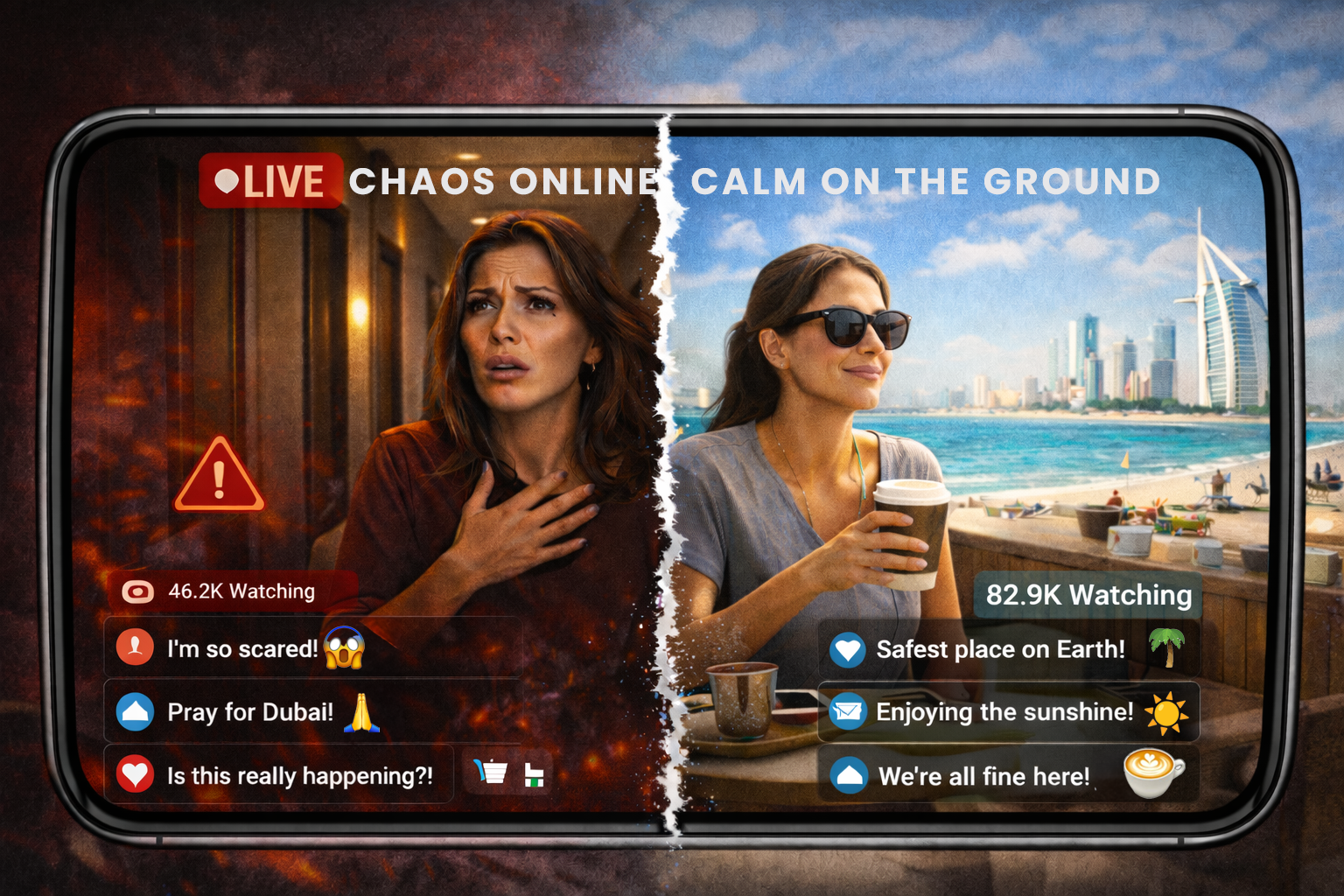
When the rocket sounds first pierced the Dubai night, Louise Starkey did what she has built a career on: she turned on her phone camera.
“I’m actually so scared,” the Australian influencer told her IG followers as she filmed in a hotel corridor. “It’s not meant to be happening here.” In a few seconds of video, Starkey captured something real: the unexpected shock of a city. She also, unintentionally, captured the internet’s rage and stopped being just another Dubai‑based content creator and became Exhibit A in a global debate about privilege, place, and what it means to be “authentic” when a real crisis hits.
Once you scroll a little further, the story looks very different.
A few kilometres away, British entrepreneur and influencer Luisa Zissman was also in front of her phone, but in a basement. She posted on her IG feed: “So surreal and scary. I do have faith that UAE defence will keep us all safe.”
The vote of confidence
Fear, yes. Panic, not quite. And crucially, a very public vote of confidence in the place these influencers chose to call home.
If Starkey and Zissman represented the “this is really happening” side of the feed, real‑estate influencer Deepti Mallik seemed to be broadcasting from another planet. Against a backdrop of a busy beach, she looked into the lens and told her audience: “This is the safest country on the planet.”
Under videos like hers, a quieter chorus of Dubai‑based followers tried to pull the mood back from the brink. “We trust our leadership, and this phase will pass,” one wrote. “Let’s avoid sharing videos that spread fear or panic.”
In other words: two Dubais, one algorithm
And then there is the Dubai that doesn’t go viral, but keeps the city running. Kris Fade, a presenter of the Virgin Radio Dubai breakfast show, described that everyday reality in stark contrast to the most dramatic clips.
“Firstly, from a radio perspective, I’m the lead presenter on a breakfast show here at Virgin Radio, and it is a regular day here at the office,” he told the BBC on March 3.
“I’m in the office right now, it’s full, we did our radio show, just got off air. The city is functioning as it always has, there’s people walking on the beaches, on the streets. What you guys are seeing from maybe a social media point of view is not exactly what is happening.”
Fade’s comments also cut through the idea that Dubai is a soulless influencer backdrop. “There’s been incidents on social media saying that Dubai has no soul. I can tell you right now, the soul that we have is tremendous and I truly believe that things will be okay again. We’re optimistic,” he told the BBC.
The stress test
For marketers and media planners, this three‑way split, between panic, calm, and grounded local voices, is more than social‑media drama. It’s a live stress test of everything the industry loves to say about influencer marketing: that it’s human, that it’s authentic, that it’s closer to “real people” than traditional media. When the missiles came, those real people reacted in real time, sometimes in ways that reassured, sometimes in ways that horrified, and often in ways that made their commercial partners wince.
The ecosystem
It’s easy to stop the story there, with schadenfreude and screenshots. But that would miss what made this moment uniquely Dubai, and uniquely important for the brands and agencies that have poured budgets into the city’s creator ecosystem.
First, the human reality. For all the “war‑core” content and eye‑rolls, many influencers over the weekend weren’t playing to the gallery; they were just showing human emotion without a filter. French reality‑TV star Maeva Ghennam reportedly said she “screamed hysterically” when she heard explosions and held up her passport as she cried, “France, protect us!” British creator Will Bailey who “is stuck” in the city, was jumpy at any noise behind him while giving a live interview that is on his feed.
“We landed Saturday morning, and at 3am we woke up to the noise. I’m on edge, really shaken,” he says as he almost ducks in front of the camera. None of this was subtle, but it was instinctively human.
The reality check
Second, the Dubai reality. While feeds filled with basements and burning buildings, the city’s systems were doing what they were designed to do. Air defences intercepted threats. Authorities communicated. Within hours, flights resumed, malls reopened, and the familiar choreography of commutes and coffee runs returned. When various influencers came out on live feeds and congratulated the government for “doing an amazing job” and said that they were “in very safe hands,” they weren’t reading from a script; they were just articulating what many residents were saying offline. Fade’s description of a full radio office, busy beaches and a united city extends the same point over a longer timeline: this is not a fair‑weather home.
Chasing the truth, not likes
That’s where another voice becomes essential to understanding the full picture: the people who live and work here, but aren’t chasing followers for a living.
Laaleen Sukhera, a Dubai‑based communications consultant, adds that grounded perspective. “I’m really fed up with influencers making the headlines, particularly British tabloids feeding a sensationalized, skewed narrative,” she says. The issue for her isn’t that creators were afraid; it’s that a handful of dramatic clips have been allowed to define an entire city to the outside world. “The vast majority of residents (in Dubai) are hardworking professionals, not reality TV actors, who don’t deserve to be mocked,” she told Communicate.
“While the overall regional situation is sensitive in context, it’s also being dealt with remarkable sophistication by our authorities here. As we’ve experienced from past scenarios, whether the pandemic or heavy rainfall, given the current situation, we know that our authorities do everything they can to keep us safe and responsibly informed.”
In a few lines, she quietly recenters the conversation: away from viral meltdowns and towards the lived reality of a diverse city that has weathered shocks before.
This is the paradox marketers now have to grapple with. The same forces that made Dubai the world’s most Instagrammable case study, a hyper‑designed skyline, a tax‑efficient ecosystem for creators, a narrative of safety and opportunity, also make any crack in that story disproportionately visible. When something goes wrong, you don’t just get a crisis; you get a crisis filmed, filtered, stitched, duetted, memed, and argued over by an entire profession whose business model is to get attention with any form of content.
So what does the takeaway look like?
One answer is to rethink what “authenticity” should mean in the markets here. For years, the industry has rewarded a narrow version: pool decks, penthouses, sports cars against the backdrop of skyscrapers. The creators who emerged from this moment with their credibility strengthened weren’t the ones who pretended nothing was happening, nor the ones who live‑streamed every interception. They were the ones who did what Zissman did, admit fear, acknowledge risk, and still say, sincerely, that they trust where they live. And they were mirrored by long‑term residents like Kris Fade and Laaleen Sukhera, who can say in the same breath that the city is on alert, that it feels safe, that perceptions have taken a hit, and that it will bounce back.
And then there’s the city itself. A product of infrastructure, investment, and a long‑term place‑branding strategy that has turned Dubai into both a global transit hub and a global stage. The strikes did not shatter that stage. They did, however, pull the camera back a little.
What’s next?
If influencer marketing is going to keep using cities as products, it will have to get more comfortable with their flaws as features. In Dubai, the influencers who come out of this moment strongest may be the ones who learned to say: this scared me; this place still holds; and I’m not just here for the tax bracket and the view. Paired with the grounded voices of residents like Laaleen and Kris that’s the kind of layered, human narrative audiences trust, and the kind of resilience brands will need the next time a notification about “breaking news in Dubai” lands between their sponsored posts.