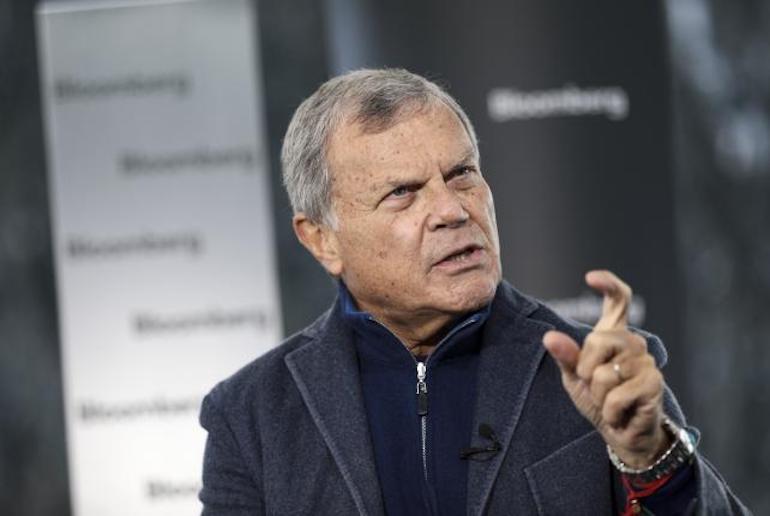
Sir Martin Sorrell, Founder and Executive Chairman of S4 Capital PLC, says how the Gulf’s startup ecosystem, AI adoption, and digital-first strategies could position the region as a global hub for advertising and tech innovation. Excerpts from an interview:
How would you describe the state of the global advertising industry today?
In 2024, the industry was roughly worth a trillion dollars: about $700 billion in digital, growing at around 10 or 15 percent, and about $300 billion in traditional media, mainly free-to-air, which was declining. If you had live sport, you were down 5 percent; without live sport, declines were 5 percent, 10 percent, or even 15 percent. Effectively, there are two industries: one that is thriving and growing in terms of ad revenue (digital), and one that is in decline.
What we are seeing with Warner Bros. Discovery, Netflix, Paramount, and the sale of Paramount by Shari Redstone to David Ellison reflects this pressure. Bob Iger returning to Disney, Comcast consolidating and then deconsolidating, these are all indicators of the stress. The Omnicom-IPG merger also reflects the compression in the traditional part of the industry.
In 2025, the industry likely grew about 8–9 percent overall, but again with a sharp divide: digital growing at 10–20 percent, possibly stronger, and traditional continuing to decline. I think 2026 will be no different. The industry will likely reach $1.2 trillion, with around 73–75 percent digital. Digital could be $800–900 billion, while traditional remains around $300 billion or less. It is a tale of two cities — vibrant digital growth and a traditional industry under pressure.
What does the Omnicom-IPG merger signal for global agency consolidation?
I doubt there will be another consolidation. Of the six holding companies, now five with IPG inside Omnicom, only one is performing relatively well: Publicis, with about 5 percent top-line growth. Havas is growing slowly at around 2–3 percent. The rest are flat or declining. Omnicom has been flat over the last three quarters, IPG has been down, and dentsu and WPP have been down 4 to 6 percent.
Market capitalization tells the story. Publicis and Omnicom are both around $25 billion. Dentsu is around $6–7 billion, WPP is around $4 billion, and Havas is about $1.5 billion. That represents a major contraction, particularly for Dentsu and WPP. Omnicom’s share price fell sharply after announcing the IPG deal and, although it has recovered to 80 percent, it still trades at a significant discount.
Will there be another consolidation, you ask? I doubt it, because I don’t see people having the enthusiasm or the determination to take on the huge management challenges that there are at dentsu and WPP. Both transactions would be big and complex. Both are highly complex professional-services businesses. Add to that AI and its impact on the future of the industry.
With digital budgets rising and traditional media shrinking, what is the industry missing?
I think the industry understands the shift. Publicis certainly does, but it has a good story around digital and data. WPP has not capitalized on it effectively. They sold their data business to deleverage, although ironically, they haven’t deleveraged.
The challenge facing holding companies is structural. There is a clear parallel with Mumbai (where I am now), where old infrastructure has to be taken down while new infrastructure is built alongside it. You see the dichotomy between the old and the new, and that is exactly the same with the holding companies. Holding companies are still built around legacy structures tied to the $300 billion traditional market, which is in decline, while trying to develop new structures that capture digital growth.
The digital advertising market is dominated by a small number of platforms. Google generates around $250 billion in advertising revenue, followed by Meta at $150 billion, Amazon at $60 billion, and TikTok outside China at $40 billion. Together, these four account for around half of the global advertising industry and the vast majority of its growth. If you include Alibaba and Tencent, six platforms dominate the industry. Below that level, revenues drop sharply, with companies like Microsoft, Apple, Snap, Pinterest, Walmart, and Netflix generating far smaller amounts.
The industry understands this. The real difficulty is that legacy organizations are still geared toward declining sectors such as traditional media, like free-to-air television or newspapers. These businesses are built on capital-intensive infrastructure designed for an outdated model. In a digital world, there are many easier ways of doing it.
You described advertising as a K-economy. Where do you see long-term growth?
It is absolutely a K-economy. Around 70 percent of the industry is growing, and 30 percent is declining. Analysts often fail to separate the two, but they are technologically and structurally different industries. Digital is up, and traditional is down.
You’ve said AI is a change-management revolution, not just a technology shift. So, what matters most?
I think it is not about tech; it’s about change management. Everybody can see that technology reduces the time taken to produce or personalize work or to plan and buy media. What is necessary to do it is to change the way we work. There is significant inertia because, currently, corporate profitability is strong. When margins come under pressure, AI adoption will accelerate.
Which AI-driven changes will disrupt the industry fastest?
The biggest impact is producing content faster and cheaper. The second is personalization at scale: the Netflix-on-steroids approach. The third is media planning and buying, which is progressing more slowly but gaining momentum through tools like Advantage+ and Performance Max. General operational efficiency, knowledge democratization, and flattening organizations will follow, but they will take longer.
In flatter AI-enabled organizations, what are the relationships between agencies, brands, and platforms going to look like?
Agencies increasingly become validators for what the platforms are saying. The four major platforms that dominate the market account for 70 percent of the digital market; algorithms are key. They will become more powerful. However, clients will need independent third parties to validate and adjudicate platform recommendations. Agencies play that role, advising on how, when, and where to invest across limited but powerful choices.
How can startups position themselves in an increasingly algorithmic world?
This environment favors smaller, more brainy, more agile, tech-driven, and code-knowledgeable companies. Scale creates opportunities for the motor torpedo boat to outdistance the aircraft carrier.
What is your message to CMOs?
Stop experimenting with AI and implement it. Radically reorganize workflows and deploy AI at scale. Do not run pilots or workshops; be brave about implementation. Creative costs should not exceed 10 percent of media costs. If they do, something needs to change.
(This interview was originally published in the print issue of TRENDS in Jan 2026)