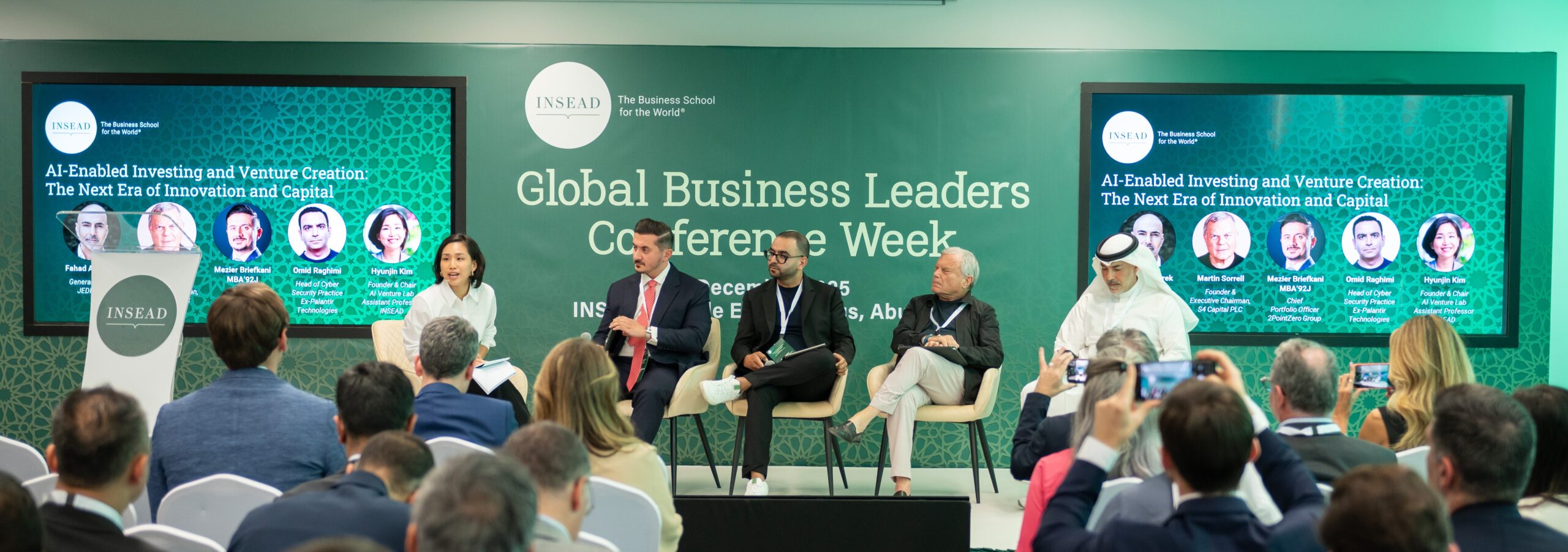
AI is fast becoming a strategic asset, a way for nations, such as the UAE and Saudi Arabia, to translate capital, infrastructure into lasting influence.
By Omnia Al Desoukie
As the world’s economic map fractures and old alliances loosen, artificial intelligence is quietly being recast. No longer just a lever for efficiency, AI is fast becoming a strategic asset, a way for nations, such as the UAE and Saudi Arabia to translate capital, infrastructure and geopolitical positioning into lasting influence.
Speaking at INSEAD Global Business Week, senior policymakers and investors pointed to the Gulf Cooperation Council as one of the unexpected winners of this turbulent era. Strong fiscal buffers, sustained non-oil growth and years of diversification have allowed several Gulf economies to keep expanding even as momentum elsewhere has faded.
“ When we look back at 2025, I would say it is a year of shocks, conflicts, fragmentation, but also a year with a huge increase in investment. It was a year where the world economy was tested, and it’s interesting that despite all of that, we are seeing the system is holding,” said Jihad Azour, director of the IMF’s Middle East and Central Asia department. While repeated global shocks have strained economic systems, he noted, the Gulf has been cushioned by deep financial reserves and increasingly robust non-oil sectors.
That resilience is now intersecting with a broader realignment of global trade. As supply chains become shorter and more regional, new economic corridors are emerging linking the Gulf with Central Asia and parts of Africa. These shifts are opening opportunities to grow services exports, expand non-hydrocarbon trade and deepen ties beyond traditional Western markets. AI, participants argued, is likely to act as an accelerant, lifting productivity and reshaping how both governments and businesses operate.
The region’s ambitions are supported by unusually favorable starting conditions. Heavy state investment, advanced digital infrastructure and a rapidly expanding network of data centers have turned the Gulf into one of the world’s fastest-growing digital ecosystems. Cloud computing, fintech and applied AI have all flourished, while governments have demonstrated an unusual ability to deploy technology at scale.
As technology itself becomes more accessible, competitive advantage is shifting to less tangible terrain. Several speakers emphasized that human capabilities — such as judgment, trust-building, ethical reasoning, and the ability to navigate uncertainty — are becoming more valuable, not less, in high-AI environments. Algorithms can optimize processes, but they cannot answer questions of purpose, governance or accountability.
These tensions are most visible in capital markets. Some investors argue that AI has already changed the mechanics of early-stage investing. As founder profiles converge and traditional signals lose their edge, machine-driven analysis is increasingly used to track behavioral indicators at scale — from hiring velocity and seniority of recruits to the movement of talent from established firms into start-ups. What once required weeks of manual research can now be surfaced automatically, compressing decision cycles and narrowing the scope for subjective judgment.
Sir Martin Sorrell, founder of S4 Capital, argued that despite years of predictions, the sweeping corporate transformation promised by AI has yet to arrive. “We keep saying the change will happen next year,” he said, “but most organizations are still structurally the same.”
“The growth spots, to me, are the US, Latin America, the Middle East, and APAC. I think Europe has a real struggle. The UK is inferring Germany. Germany may be a little more bullish because of defense spending and low government spending as a proportion of GDP,” said Sir Sorrell.
“Everything you’re seeing is about coming to terms with these dynamics. But the new will be very different from the old,” he referred to how the media will also change.
Where AI is taking hold, adoption is uneven. Sectors under immediate economic pressure — automotive groups facing competition from low-cost Chinese electric vehicle makers, or financial institutions challenged by digital-native rivals — have moved fastest. Elsewhere, resistance remains strong. The result, some suggested, is a “K-shaped” AI economy, with certain industries accelerating while others stagnate.
Inside firms that have embraced the technology, the effects are already tangible. AI is flattening organizational structures, cutting production costs and automating analytical work once handled by junior staff. In private equity, some firms have embedded AI across the entire investment lifecycle, from initial screening to exit planning, dramatically reducing analysis time. The constraint is no longer efficiency but direction: automation frees up time that must be reinvested in higher-value problem-solving.
“One point I would add is that, while we talk a lot about entrepreneurship, values, and business priorities, none of these qualities are measurable by AI today. AI cannot assess an entrepreneur’s passion, their curiosity, or their intrinsic motivation to solve problems, traits that matter enormously in both talent acquisition and identifying the right founders to back. This aspect is simply not being captured by current AI systems, said Omid Raghimi, a former Palantir executive, who argued that current AI systems remain unable to assess founder motivation, values or ethical alignment, factors that often determine long-term outcomes.
Even among the most enthusiastic adopters, there is broad agreement on AI’s limits. Machines remain poor judges of motivation, ethics, and cultural context — factors that often determine long-term success. Nor can current systems reliably incorporate societal norms into decision-making. For now, these responsibilities remain firmly human.
AI’s most visible impact today lies in accelerating workflows rather than fundamentally reshaping economies. The deeper effects — on organizational structures, capital allocation, and global influence — are still taking shape. For regions like the Gulf, however, the foundations are increasingly in place. With capital, infrastructure and regulatory frameworks aligned, the question is no longer whether the region will follow global trends, but whether it will help define them.